Living With Multiple Cats: Why Your Tiny Space Doesn't Have to Be a Battleground
They say cats are like potato chips because you can never have just one. But when your chips start hissing over the same square foot of carpet, that cozy apartment...

PurrScript Editorial Team
Editorial Team
Living With Multiple Cats: Why Your Tiny Space Doesn't Have to Be a Battleground
They say cats are like potato chips because you can never have just one. But when your chips start hissing over the same square foot of carpet, that cozy apartment can quickly feel like a tiny war zone.
Successfully living with multiple cats in a small space is not just about floor square footage. It is about understanding that your pets still have the instincts of a solitary hunter, which makes sharing a studio apartment feel like a high-stakes competition for survival.
If you are tired of cat resource guarding or seeing your nervous kitty spend all day under the bed, there are simple ways to fix the vibe. We will look at how pheromones for multi-cat homes and clever hiding spots for shy cats can turn a cramped flat into a peaceful kingdom.
You will learn how to use vertical space and the right litter box math to keep everyone happy. Let's look at how to manage territory so your home feels big enough for every cat in the family.
Cats are like potato chips because you can never have just one. Ariana Jenks of the Cat Care Society nailed it with that comparison, but there is a catch. When your one cat becomes three in a tiny apartment, the cozy vibes can quickly turn into a turf war. Many of us live in small spaces that feel perfect for humans but cramped for a group of animals with strong territorial instincts.
It helps to remember that our pets descend from the African wildcat, a solitary hunter. In a small flat, these wild instincts often lead to resource guarding. If you have seen one cat staring another away from the food bowl or physically blocking a hallway, you have seen this in action. It is not just a bad mood. It is biology. Without enough room to spread out, even the best of friends can start to feel the pressure.
So, how do we keep the peace? This guide covers everything from the n plus one litter box rule to using vertical space to stop the squabbles. You will learn how to turn your cramped apartment into a peaceful kingdom where every cat feels safe. What does this mean for you? It means less stress, fewer vet visits for stress related issues, and a home that finally feels big enough for everyone.
Key insights:
- Cats view side-by-side litter boxes as one single unit, which fails to stop territorial guarding.
- Covered litter boxes can become traps where a dominant cat ambushes a vulnerable one.
- Environmental stress in multi-cat homes often manifests as physical health problems or bathroom accidents.
Why Your Cats Think Your Apartment Is Smaller Than It Really Is
Ever wonder why your two cats act like your apartment is a tiny closet? It is not just them being dramatic. Your domestic feline is a direct descendant of the African wildcat, a solitary hunter from the dry regions of Africa and Asia. In their DNA, survival means owning resources, not sharing them. When space feels tight, cats often flip into a survival mode where every hallway and sunny patch of floor becomes a high-stakes prize. To them, sharing isn't a friendly concept. It is a risk that triggers their deep-seated instincts to protect what is theirs.
You might think your cats are getting along because they aren't screaming or because fur isn't flying. But silence can be deceptive. Many cats engage in a kind of low-key feuding that owners miss entirely. Watch for the stare-down or a cat sitting right in the middle of a doorway. This isn't an accident. It is physical blocking. If you see flattened ears or a tail flicking like a whip, tension is building under the surface. Silence often just means one cat has successfully intimidated the other into staying out of sight, which is why a quiet house isn't always a peaceful one.
This constant tension does more than just ruin the vibe. Chronic environmental stress often leads to real physical illness. When a cat feels their territory is under threat, they might start having accidents outside the box. This is usually territory anxiety, not spite. Shy cats especially need their own zip code or a safe spot within your home where they don't have to watch their back. Without a dedicated space to retreat, the chronic stress of being watched can manifest as serious urinary issues or a total withdrawal from family life.
Fixing the layout is key to keeping the peace. Think about your litter boxes first. The n+1 rule is the gold standard for multi-cat homes. This means having one box per cat plus one extra to prevent competition. Also, placing boxes side-by-side is a common mistake because cats just see them as one giant box. If one cat guards that area, the other is effectively blocked from all options. Covered boxes can also create trap scenarios where a dominant cat ambushes a vulnerable cat at the single exit. Switching to open-top boxes allows for a 360-degree view, making the cat feel much safer while they are vulnerable.
You can also use vertical enrichment like window hammocks or climbing walls to add square footage without moving to a bigger place. Using scent swapping, like wiping each cat with a towel and placing it under the other's food bowl, helps them associate each other with positive things like mealtime. Pheromone diffusers, which typically last about 30 days, can also help lower the temperature in the room. As Ariana Jenks from the Cat Care Society says, cats are like potato chips and you can't have just one. But making sure those chips have enough space to breathe is what keeps a multi-cat home happy and healthy.
Key insights:
- Side-by-side litter boxes are perceived by cats as a single unit, which fails to resolve territorial guarding issues.
- Open-top litter boxes reduce the risk of ambush scenarios by providing a 360-degree view of the surroundings.
- Silence in a multi-cat household can be a sign of successful intimidation rather than genuine social harmony.
- Vertical space effectively increases the usable square footage of a small apartment for territorial cats.
Reading the Room: Signs Your Cats Are Low-Key Feuding
Ever walk into a room and feel a weird vibe, even though your cats are sitting perfectly still? You probably aren't imagining it. While we usually look for hissing or fur flying, cat conflict is often much quieter. Think of it like a cold war. One cat might just be sitting in a doorway or hovering near the kitchen. It looks accidental, but it is actually a calculated move to block access to food or territory. This kind of resource guarding is a subtle way to show who is in charge without making a scene.
Keep an eye on the small details. Are their ears slightly flattened or are their tails doing that annoyed flick? These are the real red flags of a low-key feud. Even a simple stare-down is a high-stakes power play. The thing is, silence doesn't always mean they are buddies. Sometimes, it just means one cat has successfully bullied the other into staying away. If you see these signs, it is time to check your space and see where the tension is hiding.
Key insights:
- Resource guarding isn't always loud; physical blocking is a common way cats control territory.
- Silence can indicate a successful intimidation tactic rather than a peaceful relationship.
- Subtle body language like flicking tails and flattened ears are early warning signs of stress.
The Stress Connection: When Hiding Becomes a Health Issue
Imagine feeling like someone is always watching you in your own home. For a cat, especially one lower in the social hierarchy, this isn't just annoying, it is a health risk. Since domestic cats descend from solitary hunters, they aren't naturally wired for constant roommate drama. Chronic stress often leads to physical illness, which is why territory anxiety often shows up as painful urinary issues or avoiding the litter box.
If your shy cat is constantly hiding, they need their own zip code. This means creating safe zones where they don't have to worry about resource guarding behaviors like staring or blocking. Try vertical enrichment, like window hammocks or high shelves. These spots let them observe the room from a distance, which lowers their anxiety and gives them a way to escape ground-level tension.
Environment dictates health. Stick to the n+1 rule, which means one box per cat plus an extra. Also, remember that side-by-side boxes are viewed as one single unit by cats, so you need to spread them out. This shift, along with pheromone diffusers that mimic natural scents, turns a high-pressure apartment back into a home.
Key insights:
- Chronic environmental stress in multi-cat homes often manifests as physical illness or inappropriate elimination.
- Shy cats require their own territory or zip code using vertical enrichment to feel safe.
- The n+1 rule for litter boxes only works if the boxes are placed in separate, accessible areas.
The 'N+1' Rule and Other Litter Box Secrets
Ever wonder why your cats are in a high-stakes standoff near the bathroom? It usually comes down to simple math. In a multi-cat home, the 'n+1' rule is law: you need one box per cat, plus a spare. This isn't just about cleanliness; it is about stopping resource guarding before it starts. When space is tight, cats get stressed, and that stress often turns into health issues or messy accidents outside the box.
Putting two boxes side-by-side is a common rookie mistake. To a cat, those are not two separate bathrooms. They see them as one giant box. If one cat feels bossy, they can easily block the whole area at once. Instead, spread resources across the home. This prevents ambushes and ensures every cat has a clear sightline while they are feeling vulnerable. Think of it as giving everyone their own private wing rather than a shared stall.
Then there is the covered box trap. Lids might hide the mess from us, but they also create a single exit where a dominant cat can corner another. Switching to open-top boxes gives your cat a 360-degree view of their surroundings. One real-world case study showed that simply removing a lid stopped a cat from defecating on the floor because they finally felt safe enough to use the box without being ambushed.
Managing three or four boxes in a small apartment is tough, but smart tech can help. Self-cleaning boxes keep hygiene high without needing a dozen traditional pans. As Ariana Jenks from the Cat Care Society says, cats are like potato chips - you can't have just one. The goal is to make sure your tiny space stays a home rather than a battleground over the toilet.
Key insights:
- The n+1 rule helps prevent territorial guarding by ensuring there is always an available exit or alternative.
- Side-by-side boxes are perceived as a single resource, which fails to resolve feline hierarchy tension.
- Open-top boxes reduce the 'trap' sensation, allowing cats to monitor their surroundings for potential threats.
- Smart litter boxes can bridge the gap between high hygiene needs and the limited floor space of small apartments.
Why Side-by-Side Boxes Are a Rookie Mistake
Putting litter boxes side-by-side is a classic rookie mistake. While it looks tidy to us, your cats see those three boxes as one giant bathroom. If one cat decides to guard that specific corner, they have effectively blocked access to every toilet in the house. This 'one big box' illusion fuels resource guarding behaviors like staring or hovering, which quickly turns a small apartment into a high-stress zone.
Real territory management means spreading resources out to prevent ambushes. Cats feel incredibly vulnerable when using the box, so they need clear sightlines and multiple exit paths to feel safe. Covered boxes often act as traps, allowing a dominant cat to corner a housemate at the single opening. Following the 'n+1' rule (one box per cat plus an extra) only works if those boxes are in separate areas. Spreading them out ensures no single cat can claim the entire bathroom territory, keeping the peace for everyone.
Key insights:
- Side-by-side boxes are perceived by cats as a single resource, making it easier for one cat to guard them all.
- Open-top boxes in different rooms provide the 360-degree views cats need to feel safe from potential ambushes.
The Trap: Why Your Cat Hates Covered Boxes
Imagine being in a room with only one exit while someone waits outside to pounce. That is exactly how a nervous cat feels inside a covered litter box. While we think lids offer privacy, they actually create a trap where a dominant cat can corner others. Our cats descend from solitary African wildcats, so they are hardwired to scan for danger. An open-top box gives them a 360-degree view, which is why it often feels much safer to them.
The impact is real. One cat at the Cat Care Society stopped having floor accidents the moment their owner swapped a hooded lid for an open tray. When cats feel they can see an ambush coming, they finally relax. If your cats are clashing, remember the n+1 rule: you need one box per cat plus an extra. Just do not line them up together. Cats see side-by-side boxes as one big unit, which fails to stop resource guarding and territory disputes.
Key insights:
- Covered boxes allow dominant cats to ambush others at the single exit.
- Open-top boxes provide a 360-degree view that reduces feline vulnerability.
- Side-by-side boxes are perceived as a single resource, not separate territories.
Stopping the Stare-Down: Managing Resource Guarding
Have you ever walked into the kitchen and noticed one cat sitting perfectly still, staring daggers at the other? It looks quiet, but it is actually a high stakes standoff. This is resource guarding, and it is more than just a bad mood. Our domestic cats come from the African wildcat, a solitary hunter that never had to share a snack or a sunny spot. For them, guarding isn't being mean. It is survival. You might see them hovering near the water bowl or physically blocking a hallway. This gatekeeping is their way of saying this spot belongs to them.
The good news is that a bored cat is a grumpy cat. Emily Johnson from the Litter Robot blog points out that a mentally and physically stimulated cat is far less likely to guard resources. Think of it this way. If your cats have plenty of toys and vertical spots to climb, they do not feel the need to obsess over a single bowl of kibble. When they are busy playing, they forget to be hall monitors. Vertical enrichment like window hammocks or wall shelves helps too because it lets cats escape ground level tension and watch the room from above.
If the tension is high, you can try the scent swap trick. It sounds a bit strange, but it works wonders. Take a clean towel and rub it gently on one cat, then do the same with another towel for the second cat. Place the towel with the other cat's scent under your cat's food bowl. This helps them associate that smell with something they love, which is dinner. It is a simple way to build a group scent across the household without any hissing or raised paws.
For new cats, slow and steady always wins. You should keep a new cat in their own room for at least one week to let everyone adjust. During this time, try a dinner date strategy. Feed both cats on opposite sides of a closed door. They can smell and hear each other while they eat, but they cannot start a fight. It creates a positive link between the other cat's presence and a full belly. Over time, you can crack the door open a tiny bit as long as everyone stays calm.
Also, do not forget the n plus one rule for the bathroom. You need one box per cat plus one extra to stop competition. Here is a common mistake: putting all the boxes in one row. Cats see side by side boxes as one giant box, which doesn't solve the guarding problem. You need to spread them out in different areas. Also, try using open top boxes. Covered boxes can create a trap where a dominant cat ambushes another cat at the only exit. An open view makes them feel much safer.
Key insights:
- Cats view side-by-side litter boxes as a single resource, so you must distribute them in separate areas to stop guarding.
- Open-top litter boxes reduce the risk of ambush and help shy cats feel less vulnerable.
- Environmental stress in multi-cat homes often leads to physical health problems or cats going outside the box.
- Scent swapping with towels helps cats associate the smell of their housemates with positive rewards like food.
The Scent Swap and Dinner Date Strategy
Cats experience the world through their noses first. Since they descend from the solitary African wildcat, a new smell in the house often feels like a threat rather than a friend. To bridge the gap, you need to build a group scent using simple towels. Rub a towel on one cat and place it under the other cat’s food dish. This links that stranger danger smell to the best part of their day: mealtime.
Once they are comfortable with the scent, try a dinner date. Keep the newcomer confined to their own room for at least a week, but feed both cats on opposite sides of the closed door. They will start to associate the presence of the other cat with the reward of a full belly. If you notice signs of stress like flattened ears or hissing, just move the bowls further from the door and take it slower.
While you work through these steps, consider using pheromone diffusers. These mimic natural calming signals and typically last for about 30 days, helping lower the stakes during the initial introduction. The goal is to show both cats that they do not need to guard their territory or food. When they can eat calmly near each other, you have successfully turned a potential battleground into a shared home.
Key insights:
- Scent swapping creates a shared household identity before cats ever meet face-to-face.
- Feeding on opposite sides of a door builds positive associations with the other cat's presence.
- A minimum one-week confinement period for new cats is vital for a stress-free transition.
- Pheromone diffusers provide a continuous calming effect that supports behavioral training.
Going Vertical: Creating Space Out of Thin Air
Ever feel like your apartment is shrinking? For us, a small living room is just a floor and some furniture. But for your cats, the floor is actually the least interesting part of the home. Think about their history for a second. Domestic cats come from the African wildcat, a solitary hunter that spent plenty of time watching the world from above. When you live in a tight space with multiple felines, the floor becomes a high-traffic zone where tension builds quickly because everyone is forced to cross paths.
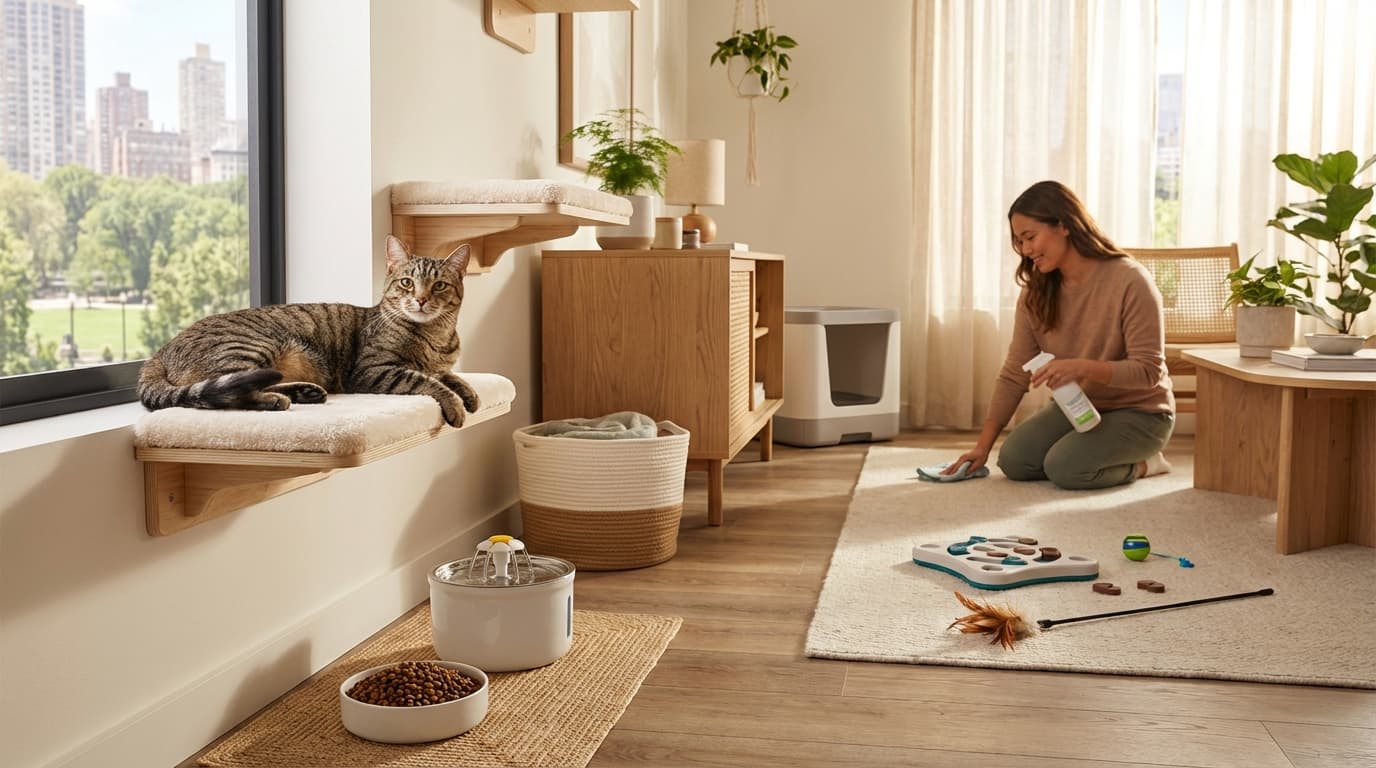
This is where vertical space saves the day. By adding shelves or tall trees, you create a sense of safety and social distance. It allows one cat to be in the same room as another without being directly in their face. It also stops resource guarding before it even starts. Instead of a dominant cat blocking a hallway by staring or hovering, the other cat can simply take the high road. We call this the cat highway. It is a path of shelves and cabinet tops that lets them cross the room without ever touching the rug. This setup is a total game changer for keeping the peace in a multi-cat home.
Now, think about your shyest cat. They need more than just a path. They need a fortress. Window hammocks turn empty glass into prime feline real estate. These spots are perfect because they offer a clear view of everything. Much like how an open-top litter box prevents a cat from feeling cornered, a high perch lets a cat see an ambush coming from a mile away. It removes the trap scenarios that happen in narrow hallways or behind couches where a more confident cat might be lurking.
When cats feel cornered in busy areas, their stress levels spike. This chronic stress often leads to physical health problems or those dreaded accidents outside the box. In fact, environmental stress is a major reason cats end up in shelters. Giving your least confident cat a private zone on the wall gives them a way to opt out of the social hierarchy for a while. It is not just about fun furniture. It is about making sure every cat has a spot where they feel completely untouchable. When they feel safe up high, they are much less likely to fight over what is happening down low.
Key insights:
- Vertical space acts as a pressure valve for social tension in small apartments.
- The cat highway allows cats to navigate rooms without forced ground-level interactions.
- High perches provide the 360-degree visibility that shy cats need to feel safe from ambushes.
- Reducing environmental stress through height can prevent common behavioral and health issues.
Window Hammocks and Safe Zones for Shy Guys
Look at your walls. In a small apartment, that vertical space is basically gold. If you have a shy guy who hides under the couch, a window hammock is a life saver. It lets them watch the room from a safe distance without feeling trapped.
This matters because cats descend from the African wildcat, a solitary hunter that needs its own space. When the hallway gets busy, having an escape route up high stops the staring or blocking that happens on the floor.
Every cat needs one spot that is completely theirs. By adding shelves or a window perch, you turn a cramped room into a multi-level home. It gives your least confident cat a private zone where they can finally relax.
Key insights:
- Vertical space acts as a pressure valve for social tension in small rooms.
- High-up perches prevent 'trap' scenarios in narrow hallways or high-traffic areas.
Pheromones and Modern Tools for a Happy Home
Ever feel like your living room is a ticking time bomb of hissed warnings? In small apartments, cats often feel they have to compete for every square inch. This is where pheromone diffusers step in as invisible peacemakers. These tools mimic the natural signals mother cats use to soothe their kittens, essentially acting as a 'vibe check' you plug into the wall. Just keep your expectations realistic: while you might see changes quickly, it usually takes a full 30-day window to see a lasting shift in the household dynamic.
We can also use smart tech to stop those 'hangry' standoffs before they start. Automatic feeders are a massive help because they remove human error and inconsistent timing from the equation. When a machine handles the schedule, your cats stop pestering you - or each other - the moment the sun comes up. This simple fix reduces resource guarding, which often manifests as staring or blocking access to the bowl. It is about creating a predictable world where no one feels the need to fight for their fair share.
Beyond gadgets, remember the 'n+1' rule: one litter box per cat, plus an extra. But here is the catch: do not put them side-by-side. Cats see clustered boxes as just one big toilet, which fails to solve territorial disputes. Spreading them out across different rooms prevents a dominant cat from guarding the entire area. These small tech and layout changes work together to turn a cramped apartment into a peaceful sanctuary for every feline resident.
Key insights:
- Pheromone diffusers require a 30-day commitment to properly evaluate their effect on cat behavior.
- Automatic feeders reduce resource guarding by creating a consistent, neutral food source.
- Litter boxes must be physically separated because side-by-side placement is perceived as a single resource.
Common Questions About Multi-Cat Life
Ariana Jenks from the Cat Care Society once said that cats are like potato chips because you can't have just one. If you have turned your small apartment into a multi-cat hub, you likely know the joy and the chaos that comes with it. But managing the cat hierarchy in small apartments can feel like a full-time job. You might see one cat staring another down or blocking access to the hallway. This is called resource guarding. It happens because our pets descend from the African wildcat, which was a solitary hunter that had to protect its own space to survive.
One of the biggest fixes for a tense home involves the bathroom. The n+1 rule suggests having one box per cat plus one extra to stop competition. But here is the trick. If you put them all in a row, your cats think it is just one big box. You need to spread them out in different areas so one cat cannot guard them all at once. Also, think about ditching the covers. While they hide the mess, they can create a trap where a dominant cat ambushes a vulnerable one at the only exit. Open boxes give cats a 360-degree view and help them feel much safer.
If you are bringing a new cat home, keep them in their own room for at least a week to start. You can try scent swapping by rubbing a towel on one cat and putting it under the other cat's food bowl. This helps them connect a new smell with a good thing like dinner. You might also try pheromones for multi-cat homes. These diffusers last about 30 days and help lower the overall tension in the air. Adding hiding spots for shy cats, like window hammocks or high shelves, lets them escape the action when they feel overwhelmed by their roommates.
When should you stop trying to fix things yourself and call a professional behaviorist? If you see flattened ears, flicking tails, or constant hissing, it is probably time for expert help. Stress in a small home often shows up as health issues or cats going outside the litter box. As Emily Johnson notes, a mentally and physically stimulated cat is much less likely to guard resources. If the fighting does not stop despite your best efforts, an expert can help you find the peace you and your cats deserve before anyone gets hurt or sick.
Key insights:
- Litter boxes placed side-by-side are perceived as one single box by cats.
- Covered litter boxes can create dangerous trap scenarios for submissive cats.
- Scent swapping helps cats associate a new companion with positive experiences like eating.
- Vertical enrichment allows cats to observe their territory from a safe distance.
Frequently Asked Questions
You can totally have two happy cats in a small apartment! It is less about the square footage on the floor and more about how you use your walls. People often say cats are like potato chips because it is hard to have just one, and they usually do great in pairs if you give them enough to do.
The trick is to use vertical space. Since cats descend from solitary hunters like the African wildcat, they love to climb and observe from above. Adding window hammocks or shelves helps them feel like they have their own territory even in a tiny home.
Just remember the 'n+1' rule for litter boxes. For two cats, you should ideally have three boxes. If you put them all side-by-side, your cats will think it is just one big box, which can lead to territory fights. Try to spread them out in different spots so one cat cannot guard the only bathroom area.
This is a classic move called resource guarding. Your cat is basically playing bouncer to control access to food or the litter box. To stop it, you need to change the environment so the hallway is not a bottleneck.
One big reason cats do this is because they feel vulnerable. For example, covered litter boxes can create a trap where one cat waits outside the only exit to ambush the other. Switching to open-top boxes gives your cats a 360-degree view so they feel much safer.
You can also try adding a cat tree or some shelves near the hallway. This gives the shy cat a way to go over the dominant cat instead of being forced to walk right past them. Using pheromone diffusers can also help lower the stress levels for about 30 days while everyone gets used to the new layout.
It is actually more common than you might think for long-term roommates to start bickering. Cats are naturally solitary animals descended from the African wildcat, so they are hardwired to be protective of their space. If something in the house changes or if they feel a bit crowded, they might start guarding resources like food bowls or the best sunny spot on the couch.
Keep an eye out for signs like staring, blocking hallways, or flicking tails. These are clues that the social balance is off. Often, the best fix is adding more vertical space like cat trees or shelves. This lets them observe the room from above and get away from each other when they need a break, which usually cools the tension.
The short answer is no, even if you are super diligent about scooping. Most experts recommend the n plus one rule, which means you should have one box for every cat plus an extra one. For two cats, that means three boxes are the magic number to keep everyone happy and prevent territorial fights.
Here is the thing that many people miss: location matters as much as the number of boxes. If you put two boxes side by side, your cats will just see them as one giant bathroom, which does not help with guarding issues. Also, try to use open-top boxes. Covered boxes can feel like a trap where one cat might ambush the other, leading to stress and bathroom accidents elsewhere in your home.
Conclusion
So, what does this all mean for your living room? It means your apartment is actually much bigger than the square footage on your lease once you start thinking like a cat. By spreading out resources and sticking to the extra litter box rule, you stop the competition before it even starts. Peace in a multi-cat home isn't about having a huge house; it's about making sure every pet feels like they own their own little slice of the world.
Your next move doesn't have to be a major renovation. Start small by adding a single window perch or trying out pheromones for multi-cat homes to take the tension down a notch. Even swapping a covered litter box for an open one can stop a hallway standoff or help with cat resource guarding. When you handle territory management for indoor cats by going vertical, you're giving them the social distance they naturally crave.
Living with multiple cats in a small space is totally doable when you trade the battleground for a playground. A little bit of height and a lot of strategy go a long way. Your cats don't need a mansion to be happy - they just need to know they're safe, respected, and have a high-up spot to call their own.
Send it to someone who should read it next.

PurrScript Editorial Team
Editorial Team
PurrScript's in-house editorial team. We research, write, and review every guide using established veterinary and behavioral resources, and update articles as best practices evolve.
View all articles