Stop the Mats: The Real Secret to Grooming Persians and Maine Coons
Did you know a Persian cat's guard hairs can reach five inches in length? That is a whole lot of fluff for one cat to manage. If you have ever...

Mia Torres
Cat Lifestyle Writer
Stop the Mats: The Real Secret to Grooming Persians and Maine Coons
Did you know a Persian cat's guard hairs can reach five inches in length? That is a whole lot of fluff for one cat to manage. If you have ever brushed your Maine Coon only to find a hard clump of tangled hair near their skin the next day, you know the frustration. Finding the best brush for Persian cats is not just about looks. It is a vital part of keeping your furry friend comfortable and healthy.
Most standard brushes just slide over the top layer, which lets the dense undercoat turn into a knotted mess. We are going to walk through a Maine Coon grooming routine built for preventing painful mats. You will learn why using undercoat rakes for cats and a detangling spray for feline fur is much more effective than a basic slicker brush vs. comb setup.
This guide covers the three essential tools you need and how to handle high-friction areas like the armpits and ears. You will also get some pro secrets for better home grooming. Let's turn that grooming struggle into a bonding session and keep that coat silky and mat-free.
The 5-Inch Hair Struggle: Why Grooming Long-Haired Cats is Different
Imagine a single hair five inches long. That is the reality for Persian cats, whose guard hairs reach lengths that make standard brushes look like toys. Since they have a dense, soft undercoat hidden beneath that long fur, a quick once-over won't cut it. You are not just brushing for a pretty photo. You are managing a complex double-layered coat that sheds year-round.
Grooming is a health requirement, not a beauty choice. If you skip a day, those hairs twist into painful mats in high-friction spots like under the legs or behind the ears. As the Pawvortex guide notes, this is about your cat's comfort. Using the wrong tool makes the job frustrating, which is why pros spent 150 hours vetting gear to ensure the pins actually reach the skin.
To end the matting cycle, you need a toolkit. Combining a slicker brush with an undercoat rake ensures you clear out shed fur before it clumps. This shift turns a daily struggle into a routine that keeps your cat's skin healthy and their coat tangle-free.
Key insights:
- Persian guard hairs can reach 5 inches, requiring tools that penetrate deep layers.
- High-friction areas like the armpits and behind ears are the first places mats form.
- A multi-tool approach is more effective than relying on one all-purpose brush.
Why Your 'Regular' Cat Brush is Letting You Down
Ever spent twenty minutes brushing your Persian only to find a massive knot behind their ears the next day? It is incredibly frustrating. Most regular brushes you find at the grocery store are built for short-haired cats. They glide right over the top, making your cat look shiny while leaving a tangled disaster hiding underneath. This is not just about looks. As the experts at Pawvortex point out, choosing the right tools is essential for your cat’s health and comfort, not just their style.
The real problem lies in the double-coat dilemma. Persians and Maine Coons have a dense, soft undercoat protected by long outer guard hairs that can reach five inches long. Think of it like a thick wool sweater under a slick raincoat. If your brush only touches the outer layer, the soft fur underneath starts to tangle and felt. These long guard hairs are beautiful, but they trap loose fur that sheds all year long. Without reaching the skin, you are basically just polishing the surface while a mess grows underneath.
Mats especially love high-friction areas like the armpits, behind the ears, and around the tail. Generic tools fail to reach the skin in these spots, leading to hidden mats that eventually pull painfully on the skin. The team at Cats.com spent 150 hours researching 45 different brands to see which tools actually penetrate these layers. They found that while something like a Safari Slicker Brush is affordable at about $17, a single tool is rarely enough for long-haired breeds.
Experts now recommend a multi-tool approach. Instead of one brush, you likely need a kit with a slicker brush, an undercoat rake, and a metal comb. Professional tools use stainless steel pins and ergonomic handles because grooming these cats is a long process. Many owners are now buying professional-grade kits to handle this at home. It is a health necessity because neglected fur leads to skin irritation and pain. Trading that old plastic brush for tools designed for the job makes a world of difference.
Key insights:
- Standard brushes designed for short-haired cats cannot penetrate the dense undercoat of a Persian or Maine Coon.
- Persian guard hairs can reach five inches in length, acting as a trap for loose fur and debris.
- Mats frequently form in high-friction areas like the armpits and behind the ears where generic brushes fail to reach.
- A multi-tool kit including slicker brushes and undercoat rakes is more effective than any single grooming tool.
The Double-Coat Dilemma: Undercoats vs. Guard Hairs
Why does your Persian look like a cloud but feel like a puzzle of knots? It is all about that double-layered coat. Beneath those long, silky guard hairs lies a dense, soft undercoat that acts like a thermal layer. While those outer hairs can reach 5 inches long, they often trap loose fur instead of letting it fall away. This creates a year-round cycle where shed hair gets caught in a structural net of its own making.
Think of guard hairs as a shield and the undercoat as a thick wool sweater. When that sweater sheds, the shield locks the dead hair against the skin. This is why mats form so fast in high-friction spots like behind the ears or under the legs. As experts from Pawvortex note, grooming isn't just about looks. It is a health necessity. Without help, trapped hair turns into painful clumps that pull on the skin.
You might wonder why a standard brush won't work. Most basic tools just skim the surface. They never reach the deep layers where the mats actually start. To keep your cat happy, you need a tool that penetrates both layers. It is the only way to stop the tangle before it becomes a real problem. Brushing your cat can be a challenge if you use the wrong tool, but understanding this coat structure makes the solution much clearer.
Key insights:
- Guard hairs can reach 5 inches and act as a trap for the shedding undercoat.
- High-friction areas like behind the ears are the first places to check for mats.
- Standard brushes are often too shallow to reach the dense Persian undercoat.
The 'Big Three' Tools Every Long-Haired Cat Parent Needs
Have you ever noticed how a standard pet store brush barely scratches the surface of a Persian or Maine Coon coat? It’s because these cats aren't just 'fluffy' - they have complex, double-layered coats with guard hairs that can reach up to five inches long. Relying on a single tool is a recipe for frustration and painful mats. To get the job done right, you need a professional-grade kit at home. This means looking for tools made with stainless steel and ergonomic handles that won't tire out your hand. As the experts at Pawvortex point out, choosing the right tools is a health necessity, not just an aesthetic choice, because it keeps your cat comfortable and skin-irritation free.
The daily workhorse of your kit should be a high-quality slicker brush. After 150 hours of research and testing 45 different brands, the team at Cats.com recommends the Safari Self-Cleaning Slicker Brush, which usually costs between $16 and $18. What makes this a game-changer is the push-button mechanism. Instead of picking hair out of pins for ten minutes, you just click the button, the pins retract, and the fur falls away. The flexible pins are designed to grab loose hair from the top layers without scratching the skin, making the daily routine much less of a chore for both of you.
But a slicker brush can't do everything. To reach the dense, soft undercoat where mats actually start, you need an undercoat rake. Think of this as your secret weapon. While a standard comb might just glide over the top, a double-sided rake penetrates deep into the fur to pull out dead hair before it tangles. It is especially useful for high-friction areas like behind the ears and under the legs. Many of these rakes feature rounded teeth, which is a vital safety detail. These teeth allow you to work close to the skin without the risk of scratching, ensuring you can remove the deep-seated shed that causes those stubborn, painful clumps.
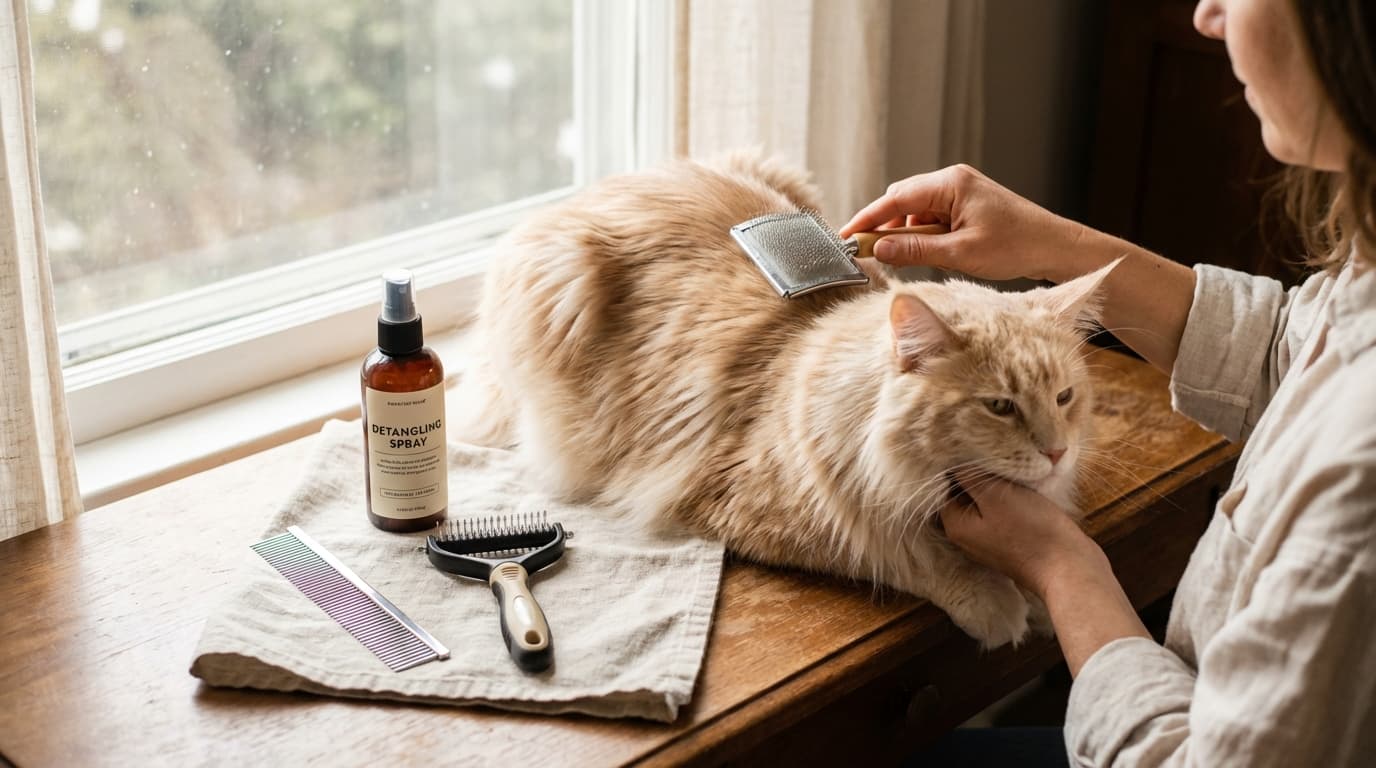
The final piece of the puzzle is a reliable detangling spray. If you have ever felt like grooming is a constant tug-of-war, this is the solution. These sprays work by reducing friction between the hair strands, allowing your rake or brush to glide through without pulling. You can use them for spot-treating specific tangles or as a general mist to help maintain the coat's natural shine. It makes the whole process feel less like a battle and more like a bonding session. When you combine the right spray with a professional rake and slicker, you aren't just grooming your cat - you are essentially providing salon-level care that keeps their skin healthy and their fur mat-free.
Key insights:
- Standard brushes often fail because they cannot reach the dense undercoat of long-haired breeds.
- A self-cleaning slicker brush saves time and reduces the mess associated with daily grooming sessions.
- Undercoat rakes with rounded teeth are the safest and most effective way to prevent mats in sensitive areas like the belly and tail.
- Detangling sprays are essential for reducing friction and preventing the 'tug-of-war' feeling during brushing.
Slicker Brushes: The Daily Workhorse
Ever tried brushing a Persian and felt like you weren't even reaching the skin? With guard hairs reaching up to five inches, a standard brush usually just skims the surface. This is why a quality slicker brush is the workhorse of any grooming routine. It’s the tool that turns a potential struggle into a quick daily habit that your cat might actually enjoy.
The Safari Self-Cleaning Slicker Brush is a standout choice, usually priced under $18 at major retailers. Experts at Cats.com spent 150 hours vetting dozens of brands to find tools that actually work for long-haired breeds. Its flexible pins are designed to grab loose fur from that thick undercoat without irritating the skin. Think of it as a magnet for the shedding that usually ends up all over your sofa.
The real win is the push-button mechanism that retracts the pins, making cleanup instant. Since matting often starts in hidden spots like under the legs or behind the ears, daily use is a health necessity rather than just a beauty choice. As Katelynn Sobus from Cats.com notes, using the wrong brush makes grooming a challenge. The right one keeps that double-layered coat healthy and pain-free.
Key insights:
- Flexible pins reach the dense undercoat without scratching the skin.
- The retractable pin mechanism eliminates the hassle of manual brush cleaning.
- Daily slicker use targets high-friction areas where painful mats typically form.
Why an Undercoat Rake is Your Secret Weapon
Ever wonder why your standard comb barely scratches the surface? For a Persian cat, whose guard hairs can reach five inches, a basic brush just won't cut it. These cats have a dense undercoat hiding beneath those long outer hairs. If you only use a regular brush, you are missing the source of most tangles. This is where the undercoat rake becomes your secret weapon. It is designed to penetrate deep layers and pull out dead hair before it turns into a painful mess.
The magic lies in the double-sided design. Unlike a flat comb, these tools use stainless steel teeth that reach through the topcoat without tugging. Katelynn Sobus from Cats.com notes that using the wrong brush makes grooming a struggle. A quality rake features rounded teeth to keep things safe. This is vital when you are working near sensitive spots like behind the ears or under the legs where friction causes the worst matting. Using this tool daily is a health necessity that keeps your cat comfortable.
Key insights:
- Standard brushes often fail to reach the dense undercoat of long-haired breeds.
- Rounded teeth on rakes protect sensitive skin in high-friction areas like the armpits and tail base.
- A double-sided rake helps manage year-round shedding that leads to painful mats.
The Magic of Detangling Sprays
Imagine trying to brush through hair that grows five inches long. For a Persian, those silky guard hairs and thick undercoats turn grooming into a daily tug-of-war. This is where a detangling spray saves the day. It acts as a lubricant, cutting down friction so your brush glides through instead of yanking on their skin.
So, when do you actually use it? Sprays are perfect for damp fur or tackling those tricky friction zones like behind the ears and under the legs where mats hide. For a simple daily touch-up, dry brushing is usually enough. But a quick mist during deep grooming sessions does more than just stop knots. It brings out a gorgeous natural shine.
Since these cats have complex double-layered coats, a little moisture keeps everything smooth and manageable. It makes the whole experience way less stressful for both of you. This simple addition helps protect those long hairs from snapping while you work.
Key insights:
- Focus your spray on high-friction areas like the tail base and armpits.
- Detanglers help maintain the natural luster of the outer guard hairs.
A Maine Coon Routine That Actually Works
Think of your Maine Coon’s coat as a high-maintenance landscape that needs a steady hand. It is not just a lot of fur; it is a complex double-layered system featuring a dense undercoat and long guard hairs that can grow up to five inches. If you skip even a few days, those layers start to weave together into a mess. The good news? You do not need an hour-long marathon to keep things under control. A focused 10-minute daily session is usually plenty to stay ahead of the tangles. The trick is timing. Catch your cat when they are already mellow, maybe right after a nap, and keep some treats handy to build a positive association.
The real work happens in what we call the friction zones. These are the spots where fur rubs together constantly, like behind the ears, deep in the armpits, and around the base of the tail. These areas are magnets for painful mats. For the bulk of the coat, a reliable tool like the Safari Self-Cleaning Slicker Brush is a solid choice. It is widely recommended and usually costs under $18 at places like Amazon or Chewy. It is great for the sides and back, but when you get to those tricky friction spots, you will want to switch to a flea comb for fine-detail work. It helps you feel out tiny knots before they become a real problem.
What does this mean for your cat? It means grooming becomes a moment of bonding rather than a battle. Recent research from Cats.com, which involved 150 hours of vetting dozens of brands, shows that using the right tool for the specific job makes all the difference. While it might seem like a lot of gear, a multi-tool approach is the only way to penetrate that thick Maine Coon undercoat. Remember, this is not just about making your cat look like a show winner; it is a health necessity. Regular maintenance prevents the skin-pulling pain of mats and keeps their skin breathing, making for a much happier, more cooperative pet.
Key insights:
- Daily 10-minute sessions are more effective and less stressful than weekly marathons.
- Friction zones like armpits and ear bases require specific attention and finer combs.
- Quality tools like the Safari slicker brush are affordable investments that save time.
- A multi-tool kit is essential for reaching through the dense double-coat layers.
Targeting the 'Friction Zones'
Ever wonder why your cat gets grumpy when you brush near their legs? Those are the "friction zones" - spots like the armpits, behind the ears, and the tail base where mats love to hide. For a Persian with guard hairs reaching up to 5 inches, these areas become tangling hotspots almost overnight. Since they have a dense, double-layered coat, a regular brush often just skims the surface. You need to get in there and feel for those tiny, pea-sized knots before they turn into painful mats that pull on the skin.
For the face, a bulky slicker brush is usually too much. A simple flea comb is the better tool here; its fine teeth are perfect for detail work around the eyes and chin where debris can hide. Don't forget the tail base, either, as it is a prime spot for friction. As experts note, grooming these long-haired breeds is a health necessity, not just for looks. Catching a small snag today saves your cat from a stressful, buzzed-off haircut later. It’s about keeping them happy, one small section at a time.
Professional Secrets: Bringing the Salon Experience Home
Have you noticed how home grooming kits are looking a lot more professional lately? It is not just your imagination. More cat parents are investing in high-end clippers and grinders that used to be strictly for the pros. This shift is happening because we have realized that maintaining a long-haired beauty like a Persian or a Maine Coon is a daily commitment. Instead of waiting for a monthly salon visit, owners are taking matters into their own hands to keep those five-inch guard hairs from turning into a tangled mess. It is about having the right gear ready the moment you spot a problem.
The cost-benefit ratio is also hard to ignore. When you consider that a solid tool like the Safari Self-Cleaning Slicker Brush costs only around sixteen or seventeen dollars, it pays for itself almost immediately compared to professional fees. Professional-grade tools are built with stainless steel and ergonomic handles, making those long grooming sessions much easier on your hands. Since Persians have a dense, soft undercoat hidden beneath those long outer hairs, having the right gear is the only way to reach the skin and prevent painful matting in high-friction areas like behind the ears or under the legs.
But what about the gear that does the work for you? You have probably seen those catified wall-mounted brushes popping up in stylish homes. These self-grooming stations are fantastic for mental enrichment. They allow your cat to take charge of their own comfort, rubbing their cheeks and sides against firm bristles whenever the mood strikes. It is a great way to integrate grooming into your home decor while giving your cat a little extra autonomy.
While these stations are a fun addition, they have their limits. A wall brush is a nice extra, but it can never truly replace the human touch. These tools mostly handle the surface level and cannot penetrate the deep double-layered coats of a Maine Coon or Persian. Think of them as a light dusting between deep cleanings. You still need to be the one checking for those tricky mats around the tail and belly. The reality is that a balanced approach works best: let the wall brush provide the fun, but keep your professional kit ready for the real work.
In the end, bringing the salon experience home is about more than just saving money. It is about the health and comfort of your cat. When you use the right undercoat rakes and slicker brushes, you turn a potentially stressful chore into a bonding moment. Is it a bit of an investment up front? Sure. But seeing your cat move freely without the pull of a tight mat makes every penny worth it. Plus, you get the peace of mind that comes from knowing your pet is pampered every single day.
Key insights:
- Professional-grade tools like stainless steel rakes are now affordable and accessible for home use.
- Self-grooming wall stations provide mental enrichment but cannot replace deep manual brushing.
- Daily home maintenance prevents painful mats in high-friction areas like the armpits and tail base.
- Investing in a high-quality home kit often costs less than two professional salon visits.
Are Self-Grooming Stations Worth the Wall Space?
You have likely seen those spiky plastic corners meant for walls. They are a popular part of the catified home trend because they give your pet a bit of independent grooming and mental stimulation. It is satisfying to watch a cat lean in for a good face rub while you are busy. But can these stations really replace your Maine Coon grooming routine? Not quite.
The catch is that a wall brush only hits the surface. Persian cats have guard hairs that can reach five inches long, hiding a dense undercoat underneath. These stationary tools simply cannot reach high-friction spots like the armpits, behind the ears, or the base of the tail where painful mats love to hide. They are great for enrichment, but they do not have the reach to maintain a thick double-layered coat.
Think of these stations as a bonus rather than the main event. While they help with some light shedding, they do not replace the human touch. To truly prevent mats, you still need a multi-tool strategy involving slicker brushes and undercoat rakes. As the experts at Pawvortex say, choosing the right tools is about health and comfort, not just looks. Use the wall brushes for fun, but keep your hands on the brush for the real work.
Key insights:
- Self-groomers provide mental stimulation but lack the depth needed for long-haired breeds.
- Wall brushes often miss high-friction areas like the tail base and behind the ears where mats form.
- A manual multi-tool approach remains the only way to penetrate a dense Persian undercoat.
Common Mistakes That Make Brushing a Nightmare
Ever wonder why your cat bolts the second the brush comes out? It usually starts with a mistake we have all made: pulling on a mat. When you tug at a knot, you are not just fighting fur. You are pulling on delicate skin. Persian cats have a dense, soft undercoat hidden beneath guard hairs that can grow up to five inches long. Because of this double-layered coat, a small tangle can quickly become a painful anchor. If you pull too hard, your cat learns that grooming equals pain, and that is a hard lesson to unlearn.
Then there is the 'I will do it tomorrow' trap. Skipping even two days of brushing creates a snowball effect that is hard to stop. High-friction areas like behind the ears, under the legs, and around the tail are magnets for tangles. Before you know it, those tiny knots have woven themselves into a solid mass. As experts at Pawvortex point out, choosing the right tools is not about looks. It is about your cat's health and comfort. Daily grooming is a necessity because their hair grows and sheds all year long.
Using the wrong brush is another common pitfall. Many owners grab a standard brush meant for short-haired cats, but these cannot reach the skin of a Maine Coon or Persian. You need a multi-tool approach. A slicker brush is great for surface hair, but you also need a metal comb to reach the undercoat. Katelynn Sobus from Cats.com notes that brushing is a challenge if you use the wrong tool. This insight comes from heavy research, like the 150 hours spent vetting 45 different brands to find what actually works. Using a slicker for a deep mat is like using a toothbrush to scrub a floor. It just will not get the job done.
Key insights:
- Pulling on existing mats creates a negative association with grooming that is hard to break.
- Persian cat hair can reach five inches, making daily maintenance a health requirement rather than a choice.
- Standard brushes fail to penetrate the double-layered coats of Maine Coons and Persians.
- High-friction areas like the tail base and underarms require extra attention to prevent 'snowball' matting.
Frequently Asked Questions
Let's be honest. If you share your home with a Persian or a Maine Coon, you know the glamour of long fur comes with a side of constant maintenance. You might wonder if you really need a professional kit or if your cat will ever stop treating the brush like a mortal enemy. It is a common worry. Persian guard hairs can reach up to five inches long, and beneath that sits a dense, soft undercoat just waiting to tangle. When you are dealing with that much fur, a standard brush from the grocery store will not cut it. It simply cannot reach the skin where the real problems start.
What about the cats who turn into tiny tigers the moment they see a comb? Katelynn Sobus from Cats.com points out that brushing is often a challenge because we use the wrong tools. If a brush pulls on a sensitive mat, your cat will remember that pain. Think of it this way: would you want someone tugging at your hair with a fork? Transitioning to a slicker brush with rounded pins or a dematting rake designed to glide through fur can change the whole vibe. Many owners are now using professional-grade home kits, including high-end clippers and specialized rakes, to keep things calm and efficient.
Cost is another big question. Do you have to spend a fortune to keep the mats away? Not necessarily. For example, the Safari Cat Self-Cleaning Slicker Brush usually sits around the 16 to 18 dollar mark at places like Amazon or Chewy. This is a small price to pay for something that lasts. You want tools with stainless steel parts and ergonomic handles so your hand does not cramp up during a long session. Investing in a few specific tools, like an undercoat rake and a slicker, is a much better strategy than buying one do-it-all brush that does not actually do much.
We also need to talk about the why behind all this work. As the experts at Pawvortex explain, choosing the right tools is about your cat’s health and comfort, not just how they look in photos. Mats are not just ugly. They are painful. They tend to form in high-friction spots like behind the ears, under the legs, and around the tail. If left alone, these mats pull on the skin every time your cat moves. Because Persian hair grows and sheds all year long, daily grooming becomes a medical necessity rather than just a choice.
If you feel overwhelmed, remember that you are not alone in this. The advice here comes from over 150 hours of research and vetting across 45 different brands. We have seen what works and what ends up in the junk drawer. Whether you are trying out a new self-grooming wall station for some hands-free help or finally tackling that undercoat with a professional rake, the goal is a happy, mat-free cat. It takes a little practice, but once you have the right gear, the process gets a lot easier for both of you.
Key insights:
- Persian cats have a double-layered coat with guard hairs reaching 5 inches, making standard brushes ineffective.
- Grooming is a health necessity because mats in high-friction areas like the tail and ears cause physical pain.
- A multi-tool approach using stainless steel rakes and slicker brushes is more effective than any single tool.
- Using the correct tool reduces grooming anxiety for 'spicy' cats by preventing painful pulling.
- Affordable, durable tools like the Safari Slicker brush provide professional results without a huge price tag.
Conclusion
Keeping a long-haired cat's coat silky is less about brute force and more about using the right kit. When you swap a basic brush for a proper undercoat rake and a slicker, you stop fighting the fur and start actually managing it. It is all about reaching the skin to clear out those hidden tangles before they turn into a solid, painful mess.
Your next move is simple: pick a quiet time today to try a ten-minute session. Focus on those tricky friction zones like the armpits and behind the ears, using a bit of detangling spray to keep things smooth. You do not need to be a professional groomer to get salon-quality results right in your living room.
The real reward is not just having a pretty cat, but a comfortable one. A mat-free Maine Coon or Persian is a much happier companion, and that extra purring lap time is worth every single minute of brushing.
Send it to someone who should read it next.
About the author

Mia Torres
Cat Lifestyle Writer
Cat mom of four and writer covering the joys, quirks, and everyday adventures of living with cats.
View all articles