The Truth About Bengal Cats: Are These Spotted Beauties Right for Your Home?
Have you ever wanted a tiny leopard roaming your living room? It sounds like a dream, but owning a Bengal is a lot more like living with a high-speed athlete...

PurrScript Editorial Team
Editorial Team
The Truth About Bengal Cats: Are These Spotted Beauties Right for Your Home?
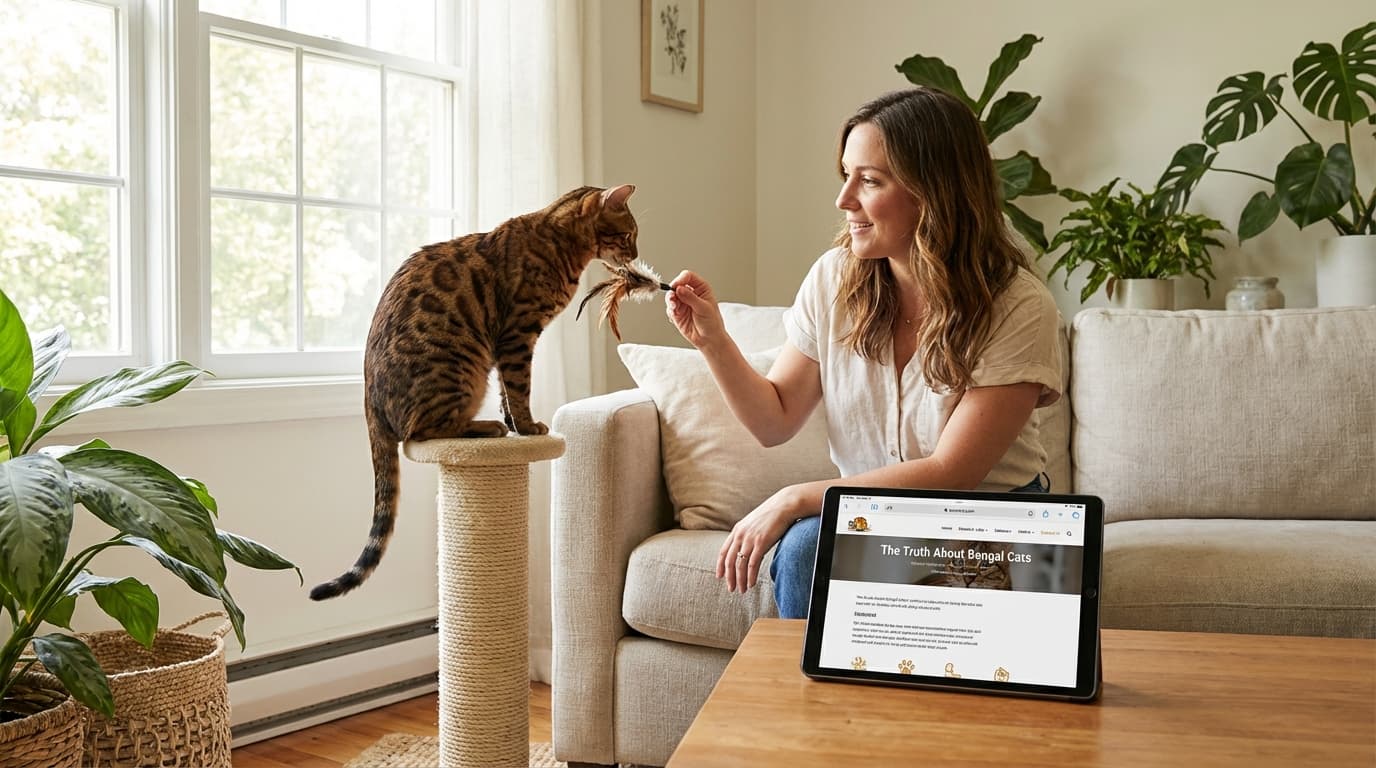
Have you ever wanted a tiny leopard roaming your living room? It sounds like a dream, but owning a Bengal is a lot more like living with a high-speed athlete than a quiet furball. These stunning pets are the most famous of the spotted cat breeds, known for their wild looks and even wilder energy levels.
While they are beautiful, the Bengal cat temperament is not for everyone. They are brilliant, chatty, and often obsessed with water. Before you bring one home, you have to understand the difference between F1 vs F4 Bengals and the specific Bengal cat exercise needs that come with the territory. It is also important to consider the hybrid cat ethics behind crossing wild Asian Leopard Cats with domestic ones.
This guide covers everything you need to know about the breed, from their unique personality quirks to the gear you will need to keep them happy. By the end, you will know for sure if a mini leopard is the right fit for your lifestyle or if you should stick to a more traditional tabby.
Ever dreamed of sharing your living room with a tiny leopard? That’s the allure of the Bengal, a cat that brings the jungle aesthetic right to your sofa. They are the most popular wild hybrid breed in the world, but there is a lot more to them than just those stunning spots.
At their core, Bengals are a mix of the wild Asian Leopard Cat and domestic breeds. Breeders use a process called backcrossing to bridge the gap between wild genetics and household life. While an F1 Bengal is a true 50/50 hybrid, the cats you will find in most homes are several generations removed. These SBT Bengals are behaviorally domestic, meaning they won't treat your house like a hunting ground, but they still retain that high-energy wild spark.
Here is the reality: these are not your typical sleepy lap cats. Because of their heritage, they need hours of exercise and mental puzzles to stay out of trouble. Think of them as high-performance athletes in fur coats. If you want a quiet ornament, a Bengal might surprise you with its need for constant action and interaction.
Key insights:
- SBT Bengals offer the exotic look with a predictable domestic temperament.
- The F designation marks how many generations the cat is from its wild ancestor.
- Owning a Bengal requires a much higher daily time commitment for play than standard breeds.
It All Starts with the Asian Leopard Cat
Ever looked at a wild leopard and thought about how cool it would be to have one in your living room? That is essentially how the Bengal story began. Back in the mid-20th century, breeders started crossing the wild Asian Leopard Cat with domestic felines. The goal was simple but ambitious. They wanted to create a cat that looked like it belonged in the jungle but acted like it belonged on your sofa. Today, Bengals are the most popular hybrid breed in the world because they offer that striking exotic look without the literal danger of keeping a wild animal as a pet.
But there is a big distinction you need to understand before you go looking for a kitten. While we call them all Bengals, there is a massive gap between a true hybrid and the domestic Bengal you see in most homes. The original crosses were about establishing the breed, but modern pet Bengals are many generations removed from their wild ancestors. Think of the Asian Leopard Cat as the spark that started the fire. The modern Bengal is the refined flame. It is also worth noting that while they look wild, the goal of the breed is specifically to keep the personality of a domestic cat.
This is where those F numbers come in. You might see breeders talking about F1 or F4 kittens, and these labels are basically a DNA map. An F1 Bengal is a direct 50/50 split between wild and domestic. By the time you get to F2, that wild percentage drops to about 25 percent. Here is the reality: F1 through F3 cats are usually reserved for very experienced handlers. They have much more intense needs, and the males in these early generations are almost always sterile. This makes the breeding process a complex game of backcrossing to ensure the lineage continues.
For most people, the magic term to look for is SBT or Stud Book Tradition. This refers to cats that are at least four generations removed from the original wild cross. TICA actually requires this three-generation gap of Bengal-to-Bengal breeding before a cat can even be shown. Why does this matter for you? Because by the fourth generation, the cat is fully domestic in its behavior. You still get the high energy and the stunning spots, but you also get a pet that is predictable and safe for a normal household. These cats still need plenty of exercise and mental puzzles to stay happy, but they are much easier to live with than their early-generation cousins.
Key insights:
- F1 Bengals are the only true hybrids in the strict sense because they are direct crosses with wild species.
- SBT status is the gold standard for household pets because it ensures a domestic temperament.
- Early generation males are typically sterile, which is why breeders use backcrossing with domestic males.
- The F number tells you exactly how many generations the cat is removed from its wild ancestor.
F1 vs. F4: Why Those Little Numbers Make a Huge Difference
Ever wonder why some Bengals cost as much as a used car? It usually comes down to that F number on their paperwork. This stands for Filial, and it tells you how many generations the cat is removed from its wild ancestor, the Asian Leopard Cat. An F1 is a direct cross, meaning it is literally 50% wild. Because of that high wild DNA, these early generations (F1 through F3) are intense, high-energy animals that usually require expert handlers. Also, early-generation males are almost always sterile, which makes them quite rare.
For most families, the goal is an SBT Bengal, which stands for Stud Book Tradition. This means the cat is at least four generations removed from the original wild cross. TICA actually requires this gap before a Bengal can even be shown. Why? Because by the time you hit the F4 generation, you have a cat that keeps those stunning leopard spots but acts like a predictable, sweet domestic pet. They are still high-octane felines, but they are much more likely to enjoy a lap than a high-generation hybrid would.
Think of it this way: an F1 is a roommate with a wild streak, while an SBT is a domestic cat in a very fancy coat. While later generations are easier to live with, they still need plenty of mental stimulation and often thrive on a raw meat diet to stay healthy. Choosing the right generation is the difference between a pet that fits your life and a lifestyle that revolves entirely around your cat's wild side.
Key insights:
- SBT Bengals (F4 and beyond) are the standard for household pets because they offer domestic behavior with an exotic look.
- Early generation Bengals (F1-F3) are true hybrids and often have unique needs, including specialized diets and more intensive social interaction.
- The F-prefix is your best guide for predicting a cat's temperament and how much time you will need to spend on daily enrichment.
What It’s Really Like Living with a Bengal
Ever wonder what it is really like to share your home with a miniature leopard? Living with a Bengal is less like owning a cat and more like living with a very smart, very athletic roommate who never quite grew out of their toddler phase. These cats are famous for a dog-like loyalty that means they do not just sit in the same room as you; they want to be involved in whatever you are doing. Whether you are folding laundry or trying to sleep, expect a shadow. And do not be surprised if that shadow follows you right into the bathroom. Bengals have a famous obsession with water. You might find yours batting at the stream from the faucet or even hopping into the shower with you. It is a quirky trait that stems from their wild ancestors, the Asian Leopard Cat, who are quite comfortable around the water.
Communication is a big part of the Bengal experience, but it is not just standard meowing. They have a massive range of sounds, from little chirps and trills to a gravelly howl when they get excited. They will tell you exactly when they are hungry or bored, and they usually expect a response. This intelligence is a double-edged sword. While it is amazing to see them learn tricks or figure out how to open cabinet doors, it means they get bored easily. Since they are the most popular hybrid breed in the world, many people choose them for their stunning spots, but the reality is that they need hours of engagement. Think of it this way: an F1 Bengal is 50% wild, which is a lot for a normal home to handle. However, most pets are SBT (Stud Book Tradition) Bengals. These are at least four generations removed from the wild, so while they look exotic, their personality is much more suited for a cozy living room.
Then there is the energy. If you have heard of the zoomies, imagine those amplified by ten. Bengals have a high prey drive and a motor that never seems to quit. This is where that high-octane reputation comes from. To keep them out of trouble, you really have to give them a job. This could be a complex puzzle feeder, a tall cat tree to scale, or even leash training for walks outside. Without mental stimulation, they will find their own fun, which usually involves your curtains or expensive glassware. The good news is that despite their intensity, they usually get along great with children and other pets, provided they have enough space to burn off steam. They are social creatures that thrive on interaction, making them a chaotic but rewarding addition to a busy home.
Key insights:
- SBT Bengals offer the exotic look of a wild cat with the predictable temperament of a domestic pet.
- Expect to spend at least a few hours daily on physical play and mental puzzles to prevent destructive behavior.
- The Filial (F) number is the best way to tell how much wild DNA and predictable behavior you can expect.
The High-Octane Bengal Temperament
Ever wonder what it is like to live with a tiny leopard that has the energy of a marathon runner? That is the Bengal experience in a nutshell. These cats do not just walk across a room; they zoom. Because of their unique heritage as a cross with the Asian Leopard Cat, they have a high prey drive and enough stamina to keep you on your toes all day. If you are not ready for a pet that might scale your curtains or fetch toys like a dog, you might be in for a big surprise.
To keep a Bengal happy and your furniture intact, you really have to give them a job. Think of them as the working dogs of the feline world. They need puzzles, tall climbing trees, and daily interactive play to satisfy their curious minds. When they get bored, they tend to get into trouble. Providing plenty of mental stimulation is not just a suggestion; it is a requirement for a peaceful home.
The interesting part is how well they fit into a busy household. While they look exotic, most Bengals you meet today are several generations removed from the wild. These cats are usually very social and love being in the middle of the action. They often get along great with children and other high-energy pets because they finally have someone who can actually keep up with them.
Key insights:
- Bengals need active 'jobs' like puzzle toys to prevent destructive behavior.
- SBT Bengals are behaviorally domestic and thrive in social, busy homes.
- Their high prey drive means they love interactive play that mimics hunting.
Keeping Your Mini Leopard Happy: Exercise and Brain Games
Ever wonder why your Bengal treats the curtains like a jungle gym? It is because these cats are not your typical sleepy lap-warmers. Since they are a hybrid breed created by crossing an Asian Leopard Cat with a domestic one, they have a motor that never seems to quit. This matters because a bored Bengal is usually a destructive one. You cannot just toss them a catnip mouse and expect them to be satisfied. They need a job to do.
Think about your home from a cat's perspective. For a mini leopard, the floor is just a starting point. They crave vertical space, so installing floor-to-ceiling cat trees or sturdy wall shelves is a total game-changer. It lets them survey their territory from above, tapping into those wild instincts that still linger in their DNA. Even though breeders aim for the personality of a domestic cat, that physical drive for climbing and jumping is hard to switch off. It is part of who they are.
How much time do you actually need to spend playing? The reality is that these high-octane felines need several hours of engagement every single day. It is a major time commitment compared to a standard breed. If you do not provide this interaction, your Bengal will find its own fun. This usually involves your furniture or kitchen cabinets. You might wonder why they are so much more demanding than a typical house cat. It comes down to their heritage. Even an F4 or F5 Bengal, which is generations removed from the wild, still carries that intense curiosity. They are essentially the athletes of the cat world. Like any athlete, they need a rigorous training schedule to stay happy and healthy.
If you value your sofa, you might want to look into an exercise wheel. These have become a staple for high-energy breeds because they provide a safe way for cats to sprint at full speed indoors. It might look like a giant hamster wheel, but for a Bengal, it is a necessary outlet for their intense physical drive. It is a simple way to keep them from getting restless during the day, especially when you are not around to lead a play session.
But physical exercise is only half the battle. Their brains are just as active as their legs. Interactive puzzles and even clicker training can keep them sharp and prevent the boredom blues that lead to behavioral issues. Some owners even take things a step further with leash training. Taking your cat for a walk might get you some funny looks from the neighbors, but it is a fantastic way to let your cat explore the outdoors safely while burning off that extra steam.
Key insights:
- Bengals require vertical territory like cat trees to satisfy their natural climbing instincts.
- Expect to spend at least two to three hours daily on direct interaction and physical play.
- Mental stimulation through puzzles and clicker training is vital to prevent destructive habits.
- Exercise wheels provide a safe indoor outlet for the intense sprinting needs of hybrid breeds.
Why a Cat Wheel Might Save Your Furniture
Have you ever watched a Bengal cat during a 'zoomie' session? It’s like living with a tiny, spotted whirlwind. These cats are natural athletes who need a way to burn off steam that doesn't involve your curtains or the back of your favorite chair. This is why exercise wheels have become such a lifesaver for owners. For a high-energy breed, a wheel offers a way to run for miles right in the living room. Even though SBT Bengals are behaviorally domestic, they still have a drive to move that most house cats simply can't match.
But it isn't just about physical speed; their brains are just as busy. If you don't provide interactive puzzles or try clicker training, your Bengal will likely find their own 'projects' - like learning how to open cabinets or unrolling every bit of toilet paper in the house. Think of it this way: a bored Bengal is a creative Bengal, and you probably won't like their version of interior design. These high-octane felines need mental challenges to stay happy and keep your furniture in one piece.
For the truly adventurous, leash training is a fantastic way to bridge the gap between the living room and the great outdoors. It takes some patience to get them used to a harness, but a walk provides the deep mental stimulation and sensory input they crave. Whether it’s a wheel, a puzzle, or a stroll around the block, keeping their minds busy is the real secret to a peaceful home and a happy cat.
Key insights:
- High-energy breeds like Bengals need dedicated outlets like exercise wheels to prevent furniture damage.
- Mental enrichment through puzzles is just as important as physical play for preventing 'creative' destruction.
- Leash training satisfies a hybrid-derived cat's natural curiosity and need for exploration.
The Ethics of 'Wild' Pets: What to Consider Before You Buy
Imagine walking into your living room and seeing a miniature leopard perched on your sofa. It is a striking image, but it raises a tough question. Is it right to keep a wild animal in a house? The debate over breeding hybrids like Bengals is often intense. We love the exotic look, but the reality starts with crossing a wild Asian Leopard Cat with a domestic one. That first generation, known as F1, is a literal 50/50 split of wild and domestic DNA. It is worth asking if a cat that is half-wild can ever truly be happy in a typical suburban home.
This isn't just a moral debate. It is a legal one too. Many states ban early-generation Bengals because they are simply too wild for the average owner to handle. There is also a major biological hurdle that most people do not see coming. Almost all early-generation males, from F1 through F3, are born sterile. Because of this, breeders have to backcross hybrid females with domestic males to move the breed forward. It is a slow, difficult process used to keep the beautiful spots while trying to phase out the wild instincts.
The main goal here is to create a cat with the look of a leopard but the heart of a house cat. By the time a Bengal is four generations removed from the wild, it is considered a domestic pet. But even then, these cats are not lazy lap-warmers. They need hours of interaction and often a raw meat diet to stay healthy. Before you bring one home, think about whether you are ready for a high-energy partner or if you are just in love with a pretty coat. The ethics of ownership start with being honest about what you can provide.
Key insights:
- Early-generation Bengal males are almost always sterile, making breeding a complex challenge.
- F1 Bengals are 50 percent wild, which leads to strict legal bans in many regions.
- SBT Bengals are at least four generations removed and are behaviorally domestic pets.
- Owning any hybrid requires a massive time commitment for exercise and mental stimulation.
Other Spotted Breeds That Give You the Wild Look
You love the look of a miniature leopard prowling through your living room, but is a Bengal the only way to get it? Not quite. While Bengals are the most famous hybrid-derived cats, other breeds offer that same exotic vibe with different personalities. Take the Savannah, for example. Like the Bengal, it is a hybrid cross, but it comes from a wild Serval. If you think a Bengal is high-energy, a Savannah is often a whole different level of intensity. They are leggy, incredibly athletic, and usually need even more vertical space and mental stimulation to stay happy.
If you want the spots without the hybrid history, the Ocicat or the Egyptian Mau might be your best bet. The Ocicat was actually bred from domestic lines like the Abyssinian and Siamese to look like a wild cat, even though it has zero wild DNA. Then there is the Egyptian Mau, which is the only naturally spotted domestic breed in existence. These cats are not just pretty; they are lightning-fast and fiercely loyal. They give you that ancient, temple-cat look without the complex dietary needs or behavioral quirks that sometimes come with early-generation hybrids.
Choosing between these breeds really comes down to your daily routine. An F1 Bengal or Savannah is basically a part-time job, often requiring specialized raw meat diets and hours of one-on-one engagement. On the other hand, an SBT Bengal or an Ocicat fits much more easily into a typical household. They still need plenty of play, but they will not treat your curtains like a jungle gym quite as often. Before you bring one home, ask yourself if you want a relaxed roommate or a high-octane athlete that needs constant supervision.
Key insights:
- SBT Bengals are fully domestic in temperament, making them better for most families than early F1-F3 generations.
- The Egyptian Mau offers a naturally spotted look without the hybrid breeding requirements or restrictions.
- True hybrids often require specialized raw meat diets to mimic what their wild ancestors eat.
- Ocicats provide the 'wild' aesthetic through selective domestic breeding, offering more predictable behavior.
Common Questions About Bengal Life
Thinking about bringing a mini leopard into your living room? You likely have a few burning questions before taking the plunge. First, let’s talk dinner. While your average tabby is often fine with standard kibble, these athletic cats frequently thrive on a raw, high-protein diet to mimic what their ancestors ate. It keeps their coat shimmering and their energy levels right where they should be.
You might wonder if their wild heritage makes them difficult housemates. Here is the good news: by the time a Bengal reaches the F4 generation, they are essentially domestic pets with a flashy coat. They use the litter box just like any other cat, though they might try to play in the water bowl afterward. They are famous for their love of splashing around!
Expect a long-term friendship, as these cats usually live between 12 and 16 years. Because they are so smart, the real challenge isn't their temperament - it's keeping them busy. Without enough climbing trees or puzzle toys to burn off steam, they might decide your curtains are the next best thing. Are you ready for a pet that is as active as it is beautiful?
Frequently Asked Questions
While no cat is truly 100% hypoallergenic, Bengals are often much easier on people with allergies. They have a unique, pelt-like coat that is very different from your average house cat. Because they don't have a thick undercoat, they shed significantly less, which means there is less dander floating around your living room.
It also helps that they don't spend as much time grooming as other breeds. Since allergens are actually found in cat saliva, less grooming means less dried spit on their fur. If you have mild allergies, you might find that you can live comfortably with a Bengal, but it is always a smart idea to spend some time with one before you commit.
If you are looking at a standard pet Bengal, also known as an SBT, they aren't naturally more likely to spray than any other domestic cat. As long as they are neutered or spayed early, they usually have great litter box habits. The reputation for spraying mostly comes from the early generation hybrids, like F1s or F2s, who still carry much stronger wild instincts from their Asian Leopard Cat ancestors.
Also, keep in mind that Bengals are incredibly smart and active. Sometimes, what looks like a spraying problem is actually just a bored cat trying to tell you they need more exercise or mental stimulation. If you give them enough climbing spots and puzzle toys to keep their brains busy, they are usually happy to stick to their litter box.
It really depends on the individual cat and its generation, but generally, Bengals aren't your typical sit still for hours lap cats. While they are incredibly affectionate, they usually prefer to show it by following you from room to room or playing games rather than just snoozing on your knees.
If you have an SBT Bengal, which is at least four generations removed from its wild ancestors, they have a much more domestic personality. You might get lucky with a cuddler, but most of the time, they would rather be part of the action than a warm pillow. It is all about their high energy levels and need for mental stimulation.
Because of their wild heritage, Bengal cats often do best on a diet that is heavy on real, raw meat. Think of it as fueling a tiny, high-performance athlete. While many owners use high-quality commercial grain-free food, a lot of breeders suggest a carnivorous raw diet to mimic what an Asian Leopard Cat would eat in the wild.
This kind of diet helps with their digestion and keeps that famous coat looking shiny. Just remember that if you go the raw route, you need to make sure it is nutritionally balanced so they get all the vitamins they need to stay healthy and active. High protein is the way to go for these energetic felines.
Conclusion
So, where does this leave you and your dreams of owning a mini leopard? Bringing a Bengal into your home is a big shift from owning a typical domestic cat. You are not just getting a pet with a stunning coat; you are signing up for the high-octane Bengal cat temperament that defines the breed. Whether you choose the more wild-leaning early generations or a standard pet-sized companion, the reality is that these cats need a lot of engagement to stay happy and out of trouble.
Understanding the jump from F1 vs F4 Bengals is key to making sure you do not end up overwhelmed. While these wild cat look-alikes are undeniably beautiful, they require a serious commitment to meeting Bengal cat exercise needs and mental challenges. From installing cat wheels to managing their obsession with water, life with a Bengal is never boring, but it does require a home that embraces their active, vocal nature.
If you are still excited after learning about the work involved, your next step should be meeting a breeder or a rescue to see that energy in person. For the right owner, the bond with a Bengal is unlike any other. Just be prepared to trade your quiet afternoons for a lot of play and a very chatty, spotted best friend.
Send it to someone who should read it next.
PurrScript Editorial Team
Editorial Team
PurrScript's in-house editorial team. We research, write, and review every guide using established veterinary and behavioral resources, and update articles as best practices evolve.
View all articles