The Truth About Cat Baths: How to Clean Your Kitty Without the Scratches
Cats spend nearly half their lives grooming, yet they still find ways to get impossibly dirty. While those sandpaper tongues are great for daily dust, they can't always handle heavy...

PurrScript Editorial Team
Editorial Team
The Truth About Cat Baths: How to Clean Your Kitty Without the Scratches
Cats spend nearly half their lives grooming, yet they still find ways to get impossibly dirty. While those sandpaper tongues are great for daily dust, they can't always handle heavy grease or outdoor messes. If you've ever tried to force a feline into a tub, you know why many owners avoid cat grooming like the plague. It usually feels like a high-stakes mission where the only real prize is a handful of painful scratches.
But you don't have to choose between a smelly pet and your own safety. We're looking at the reality of waterless cat shampoo, the truth about using dawn dish soap for cats, and which cat-safe soaps actually protect their skin. There is a big difference between a quick refresh and a deep clean, and knowing what your kitty needs is the first step to a happier, cleaner home.
This guide covers the essential survival tips for bathing a cat without getting scratched, from the pre-bath nail trim to the 'burrito' method for drying a wet cat. You will learn how to handle the point of no return for feline messes and how to make the process much smoother for everyone involved. Let's turn that soggy mess into a fluffy success.
When Do Cats Actually Need a Bath?
Have you ever watched your cat groom and wondered if they actually need your help? Cats are famously clean, spending between 30% and 50% of their entire day licking their fur. It is a full-time job. But even with that much dedication, there comes a point where their natural tools just are not enough to get the job done. While they are great at daily maintenance, certain messes require a level of cleaning that a tongue simply cannot provide.
Think of a cat tongue like a built-in hairbrush. It is covered in tiny, hook-like structures that are perfect for pulling out loose fur or bits of dust. However, these hooks fail when it comes to grease. Since cats have naturally oily skin, that oil can trap dead skin cells and create a buildup that looks like dandruff but is actually just filth. This is a common issue for senior cats who have lost the flexibility to reach every spot. When the tongue cannot reach or the mess is too oily, a human intervention is the only way to get them truly clean again.
Most feline baths should be about medical necessity rather than just looking pretty. If your cat gets into something sticky, smelly, or toxic, like a run-in with a skunk or a pile of mud, you cannot wait for them to lick it off. In these cases, a soak is mandatory. You might have heard that Dawn dish soap is a good shortcut because it is safe and kills fleas. That is true in an emergency, but it is not a great long-term habit. It is a heavy-duty degreaser that strips away the natural oils their skin needs to stay hydrated. The goal is a balance: clean enough to be healthy, but not so clean that you are causing dry, itchy skin.
Key insights:
- Cat tongues are effective for debris but cannot emulsify the natural oils that cause skin buildup.
- Feline dandruff is often a sign of greasy skin buildup rather than dryness, requiring a water-based wash.
- Use household degreasers like Dawn sparingly because they lack the skin-conditioning agents found in cat-specific shampoos.
The Self-Grooming Limit: When the Tongue Isn't Enough
Your cat likely spends up to half their waking hours licking their fur. It is a dedicated habit, but those tiny tongue hooks are really only meant for light dusting. While they work like a natural comb for loose hair and parasites, they simply cannot cut through heavy grease or stubborn outdoor grime that sticks to the coat.
Scent masking is a major part of feline biology, but a messy adventure outside can leave smells that no amount of licking can fix. Also, older cats often lose the flexibility to reach tricky spots on their backs or hindquarters. You might consider waterless cat shampoo for convenience, but these products often just sit on the surface. They do not actually remove the oily buildup or 'dandruff' that is usually just a layer of dead, greasy skin cells.
Sometimes, the tongue just hits its limit. When self-grooming fails, a proper bath is the only way to ensure your cat stays truly clean and comfortable. It is about more than just a shiny coat; it is about helping your pet manage the messes they cannot handle alone.
Key insights:
- Cat tongues are effective for daily maintenance but fail to emulsify and remove natural skin oils.
- Senior cats often require human assistance because of reduced mobility and reach.
- Feline dandruff is frequently a sign of greasy skin buildup rather than dryness.
Medical Necessity vs. Cosmetic Cleaning
Cats are self-cleaning experts, spending up to half their day grooming with those tiny, hook-covered tongues. But sometimes, a tongue just isn't enough. If your kitty gets sprayed by a skunk or comes home caked in mud, you can't wait for them to lick it off. In these moments, or when a vet prescribes medicated washes for skin conditions, a bath becomes a medical necessity.
The key is balance. Over-bathing is just as bad as never bathing because it strips away protective natural oils. While Dawn soap is a famous flea fix, using it too often leads to itchy skin. Waterless shampoos often fail to remove actual grease, so sometimes only a real soak works.
Key insights:
- True feline dandruff is often a buildup of greasy skin cells rather than simple dryness.
- Waterless products are convenient but rarely address the oily nature of a cat's skin.
The Waterless Shampoo Trap: Why Sprays Usually Aren't Enough
We’ve all been there. You see a "waterless" mousse at the pet store and think you’ve found the ultimate loophole in cat care. No scratches, no soggy bathroom, and a fresh-smelling kitty in seconds. But there is a catch. While these products are fine as a quick bridge between real cleanings, they often fail to actually clean. Cats already spend up to half their day grooming themselves with those tiny, hook-like structures on their tongues, yet even their natural biological combs can't always beat the heavy grease that builds up over time.
The real problem comes down to chemistry. Feline skin is naturally oily, and waterless sprays simply don't have the power to emulsify and lift those heavy lipids. Think of it like trying to clean a greasy frying pan with a dry paper towel and some perfume. You might hide the smell for a minute, but the gunk is still there. Even when people use household soaps like Dawn for flea control, the effectiveness relies on the water to carry the grime away. As the National Cat Groomers Institute points out, nothing achieves real results like an old-fashioned bath with water.
When you pump that foam onto your cat’s fur, it usually just sits on top of the filth. Instead of removing oils, mousses can trap dirt against the skin, leading to what professional groomers call sticky coat syndrome. You think you're helping, but you're actually creating a layer of residue that attracts even more dust. This is also why cat dandruff often persists after a spray-down. It is rarely dry skin; it is usually a buildup of greasy, dead cells that require a thorough scrub and rinse to fully disappear.
So, when should you reach for the spray? Use it for minor touch-ups, like if your cat stepped in something dusty or needs a quick scent refresh. But if you are dealing with real odors, flea residue, or that heavy, separated look in their fur, it is time to face the faucet. Water is the only solvent that can truly reset the coat.
Key insights:
- Waterless products often mask odors rather than removing the underlying grease and filth.
- Feline dandruff is frequently a symptom of greasy skin buildup that requires water to dissolve.
- Mousses can cause sticky coat syndrome by trapping residue against the skin.
- Professional groomers view waterless options as temporary fixes rather than cleaning solutions.
Why Mousses Just Sit on Top of the Filth
Ever wonder why your cat still feels grimy after a waterless foam bath? These mousses and sprays often just sit on top of the dirt rather than removing it. While they seem like a great shortcut for water-shy kitties, they cannot actually emulsify the deep oils that naturally build up on feline skin. Instead of lifting away the filth, you are often just layering a refreshing scent over a greasy base.
Professional groomers often see the result of this: sticky coat syndrome. Because cats are naturally oily, using a product without a rinse just traps dead skin and debris in the fur. Many owners see white flakes and reach for more moisturizing mousse, thinking it is dry skin. In reality, that dandruff is usually a buildup of greasy cells that need a real scrub. As the National Cat Groomers Institute points out, nothing beats an old-fashioned bath with water to get the clean results your cat needs.
Key insights:
- Waterless products fail to break down the natural grease on a cat's skin, leading to residue buildup.
- Feline dandruff is often actually a collection of oily, dead skin cells that require a full bath to remove.
- The sticky coat syndrome occurs when sprays and mousses trap dirt against the skin instead of lifting it away.
Dawn Dish Soap: Is It a Miracle Cleaner or a Skin Irritant?
If you spend any time on pet forums, you have likely seen Dawn dish soap hailed as a miracle cure for everything from greasy fur to flea infestations. It is the go-to for rescuers cleaning oil-slicked ducks, so it seems like a no-brainer for your cat. But there is a catch. While Dawn is an unbeatable degreaser and a handy tool in an emergency, using it regularly can do more harm than good to your cat's skin.
The viral flea hack works because the soap breaks the surface tension of water. This causes pests to drown instead of floating on the fur. It is a brilliant one-time fix for a heavily infested kitten, but it is not a real monthly prevention strategy. Since Dawn is made to eat through heavy kitchen grease, it is very harsh on skin. It strips away the natural protective oils that keep a cat’s skin hydrated and healthy. Experts note that Dawn is not formulated to leave those essential oils behind. Using it too often leads to intense dryness and itching, which just makes your pet even more uncomfortable. Think of it this way: you are trading a temporary pest problem for a long-term skin condition. Always follow up with a vet-approved treatment to keep the bugs away for good.
So, what should you actually use? The secret lies in the pH balance. A cat’s skin is much more neutral than ours, and dish soap is made for cleaning plates, not living tissue. When shopping for a cleanser, stay away from anything with essential oils or artificial perfumes because these can be toxic or irritating. You might be tempted by waterless shampoos or foams, but they often just sit on top of the coat without removing the actual filth or dander. Since cats have naturally oily skin, they need a soap that can gently remove grease without destroying their moisture barrier. Look for pet-specific formulas with oatmeal or aloe to keep their coat soft and their skin calm and healthy.
Key insights:
- Dawn is a physical drowning mechanism for fleas but lacks the chemical residual power of professional preventatives.
- Feline skin has a unique pH balance that is easily disrupted by harsh household degreasers.
- Waterless shampoos often fail to emulsify the natural oils and dander that cause skin issues in cats.
The Flea Myth: What Dawn Actually Does
If you spot a flea on your kitty, you might reach for the blue dish soap. It is a famous hack because it works. The soap breaks the water's surface tension, so pests cannot float. Instead of hopping away, they drown.
But here is the catch. While Dawn is great for a one-time emergency, it is not a monthly prevention plan. It is a heavy-duty degreaser that strips away natural oils. Dr. Tabitha Henson warns that it is not made to keep skin hydrated.
Using it too much causes itching and dry skin. Remember, cats spend up to half their day grooming with their natural hook-like tongues. They need those oils to stay comfortable. Save the dish soap for grease and stick to vet-approved flea meds for the long run.
Key insights:
- Dawn kills fleas by drowning them but offers zero long-term protection.
- Frequent use strips essential oils, leading to chronic skin irritation.
- Vet-approved preventatives are safer and more effective for monthly care.
Choosing Truly Cat-Safe Soaps
Why can’t you just use your favorite body wash on your cat? It’s all about chemistry. A cat’s skin has a different pH balance than ours, so human soaps often lead to itchy, dry patches. Even Dawn dish soap, while handy for a sudden flea problem, is a bit too harsh for regular use. It’s made to cut through grease on dishes, so it tends to strip away the natural oils your cat needs to stay shiny and protected.
You also want to skip anything with artificial perfumes or essential oils. Since cats spend up to half their day licking themselves, those ingredients can be dangerous if swallowed. If you notice white flakes, don't be fooled by waterless sprays. That is usually just greasy buildup that needs a proper scrub with a cat-safe, soap-free shampoo to actually disappear.
Key insights:
- Human and dish soaps can strip essential oils and disrupt feline skin pH.
- Artificial scents and essential oils are safety risks because cats ingest residue while grooming.
- Feline dandruff is often grease buildup that waterless products cannot remove.
The Survival Guide: Bathing Your Cat Without Getting Scratched
Most cats spend up to half their day licking themselves with those sandpaper-like tongues, but sometimes their natural 'hooked' combs just aren't enough to handle real grime. When a bath becomes unavoidable, your goal isn't just a clean cat - it's keeping your skin intact. Prep work is actually more important than the water itself. If you dive in without a plan, you're basically asking for a fight. Success comes down to reading their body language; if those ears go flat or the tail starts thumping like a drum, it's time to stop immediately. Safety always comes before a shiny coat.
Before the first drop of water hits the tub, you need to neutralize the weapons. A quick nail trim is your best defense against those accidental reflex scratches. Once the claws are dulled, focus on the environment. Cats panic when they lose their footing, so a non-slip mat is a total game-changer to prevent that frantic sliding. Keep the water lukewarm - not hot, not cold. Their skin is sensitive, and the wrong temperature can trigger an immediate escape attempt. This stage is about building a sense of security before the real work begins.
Think about the last time you tried to hold a wet, angry cat alone. It's not easy. If you can, recruit a partner to try a four-handed approach. Having a designated 'holder' and a 'washer' makes the process much faster. One person provides gentle, calming restraint while the other manages the cleaning. Avoid using a loud, high-pressure spray nozzle; the sound and force are enough to send most cats into orbit. Instead, use a cup or a very 'slow water' technique to pour water gently over their fur.
You might be tempted by those waterless mousses or sprays advertised as miracle fixes. However, the reality is that these products often just sit on top of the coat. They don't actually remove the grease or that 'dandruff' which is usually just a buildup of oily skin cells. While household degreasers like Dawn are famous for helping in oil spills or repelling fleas, they can strip away the natural oils a cat needs for healthy skin if used too often. Sometimes, nothing beats a real soak and a pet-specific shampoo to get the job done right.
Key insights:
- Preparation, like trimming nails and using non-slip mats, is more critical for safety than the washing process itself.
- Waterless shampoos are often ineffective because they fail to break down the natural oils and greasy buildup on a cat's skin.
- Dawn dish soap is a powerful degreaser but should be used sparingly since it can cause long-term skin dryness by stripping natural oils.
- Feline 'dandruff' is frequently a sign of greasy skin buildup that requires a traditional water-based bath rather than a surface-level spray.
Pre-Bath Prep: The Secret to a Calm Cat
Think about how much time your cat spends grooming. It is actually 30% to 50% of their day. Their tongues are like tiny combs, but even those can't always tackle deep-down grease. When a real bath is unavoidable, the secret is in the prep. Before you turn on the tap, grab the nail clippers. Trimming those claws is your best defense against the 'climb the human' maneuver. It is a simple move that keeps a stressful moment from turning into a need for bandages.
Next, check the tub. Cats panic when they lose their footing, so use a non-slip mat to stop the sliding. It makes a huge difference in their confidence. While you are at it, keep the water lukewarm. Cats are sensitive to heat, and a gentle, warm flow feels less like a threat. You might be tempted by waterless foams, but they usually just sit on the fur. A real bath is the only way to truly scrub away the oily buildup that causes dandruff.
Key insights:
- Lukewarm water is essential because cats are sensitive to temperature changes.
- Non-slip mats prevent the 'panic-sliding' that leads to scratches.
- Real baths outperform waterless shampoos for removing greasy skin buildup.
The Four-Handed Approach: Should You Have a Helper?
Ever tried to bathe a cat alone? It usually ends with you bleeding and the cat hiding under the sofa for three days. This is where the four-handed approach saves the day. One person acts as the holder, providing gentle restraint and chin scritches to keep things calm. The other is the washer, focusing on getting the job done fast.
Instead of using a loud or scary spray nozzle, try the slow water technique by using a small cup or a very low-pressure stream. Since cats spend up to half their day grooming, they are usually clean, but when they get truly filthy, waterless shampoos often fail. Those mousses just sit on the fur without removing the deep-down grease. Having a partner makes it easier to use real water and cat-specific soap without the drama. It is much safer for everyone involved.
Key insights:
- A two-person team allows for gentle restraint, which reduces feline anxiety better than solo bathing.
- Waterless products often fail to remove the oily residue that naturally builds up on a cat's skin.
Drying a Wet Cat: From Soggy Mess to Fluffy Best
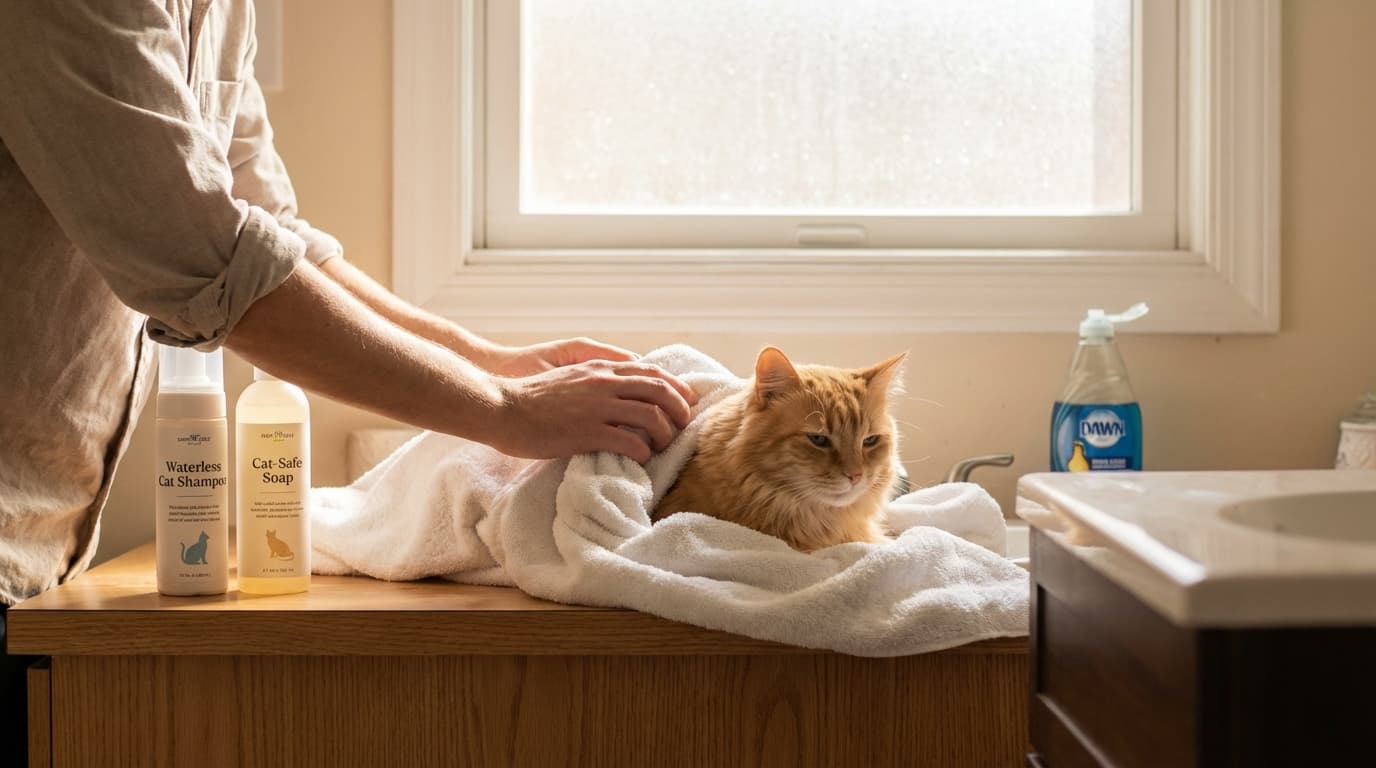
Once the water stops running, you are left with a creature that looks less like a cat and more like a tiny, wet alien. Your first instinct might be to grab the blow dryer to speed things up, but you should probably put it back in the cabinet. Most cats find the loud, high-pitched roar of a dryer absolutely terrifying. Beyond the noise, their skin is much more sensitive to heat than ours, which makes the risk of accidental burns much higher than you might think. Instead of using loud tools, try the burrito method. Wrap your cat snugly in a large, warm towel so only their head pokes out. This does more than just soak up water because it helps them feel secure and lowers their stress levels after the bath.
The reality is that cats are already professional groomers who spend between 30 and 50 percent of their day cleaning themselves. Their tongues even have tiny, hook-like structures that act like a natural comb for removing dirt, so a full bath is a major shock to their biological routine. To make sure they do not stay mad at you, keep some high-value rewards ready. A few special treats or a little bit of wet food right after the towel comes off helps build a better association for the next time you need to reach for the shampoo. You want them to remember the delicious snack more than the soak.
When you move on to the towel dry, focus on your technique rather than speed. If you have a long-haired cat, do not rub the fur roughly with the towel. Rubbing creates tangles and dense mats that are almost impossible to brush out once the hair actually dries. Instead, use a firm patting motion to squeeze the moisture out of the coat. It is especially important to be thorough and make sure the thick undercoat is dry so your cat does not catch a chill. A damp undercoat can stay cold for hours, which is uncomfortable for a desert-descended animal that prefers to stay warm.
Do not be shocked if your cat suddenly turns into a blurry streak of fur the moment you let them go. These post-bath zoomies are a common way for cats to shake off the lingering tension of being handled and finish the drying process on their own terms. It is their way of air-drying the last few damp spots while burning off that frantic energy. Just make sure the house is warm and free of drafts while they do their victory laps around the living room.
Key insights:
- Loud blow dryers can cause extreme stress and potential skin burns for sensitive felines.
- The burrito wrap technique provides both efficient drying and a sense of security.
- Patting is essential for long-haired breeds to prevent painful fur matting.
- Post-bath zoomies are a natural physiological response to release stress and assist in air-drying.
The Art of the Towel Dry
Once the water stops, the chaos begins. Most cats immediately get the 'zoomies,' racing around to shake off every drop of moisture. It is tempting to grab a towel and scrub them dry, but for long-haired breeds, heavy rubbing creates painful mats. Instead, use a soft towel to gently pat the fur. Think of it as squeezing the water out rather than buffing it away.
You must reach all the way to the undercoat. If that bottom layer stays damp, your cat could catch a chill. Even though cats spend up to half their day self-grooming with their natural, comb-like tongues, they still need a hand staying warm and tangle-free after a proper bath.
Dandruff or Just Dirt? Identifying What’s Really on Your Cat’s Coat
Have you ever spotted white flakes on your cat and reached for a moisturizing spray? You are not alone, but you might be making the problem worse. Most owners see those specs and assume it is dry skin. In reality, feline dandruff is often a buildup of greasy, dead skin cells. Because cats are naturally oily, these flakes get trapped in the coat instead of falling away.
This is why waterless shampoos usually fail. While a quick mousse or spray feels convenient, these products do not actually remove filth or heavy oils. They just sit on top of the fur. Experts note that nothing works like a real bath with water to break down that residue. Even though cats spend up to half their day grooming with their specialized tongues, they still need a deep scrub sometimes.
If you see redness or your cat is scratching constantly, it is time for a vet visit. Otherwise, a proper bath is the best fix. Skip the powders and stick to a real wash to get their skin healthy again.
Key insights:
- Feline dandruff is typically a buildup of oily skin cells rather than simple dryness.
- Waterless shampoos often trap grease on the skin instead of removing it.
- Redness or constant scratching are signs that a skin issue requires a vet visit.
Frequently Asked Questions
It is usually a bad idea to reach for your own shampoo. Human skin and cat skin have totally different pH levels, so what makes your hair shiny could actually leave your cat itchy and irritated. Plus, many human products have scents and dyes that are way too harsh for them.
If you are in a total bind and they are covered in something sticky, a tiny bit of Dawn dish soap is a better emergency backup than human shampoo. It is safe enough to use once in a while, but it is not a long term fix because it strips away the natural oils that keep their skin healthy. Your best bet is always a soap made specifically for cats.
The loudest part of the bath is often what scares them most. Instead of running the faucet while your cat is right there, try filling the sink or tub before you even bring them into the bathroom. Eliminating that sudden rushing sound can make a huge difference in their stress levels.
You can also put a small towel or a rubber mat at the bottom of the tub. Cats panic when they feel like they are sliding around, so giving them something to grip with their claws helps them feel much more secure. If they still seem terrified, remember that cats spend a huge chunk of their day grooming themselves anyway, so unless they are truly filthy, a quick wipe with a damp cloth might be enough.
You can use Dawn dish soap in a pinch to help kill fleas, but it is not something you should use as a regular shampoo. While it is effective at repelling pests because it is a powerful degreaser, it is not actually formulated for a cat's skin. It is safe enough for a one-time emergency wash, but it is not a long-term fix.
The problem is that Dawn is so good at cutting through grease that it also strips away the natural oils a kitten needs to keep their skin healthy. If you use it too much, you'll likely end up with a kitten that has very dry or itchy skin. It is always better to use a vet-approved flea treatment and a soap specifically made for pets when you can.
Most healthy cats rarely need a bath because they spend about 30% to 50% of their day grooming themselves. If you are bathing your cat every week or even every month without a specific medical reason, that is probably too often. Over-washing can mess with their skin's natural balance and lead to irritation.
You really only need to step in if your cat gets into something they can't clean off themselves, like oil or thick mud, or if they have a skin condition that requires special shampoo. Remember that their tongues are already built like natural combs to handle daily dirt. Unless they are visibly filthy or have a buildup of greasy skin cells, it is usually best to let them handle the cleaning.
Conclusion
So, where does that leave us and our water-hating friends? Most of the time, your cat has things under control with their own sandpaper tongue. But when a mess is too big for them to handle, you need a plan that goes beyond a quick spray of waterless cat shampoo. Real cleanliness usually involves a bit of water, the right cat-safe soaps, and plenty of patience to get the job done right.
The secret is that a good bath happens long before the faucet turns on. By trimming claws early and skipping harsh options like Dawn dish soap unless it is a flea emergency, you protect your cat's skin and your own arms. If a full soak is needed, keep the water lukewarm and have a towel ready for a quick burrito wrap to keep them calm while drying a wet cat.
Bathing a cat without getting scratched is mostly about staying calm and being prepared. Your cat might not love the process, but they will feel much better once they are dry and fluffy again. Keep the treats close and remember that a little bit of prep makes for a much happier, scratch-free home for everyone involved.
Send it to someone who should read it next.
PurrScript Editorial Team
Editorial Team
PurrScript's in-house editorial team. We research, write, and review every guide using established veterinary and behavioral resources, and update articles as best practices evolve.
View all articles