The Truth About Scottish Folds: Why Those Cute Ears Come With a Catch
Have you ever seen a cat that looks more like a tiny, wide-eyed owl than a feline? That is the charm of the Scottish Fold, a folded ear cat breed...

PurrScript Editorial Team
Editorial Team
The Truth About Scottish Folds: Why Those Cute Ears Come With a Catch
Have you ever seen a cat that looks more like a tiny, wide-eyed owl than a feline? That is the charm of the Scottish Fold, a folded ear cat breed famous for its adorable tucked ears and round face. This unique look started with a single barn cat named Susie in 1961, but there is a serious side to those folded ears.
While they are internet stars, the Scottish Fold carries a genetic mutation that affects more than just their appearance. If you are thinking about bringing one home, you need to understand how their genetics impact their health. We are going to talk about their sweet personalities, the truth about Scottish Fold ear health, and why some kittens in the same litter have straight ears.
From their history in the Scottish Highlands to the ethics of breeding them today, this guide covers everything a future owner should know. Let us look at what makes these owl cats so special and the care they really need to live a happy life.
Have you ever seen a cat that looks more like a wide-eyed owl than a feline? That is the charm of the Scottish Fold. These cats are famous for flat ears that make their faces look perfectly round and sweet. It all started in 1961 with a white barn cat named Susie in Coupar Angus, Scotland. She had a natural mutation that gave her those unique ears, and her kittens soon followed suit. It is a classic origin story, but it comes with a serious catch.
The trait we love is actually caused by a genetic condition called osteochondrodysplasia. This mutation affects cartilage throughout the body, not just in the ears. Because of this, groups like the GCCF do not recognize the breed due to welfare concerns. While they are medium-sized cats, usually weighing between 6 and 13 pounds, their health is a major talking point. All folded cats have this condition to some degree, which is why the breed is so controversial today.
The interesting part is that not every kitten has folded ears. In early breeding, about 42 out of 76 kittens had the fold, while the rest had straight ears. These Scottish Straights are now gaining more respect in the show world. They offer the same calm personality without the same level of health risk. It is a complicated choice for any pet owner, but understanding the history helps you see why these cats are both deeply loved and highly debated.
Key insights:
- The defining owl-like look is actually the result of a systemic skeletal disorder called FOCD.
- The breed began with a single barn cat named Susie in 1961.
- Scottish Straights offer the breed's personality without the same genetic ear health concerns.
- Major registries like the GCCF and FIFe refuse to recognize the breed because of welfare issues.
From a Scottish Farm to Global Fame
Imagine walking through the damp fields of Tayside, Scotland, in 1961. You might have passed a simple white barn cat named Susie without a second thought. But Susie had a secret that would eventually take the pet world by storm. Her ears folded forward and down, giving her a face that looked more like a little owl than a typical farm cat. This was not a planned breed or a lab experiment. It was a natural fluke of nature found on a farm near Coupar Angus.
A local shepherd named William Ross saw Susie and was immediately hooked by her unique look. When Susie eventually had kittens, Ross and his wife Mary took one of the folded-ear females home and named her Snooks. This was the spark that started everything. By working with geneticists, they began a breeding program that produced 76 kittens over the first three years. Out of those, 42 had the signature folded ears while 34 had straight ears. This proved the trait was dominant, meaning only one parent needed the gene to pass it on.
As the breed's popularity grew, it made the big jump across the ocean to the United States in the 1970s. American breeders fell in love with the owl cat look, but the journey was not always smooth. While groups like the CFA eventually embraced them, others like the GCCF in the UK stopped recognizing the breed because of health worries. The very thing that makes them cute, that ear fold, is actually caused by a condition called osteochondrodysplasia. It affects cartilage throughout the whole body, not just the ears, which makes the breed controversial even today.
Every single Scottish Fold you see now can be traced back to Susie. She is the foundation mother of the entire lineage. It is amazing to think that a lone barn cat from a Scottish farm created a global phenomenon. William Ross did not just find a pet. He found the start of a legacy that changed cat breeding forever. Even today, breeders look back at those early days in Tayside to understand the health and history of the cats sitting on our couches.
Today, the debate continues between registries and cat lovers. Some people focus on the charming look and the sweet personality, while others worry about the skeletal issues that come with the fold. Even the straight-eared versions are now gaining respect in the show ring. It shows that while the ears get all the attention, there is a lot more to these cats than just a quirky physical trait. They are a mix of accidental history and complex genetics that we are still learning to manage responsibly.
Key insights:
- The entire breed originated from one white barn cat named Susie found in Scotland in 1961.
- William Ross and his wife Mary were the primary drivers behind the early breeding and recognition of the fold trait.
- Initial breeding data showed that 42 out of 76 kittens inherited the folded ear mutation, proving its dominance.
- The breed is not recognized by some major registries like the GCCF due to the systemic skeletal issues linked to the ear fold.
Susie's Legacy: The Foundation Mother
Imagine walking through a farm in Tayside, Scotland, back in 1961. You might have spotted a simple white barn cat named Susie. She looked like any other mouser, except for one odd feature: her ears folded flat against her head. Susie is the foundation mother of the entire breed. Every single folded ear cat you see today can be traced back to her. It is incredible to think a random genetic mutation in a quiet barn started a global phenomenon.
A local shepherd named William Ross noticed Susie and was hooked by her unique look. He started a breeding program that produced 76 kittens over three years. While 42 had those famous folded ears, 34 were born with straight ears. This early work by Ross turned a farm cat’s quirk into a formal breed. But here is the catch: we now know that same mutation affects cartilage throughout the body, not just the ears. That owl-like charm comes with a hidden cost.
Key insights:
- The entire Scottish Fold breed originated from a single white barn cat named Susie.
- William Ross's initial breeding results showed that the folded trait is dominant but does not appear in every kitten.
The Science Behind the Signature Fold
Those famous ears are the first thing anyone notices. It is a look that the Cat Fanciers Association calls an owl-like charm, and it is hard to disagree. But there is a reason behind that fold that goes deeper than just being cute. It all started with a single white barn cat named Susie. She was found in Scotland back in 1961, and she is the grandmother of every Fold you see today. Her unique look came from a natural genetic mutation. Specifically, it is an autosomal dominant gene. This means if a kitten gets the gene from even one parent, their ears will likely fold. The funny thing is that you cannot tell which kittens have it right away. They are all born with straight ears. You have to wait about three weeks to see if that cartilage starts to soften and drop.
This mutation is not just about the ears though. It actually changes how cartilage develops throughout the entire body. Think of cartilage as the shock absorber for joints. In these cats, the gene makes that padding a bit different. In one early breeding study, researchers tracked 76 kittens. About 42 of them had the fold while 34 had straight ears. This shows just how common the trait becomes once it is in the bloodline. Because it affects the whole body, breeders usually cross a folded cat with a straight-eared one. This helps keep the kittens healthier while still giving them that round, soulful look that people love. It is a delicate balance of genetics and health.
The medical side of this is called feline osteochondrodysplasia, or FOCD for short. It sounds like a mouthful, but it basically means the bones and cartilage are not developing normally. Since the fold in the ear is caused by weak cartilage, the rest of the cat's joints can be affected too. This is the catch that many people do not realize at first. While the ears look amazing, the same process is happening in their legs and spine. Because of this, some big registries like the GCCF and FIFe actually refuse to recognize the breed. They feel that breeding for a skeletal deformity is not fair to the cats. It is a big debate in the cat world, and it is something every owner should understand before bringing one home.
If you have one of these cats, you have to be a bit of a detective. You should watch how they move. Do they seem a little stiff when they wake up from a nap? Do they have trouble jumping onto the bed? Sometimes their tails can feel a bit stiff or thick because of the way the bones grow. These are all signs that the FOCD might be causing some discomfort. Even though males can weigh up to 13 pounds and females up to 9, they are not always as agile as other breeds. Keeping them at a healthy weight is huge because extra pounds put more stress on those sensitive joints. It is all about giving them the best quality of life possible.
The reality is that every single Scottish Fold has some degree of this bone condition. It is what makes them who they are. While the straight-eared versions are becoming more popular because they avoid these specific health risks, the folded ones remain the stars of the show. They are charming, sweet, and look like little forest creatures. Just remember that their unique look is tied directly to their health. Being a good owner means looking past the cute ears and making sure their joints feel just as good as they look. It takes a little extra care, but for many, that owl-like face is worth the effort.
Key insights:
- Every Scottish Fold can trace its lineage back to a single barn cat named Susie found in 1961.
- The signature ear fold is actually a visible sign of a broader skeletal condition called FOCD.
- Kittens are born with straight ears and only develop the fold after about twenty-one days.
- Major registries like the GCCF do not recognize the breed due to concerns about their bone health.
- Owners should watch for signs of stiffness or thick tails as indicators of joint discomfort.
Understanding FOCD and Skeletal Health
Those adorable, tucked-back ears are why people love Scottish Folds. But here is the catch. That signature look is actually a symptom of feline osteochondrodysplasia, or FOCD. It is not just about a quirky ear shape. Since the mutation is autosomal dominant, it affects cartilage throughout the entire body. If the cartilage is weak enough to make the ears fold, it is also impacting the joints and limbs.
This is why some major registries refuse to recognize the breed. They are concerned about the cats' well-being. While a male Fold might weigh up to 13 pounds, his skeleton often faces joint issues early on. Every folded-ear cat has some degree of this abnormality. It is a systemic problem, meaning it does not just stay in the ears.
Watch for signs of stiffness when your cat jumps. You might notice an inflexible tail or a cat that avoids climbing. Sometimes they walk with a slight limp or move slowly for their age. It is often about discomfort rather than just being a lazy pet. If you see these changes, talk to your vet about joint support.
Living With an 'Owl Cat': Personality and Perks
Ever wonder why people call the Scottish Fold an "owl cat"? It is not just the folded ears. Without upright ears to distract you, those big, round eyes take center stage. The Cat Fanciers' Association notes that these soulful eyes are so dominant they practically overwhelm you with charm. This look makes them one of the most recognizable breeds in the world, but life with a Fold is about much more than just a cute face. They are classic lap cats, often following their owners from room to room just to stay close and be part of the action.
These cats have some of the weirdest sitting habits in the feline world. You might walk into the living room and find your Fold in the "Buddha position," sitting flat on their bottom with their back legs stretched out and their front paws resting on their belly. It looks hilariously human and is a common sight for Fold owners. They are also remarkably quiet companions. Instead of loud meowing, you will usually hear soft chirps or tiny trills when they want your attention. It is a gentle way of communicating that fits their mellow, easygoing personality perfectly.
While they are famous for those ears, not every kitten in a litter actually has them. In the early breeding programs, out of 76 kittens produced over three years, 42 had folded ears while 34 had straight ears. These "Scottish Straights" are actually gaining more respect in the cat world lately, with some registries even granting them championship status. They have the same sweet nature but without the same level of health concern regarding the ear mutation. Whether they have the fold or not, these cats usually weigh between 6 and 13 pounds, making them a sturdy but manageable size for most modern homes.
If you have a busy house with kids or other pets, a Scottish Fold usually fits right in. They are known for being adaptable and rarely get rattled by a little chaos or noise. Because they are so soft-spoken and gentle, they tend to get along well with children who know how to handle animals with respect. They are not the type of cat to hide under the bed for hours when guests arrive. Instead, they are more likely to wander out and see if anyone has a spare lap available for a nap.
They also do great in multi-pet households. Whether it is another cat or a dog, Folds are generally peaceful roommates who avoid conflict. They do not usually feel the need to be the "boss" of the house, which makes introductions much easier than with more territorial breeds. Just keep in mind that because of their genetic makeup and potential for joint stiffness, they might be a bit slower than other breeds as they get older. They just want to be part of the family circle, soaking up the quiet moments and occasional play sessions with you.
Key insights:
- The 'Buddha position' is a unique breed trait where they sit upright like a human on their hindquarters.
- Scottish Folds are famously quiet, using soft chirps rather than loud meows to communicate with their owners.
- Their adaptable personality makes them excellent choices for families with children and other pets because they rarely get stressed by busy environments.
- Scottish Straights share the same 'lap cat' personality as their folded-ear siblings but are often healthier due to the lack of the fold mutation.
Are They Good With Families?
If you want a cat that fits the hum of a busy home, the Scottish Fold is a great choice. They are famous for their owl-like charm, but their mellow personality is what really wins families over. They are remarkably patient and do not get easily rattled by a loud TV or a zooming toddler. Most owners find they adapt quickly, often following you from room to room just to stay in the loop.
But here is the catch: their sweet nature has a physical limit. Because the genetic mutation that folds their ears also affects their joints, these cats can be physically sensitive. While they love affection, they might not enjoy being squeezed too hard or lugged around by a playful child. It is smart to teach kids to be gentle. They are sturdy enough for family life, but they definitely prefer a soft touch over roughhousing.
When it comes to other pets, they are usually peaceful roommates. They are not typically alpha types looking for a fight. Instead, they are happy to share the couch with a dog or another cat. As long as everyone respects their space and handles them with care, they make wonderful, quiet companions for almost any household.
Key insights:
- Their patient temperament makes them a good fit for multi-pet homes.
- Joint sensitivity from FOCD means they require gentle handling, especially from children.
- They are social cats that prefer being near their family rather than being isolated.
The Rise of the Scottish Straight
Imagine picking out a Scottish Fold kitten and finding one with perfectly upright ears. It happens more often than you might think. In the very first breeding programs back in the sixties, out of 76 kittens produced over three years, only 42 had those famous folded ears while 34 stayed straight. This is not a mistake or a 'bad' batch of kittens. It is just how the genetics work. Since the fold comes from a specific mutation found in the original barn cat, Susie, it does not always pass down to every single kitten in a litter.
So, why are these straight-eared cats suddenly getting so much attention? For a long time, they were the 'forgotten' siblings, but that is changing fast. The Cat Fanciers' Association recently decided to grant these variants full championship status. This is a big deal because it acknowledges that the 'Straight' is a vital part of the breed. These cats carry the same round faces and sweet, owl-like expressions but without the folded ears that signify a systemic skeletal disorder called osteochondrodysplasia. Because this mutation affects cartilage throughout the whole body, breeding two folded-ear cats together is a recipe for serious health problems.
This makes the Scottish Straight the secret weapon for ethical breeders. By crossing a Fold with a Straight, breeders can produce those charming folded ears while significantly lowering the risk of severe joint issues. You get a cat that might weigh anywhere from six to thirteen pounds and keeps that famous personality without the same level of physical baggage. While some registries still avoid the breed entirely due to welfare concerns, the rise of the Straight offers a middle ground. It lets cat lovers enjoy the breed's unique temperament while prioritizing the actual health of the animal over just a specific look.
Key insights:
- Scottish Straights are now recognized for championship status by the CFA.
- Roughly half of kittens in a typical litter will have straight ears.
- Using straight-eared cats in breeding is essential to avoid severe skeletal issues in the kittens.
The Big Ethics Debate: To Breed or Not to Breed?
You have probably seen the photos. Those massive, soulful eyes and tiny flattened ears make the Scottish Fold look like a little feathered owl in a cat suit. It is a look that is undeniably charming, but it is also the center of one of the biggest arguments in the pet world. While many owners see a cute companion, major organizations like the Governing Council of the Cat Fancy and the Federation Internationale Feline see a welfare crisis. They refuse to recognize the breed because that signature fold is not just a quirk of fashion. Instead, it is a visible symptom of a systemic skeletal issue.
Here is the reality that is hard to swallow. The same genetic mutation that makes the ears flop also affects cartilage throughout the cat's entire body. This condition is known as feline osteochondrodysplasia, or FOCD, and it can lead to painful, progressive joint disease. Think about it this way. The very thing that makes them look so unique is actually a health struggle they carry from birth. This is not just a theory. Research shows that every single cat with folded ears is affected by this disorder to some degree. It is why some countries have moved toward breeding bans, treating the trait as a defect rather than a feature.
It all started back in 1961 with a white barn cat named Susie in Scotland. When breeders realized they could replicate her look, they produced dozens of kittens, but the health trade-off became clear early on. In one initial program, out of 76 kittens, only 42 had the folded ears. The others, known as Scottish Straights, had normal ears and lived without the same skeletal risks. Today, the debate is about whether it is fair to keep breeding for a look that guarantees some level of physical discomfort for the animal.
So, where does that leave someone who loves the breed's personality? Some responsible breeders are trying to find a middle ground by prioritizing health over aesthetics. They often cross Folds with Straights or other breeds like the American Shorthair to keep the genetic pool diverse. Interestingly, the Cat Fanciers' Association now gives championship status to the straight-eared versions. This allows the breed's sweet, calm temperament to continue without the catch of the folded ear. It is a way of saying we can love the cat without needing them to look like an owl at the expense of their joints.
What does this mean for you if you are looking for a new feline friend? It means doing a lot of homework. You have to ask yourself if the aesthetic is worth the potential vet bills and the heartbreak of watching a pet struggle with mobility. If you are set on a Fold, finding a breeder who is transparent about genetic testing is non-negotiable. But maybe a straight-eared Scottish Fold is the better choice. You get all the personality with none of the pain.
Key insights:
- The ear fold is caused by an autosomal dominant mutation that affects cartilage throughout the body, not just the ears.
- Registries like the GCCF and FIFe refuse recognition due to the inherent link between the fold and degenerative joint disease.
- Scottish Straights offer the same temperament without the skeletal health risks associated with the folded trait.
Caring for Your Fold: Grooming and Comfort
Think about that iconic round face for a second. The Cat Fanciers Association says those big eyes can practically overwhelm you because there are no upright ears to distract from them. But behind that owl-like charm is a coat that needs some serious love. Whether you have a sleek Shorthair or a fluffy Highland Fold, which is also called a Coupari, brushing is a must. The Highland version has a thick, double coat that can get messy fast if you skip a few days of grooming. Even the Shorthairs have dense fur that sheds more than you might expect, so keeping a brush handy is just part of the deal.
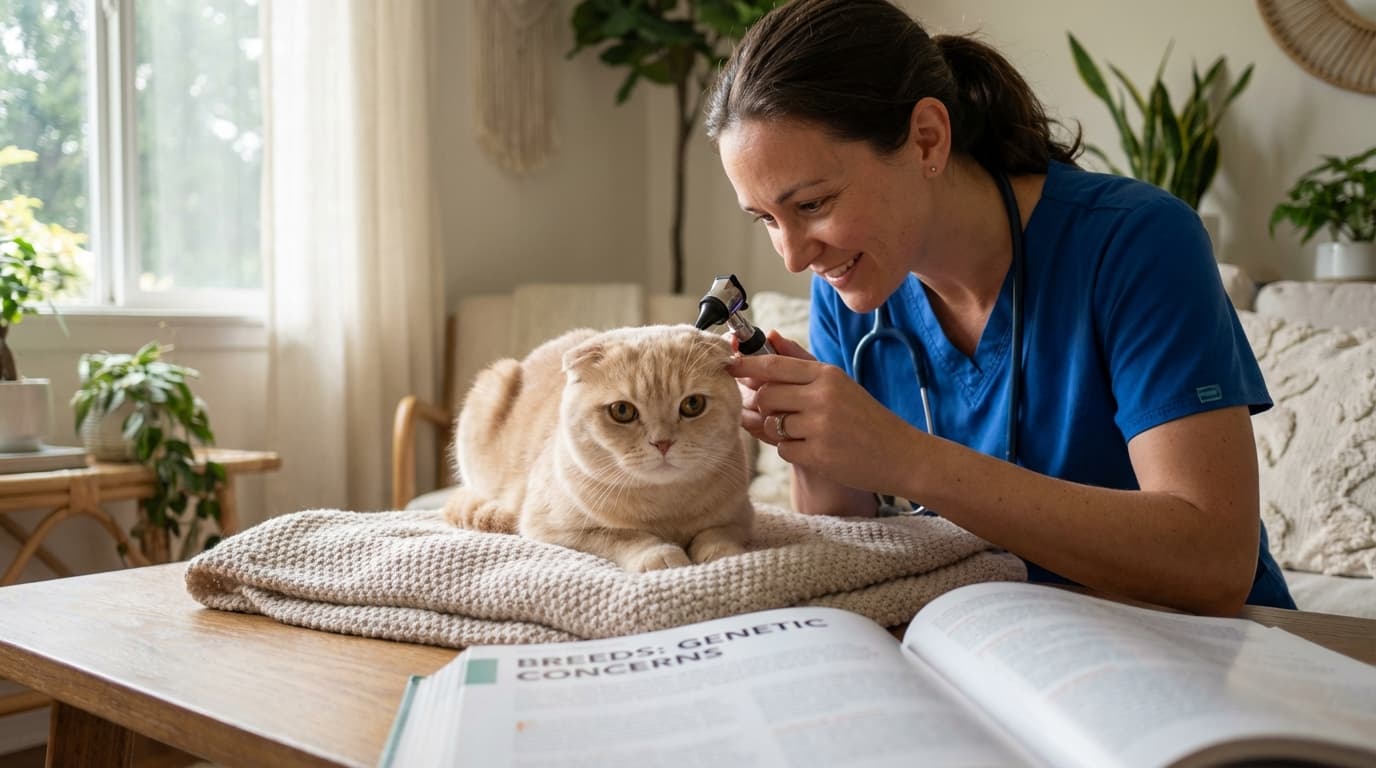
Now we have to talk about those famous ears. Because they are folded down due to a natural mutation, they do not get the same airflow as a normal cat. This makes them a magnet for wax buildup and potential infections. You should get into the habit of checking them at least once a week. Here is the thing: you have to be very gentle. You are looking for redness or a bad smell that might mean trouble. If they look a bit dirty, use a vet-approved cleaner and a soft cotton ball. Just remember that the fold is part of a bigger skeletal issue called osteochondrodysplasia, so always handle their head and ears with a light touch.
What does this mean for your daily routine? It means watching the scale. Since all Scottish Folds carry the gene for this cartilage disorder, their joints need extra support from day one. This is not just about buying fancy kibble. It is about keeping them at a healthy weight so their limbs do not have to carry extra baggage. A typical male weighs between 9 and 13 pounds, while females usually stay around 6 to 9 pounds. If they get too heavy, it puts a lot of pressure on their already sensitive bones. It is a good idea to talk to your vet about foods rich in omega-3 fatty acids to keep them moving comfortably.
It is also worth noting that because of these health concerns, some big groups like the GCCF do not actually recognize the breed. This tells you how important your role as a caretaker really is. You are not just a pet owner, you are a health manager for a cat that was born with a bit of a disadvantage. It might sound like a lot of work, but when that round little face looks up at you, most owners will tell you it is totally worth the effort. Keeping them comfortable is the best way to ensure they stay the happy, quirky companions they were meant to be.
Key insights:
- The Highland Fold and Shorthair versions both require regular brushing to manage their dense, thick coats.
- Weekly ear checks are vital because the folded shape prevents natural airflow and traps debris.
- Weight management is a priority to reduce the physical stress on joints affected by the FOCD mutation.
- A diet focused on joint health can help manage the long-term effects of the breed's unique genetic makeup.
Final Thoughts: Is a Scottish Fold Right for You?
So, does the owl cat belong in your home? It is easy to see why people fall for them. Those big, soulful eyes and folded ears create a look that is almost impossible to resist. But as we have seen, that cute fold comes from a genetic mutation called osteochondrodysplasia. It is a big word for a tough reality because the same gene that makes the ears flop also affects the cartilage in their joints. This means your charming companion might face some painful health hurdles as they get older.
If you are set on this breed, you have to be ready for the commitment. This is not just about basic grooming or feeding. It is about being a dedicated advocate for their well-being. Many major registries like the GCCF actually refuse to recognize the breed because they worry about these welfare issues. On the flip side, some groups now champion the Scottish Straight version. These cats have the same sweet personality and round faces but without the folded ears and the skeletal risks that come with them. It is often a great middle ground for many families.
Finding the right breeder is the most important step you will take. A good one will be completely open about genetic testing and won't just hide behind cute photos. They should be able to explain exactly how they manage the health of their litters. While these cats are famous for being mellow and affectionate, their lives are often complicated by their biology. At the end of the day, loving a Scottish Fold means loving them through the challenges. They are wonderful pets, but they require an owner who goes in with their eyes wide open.
Key insights:
- The folded ear is a visual sign of a systemic skeletal disorder that requires lifelong awareness.
- Scottish Straights offer the breed's famous personality without the same level of health risks.
- Ethical breeders must prioritize health testing over aesthetic traits to protect the cats.
Frequently Asked Questions
Actually, they aren't. All Scottish Fold kittens are born with perfectly straight ears, so you can't really tell them apart at first. You'll only start to see that famous fold begin to develop when they're about three or four weeks old.
It's a bit of a waiting game for breeders because not every kitten in a litter will get the fold. About half of the kittens usually end up with upright ears. These are known as Scottish Straights. Even though they don't have the owl cat look, they still have the same round face and sweet personality that people love about the breed.
This is the toughest part about the breed. Because the gene that makes their ears fold is actually a skeletal disorder, almost every Scottish Fold is affected by a condition called FOCD. This affects the cartilage throughout their whole body, not just in their ears.
While some cats might only show mild stiffness, others can develop painful arthritis or joint issues quite early in life. It's the main reason why many international cat groups won't officially recognize the breed. If you have one, keep a close eye on how they move and talk to your vet about keeping their joints healthy as they age. This is also why many people are now looking into the straight-eared Scottish Fold as a healthier alternative.
Actually, you definitely shouldn't breed two folded-ear cats together. It might seem like a way to get more kittens with that cute look, but it is really risky for their health.
The gene that makes their ears fold is the same one that affects their whole skeleton because of a condition called osteochondrodysplasia. When both parents have folded ears, the kittens are much more likely to develop painful bone and joint problems very early on. This is a big reason why some groups like the GCCF don't recognize the breed at all.
To keep things as safe as possible, responsible breeders only ever mate a folded-ear cat with a straight-eared one. This helps reduce the severity of health issues while still producing some kittens with those signature ears.
The only real difference is the length of their fur. You can think of them as the same cat but with a different hairstyle.
A standard Scottish Fold has short and dense hair. A Highland Fold is just the longhaired version of the breed. They still have the same folded ears and round faces that make them look like little owls, but they are just a bit fluffier. You might also hear them called Scottish Fold Longhairs or Couparis.
Since they are basically the same breed, their personalities and health needs are very similar. Just remember that if you pick a Highland Fold, you will need to spend more time brushing them so their long coat doesn't get tangled.
Conclusion
So, what is the bottom line on these famous owl cats? It is easy to see why everyone falls for them. Between their quiet chirps and that classic Buddha sit, they really are wonderful lap cats. But as we have seen, those folded ears come from a complex genetic story that started with one barn cat named Susie. Understanding that history helps you see the breed for what it is: a mix of incredible charm and serious health needs.
If you are thinking about bringing one home, remember that the straight-eared Scottish Fold is a fantastic option too. These cats have the same sweet personality without the same level of joint concerns. Choosing a healthy cat matters more than a specific look, and many owners find that a straight is the perfect middle ground for a happy, active pet.
Your next move should be finding a breeder who puts health tests before everything else. Ask the tough questions about their cats' joints and family history. While the Scottish Fold is a truly unique companion, they deserve owners who are ready for the responsibility. At the end of the day, a happy cat is always the cutest one in the room.
Send it to someone who should read it next.
PurrScript Editorial Team
Editorial Team
PurrScript's in-house editorial team. We research, write, and review every guide using established veterinary and behavioral resources, and update articles as best practices evolve.
View all articles