Cat Behavior: Hiding, Jumping on Counters, Hissing, and Random Biting
Cat hiding, counter jumping, hissing, and biting are not personality problems — they are outputs of medical conditions, unmet biological drives, or inadvertent reinforcement. This guide explains the mechanism behind each behavior and what actually fixes it.

Oliver Chen
Cat Rescue Advocate
Cat Behavior: Hiding, Jumping on Counters, Hissing, and Random Biting
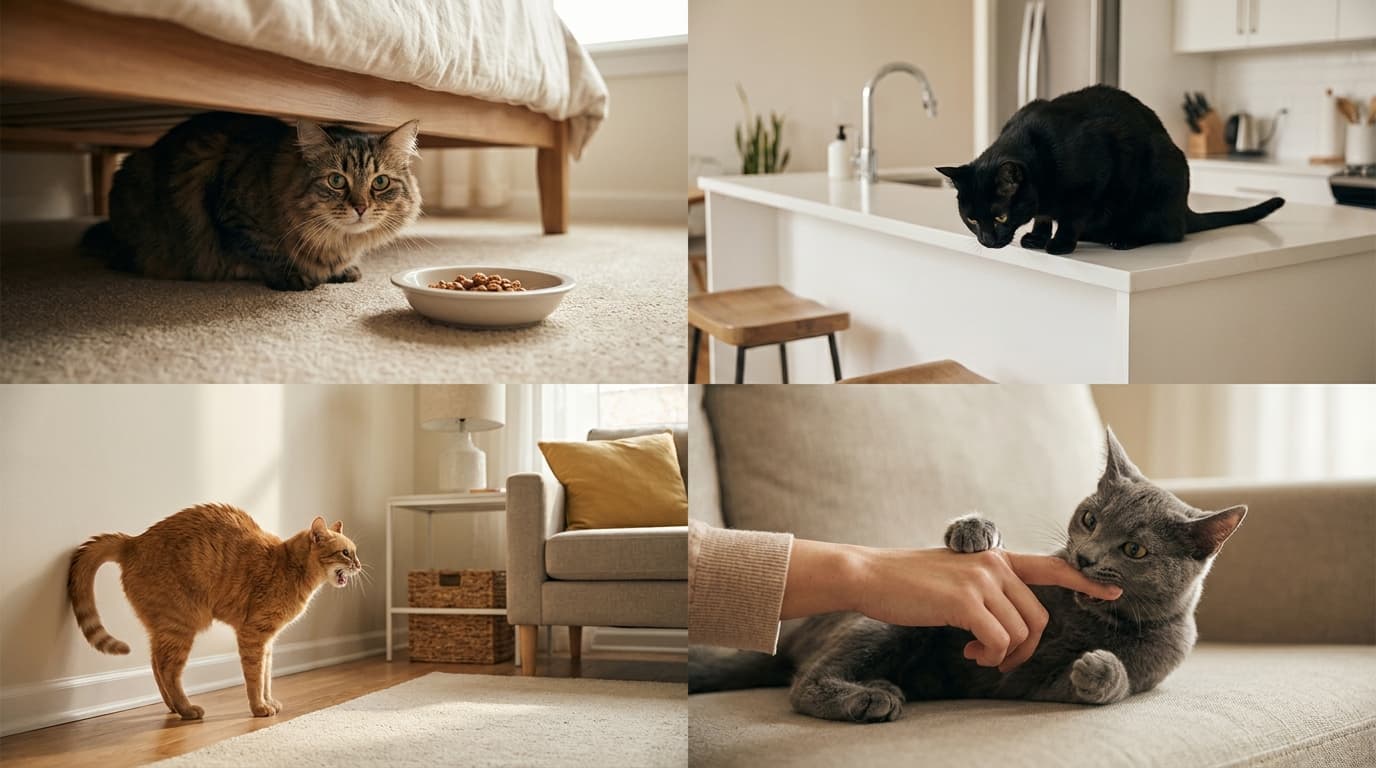
Cat behavior problems — hiding under the bed and not eating, jumping on counters repeatedly despite correction, hissing at apparently nothing, sudden biting during a calm petting session — share a common property that changes how every one of them should be approached. These behaviors are outputs of something else: a medical condition, an unmet biological need, a stress response to something in the environment, or a communication pattern that has been inadvertently reinforced. Treating the behavior directly, rather than identifying its source, is why most behavioral interventions fail.
The medical cause is the first differential to rule out for any sudden behavioral change in a cat, and this is not a precautionary recommendation — it is mechanistically grounded. Pain inhibits normal behavior and activates defensive behavior. A cat with dental disease, hyperthyroidism, or joint pain cannot be behaviorally trained out of aggression, hiding, or reactivity because those behaviors are driven by physical discomfort that training does not address. Cornell's Feline Health Center documents this connection: medical issues including dental disease, hyperthyroidism, and osteoarthritis frequently manifest first as behavioral shifts before other clinical signs appear.
This guide covers each of the major feline behavioral complaints with the specific mechanism behind the behavior, the distinction between normal expression of natural drives and behavior indicating a problem, and what interventions are actually supported by behavioral science versus which are popular but counterproductive.
One principle applies across every topic: physical punishment — spray bottles, hitting, yelling — is not simply ineffective for cats. It is actively counterproductive. It produces fear, fear produces stress, and chronic stress produces or worsens the aggression, hiding, and defensive behavior the punishment was attempting to address. The correct interventions are all oriented toward addressing the source, providing appropriate behavioral outlets, and using positive reinforcement to build the behaviors you want rather than punishing the ones you do not.
Why Is My Cat Hiding Under the Bed and Not Eating?
Hiding in cats is a behavioral response to felt physiological vulnerability, not a mood or social statement. The instinct is evolutionarily conserved: a visibly compromised animal is a target in the wild, and withdrawal to an enclosed, dark, and protected location is the appropriate behavioral response to illness, pain, or serious threat. Indoor cats retain this instinct fully despite the absence of predators in most domestic environments. When a cat hides, they are communicating that they feel unsafe — and when hiding is combined with food refusal, the most probable explanation is not environmental stress but physical illness.
The combination of hiding and appetite loss carries specific clinical urgency in cats because of hepatic lipidosis — fatty liver syndrome. When a cat stops eating, the body mobilizes fat reserves to meet caloric needs. The feline liver cannot efficiently process large volumes of mobilized fat, and lipid accumulates in hepatocytes (liver cells), impairing function. This condition can develop within 24 to 48 hours of food cessation in susceptible cats, particularly overweight individuals. A cat that has not eaten for 24 hours warrants a same-day veterinary contact. A cat that has not eaten in 48 hours requires urgent care regardless of other symptom severity.
Distinguishing stress-triggered hiding from illness-triggered hiding requires assessing the correlation with environmental context. A cat that retreats during a thunderstorm, a loud gathering, or a significant household change — new person, new animal, construction noise — and returns to normal behavior when the trigger passes is exhibiting a normal stress response to an identifiable stressor. A cat that retreats in a calm, familiar, unaltered environment with no identifiable trigger is communicating something internal rather than environmental, and physical illness is the first differential to investigate.
The physical signs accompanying hiding that indicate medical rather than stress origin: the third eyelid (nictitating membrane) visible at the inner eye corner, which appears in illness, pain, and fever; a hunched body posture with the abdomen drawn up, suggesting abdominal pain; an unkempt or flat coat indicating the cat has stopped grooming; and any abnormality in gum color. These signs do not require veterinary training to recognize, and their presence alongside hiding and food refusal should accelerate the urgency of veterinary contact.
The intervention that is never helpful for a hiding, unwell cat is forced removal from the hiding spot. The spot is providing the psychological resource the cat is using to cope with feeling vulnerable. Removing it by force adds the stress of physical handling to an animal already in distress, and the brief owner reassurance gained does not offset the harm. The productive intervention is removing barriers to veterinary assessment — noting when the cat last ate, drank, and appeared normal, and providing that specific timeline information when contacting the vet.
**Key insights:
- Contact your vet at 24 hours of food refusal — hepatic lipidosis begins to develop in this window, and early intervention is dramatically more effective than late.
- Distinguish context-correlated hiding (identifiable stressor, returns to normal after) from unprompted hiding (calm environment, no obvious trigger) — the latter requires medical assessment.
- Look for third eyelid visibility, hunched posture, or unkempt coat alongside hiding — these physical signs indicate systemic illness rather than behavioral stress response.
- Never forcibly remove a hiding, unwell cat — the hiding spot is a coping resource, and forced removal adds stress to an animal already in physiological distress.
- Provide the vet with a specific timeline — when the cat last ate normally, when behavior changed — rather than a general impression; specific durations affect urgency assessment.
Distinguishing Stress-Triggered Hiding From Illness-Triggered Hiding
The diagnostic distinction that changes the response is whether the hiding has an identifiable environmental correlation. Stress-triggered hiding follows a recognizable pattern: onset coincides with a specific environmental change or event, the cat returns to normal territory and behavior when the event passes or the stressor is removed, and other behavioral indicators (appetite, litter box use, grooming) remain essentially normal during the hiding period. The cat's response is proportionate and specific.
Illness-triggered hiding does not follow this pattern. It may begin without any obvious environmental trigger, it persists after any apparent stressor has passed, and it is accompanied by the deterioration of other behavioral systems — appetite, grooming, litter box use, social engagement. The critical assessment question is: is anything else different? A hiding cat that is eating, using the litter box, and grooming normally in all other respects is likely managing a stress response. A hiding cat that has stopped doing several normal things simultaneously is likely managing physical illness.
**Key insights:
- Assess the full behavioral picture, not just the hiding — appetite, litter box use, and grooming changes alongside hiding point toward illness rather than stress.
- Identify whether a specific environmental trigger preceded the hiding and whether the behavior resolves when the trigger passes — correlation confirms stress origin.
- Contact your vet when hiding occurs without an identifiable trigger in an otherwise calm, familiar environment.
How to Stop Your Cat From Jumping on Counters
Counter jumping in cats serves multiple simultaneous functions that explain why verbal correction and shooing are ineffective long-term strategies. Elevated surfaces provide territorial surveillance — height allows a cat to monitor the environment from a position where they cannot be approached from above. Kitchen counters specifically combine elevation with olfactory stimulation from food preparation, making them the highest-value surfaces in the home by two distinct criteria simultaneously. The cat is not being defiant when they jump on the counter immediately after being removed. They are responding to a persistent biological drive for the resources that surface provides.
Scent gland activity in the paws adds a territorial marking dimension to counter use. Cats have interdigital scent glands between the toes that deposit chemical signals when walking or kneading on a surface. Counter walking is not just exploration — it is a territorial marking behavior that leaves a chemical signature the cat can detect on subsequent visits, reinforcing the surface as claimed territory. Removing the cat without providing an alternative territorial surface to mark does not reduce the territorial drive; it simply redirects it toward the next available high surface.
The intervention that works reliably combines two elements: making the counter less rewarding and providing a better alternative in the same general area. Double-sided tape or commercially available sticky mats on the counter surface create a tactile aversion — cats strongly dislike the sensation of sticky material on their paws. This is a passive aversive that does not require owner presence and does not produce fear-based aggression. Simultaneously, a cat tree or wall-mounted shelf positioned near or adjacent to the counter provides an elevated, appropriate alternative that satisfies the height and territory drives without requiring counter access. The cat does not stop wanting to be high; they simply have a better option available.
Food odor elimination is a supporting intervention for kitchen counters specifically. Cats respond to olfactory cues at concentrations far below human detection thresholds. A counter that has been wiped clean by human standards may still carry detectable food odors to a cat. Enzymatic cleaners that break down organic compounds rather than simply masking them are more effective at reducing the olfactory draw to the counter than standard household cleaners. Removing the smell-based reward reduces one of the two primary drivers of counter use.
**Key insights:
- Apply double-sided tape or sticky mats to counter surfaces — this creates a passive tactile aversion that works without owner presence and does not produce fear.
- Position a cat tree or wall-mounted shelf adjacent to the counter as a simultaneous alternative — the cat needs a better elevation option in the same location, not just a denied one.
- Use enzymatic cleaners on counter surfaces to eliminate food odors at the molecular level — standard cleaning leaves detectable residue at feline olfactory thresholds.
- Never use spray bottles or physical deterrents — they require owner presence to function and produce fear-based stress that increases other behavioral problems.
- Reward counter tree or shelf use specifically with high-value treats when observed — positive reinforcement for the appropriate behavior accelerates the transition faster than aversion alone.
Why Does My Cat Hiss at Nothing?
A cat hissing at an apparently empty space is almost certainly responding to a genuine stimulus that is below human sensory threshold. Cats hear frequencies up to approximately 64,000 Hz — the human upper limit is around 20,000 Hz. Ultrasonic sounds from pest control devices, high-frequency electronic equipment, pipes, and small animals within walls are all audible to cats and inaudible to humans. Cats also have an olfactory sensitivity roughly 14 times greater than human capacity, detecting chemical signals — the scent of another animal on a visitor's clothing, an outdoor animal that passed near a window, territorial pheromones from a neighboring cat — that are completely undetectable to the human nose. The empty corner is not empty to the cat.
When hissing is the response, the cat is communicating that the stimulus is threatening or overwhelming rather than merely interesting. Hissing is defensive communication — it is a warning signal addressed to a perceived threat, not an aggressive signal directed at the owner. The appropriate response from an owner is to give the cat space to decompress rather than attempting to comfort or correct. Physical contact with a cat in a defensive hissing state often triggers redirected aggression — the cat's arousal is high, their defensive threshold is low, and an approaching hand is more likely to be bitten than comforting. Moving away and allowing the cat to reorient once the stimulus passes is both safer and more behaviorally appropriate.
Sudden-onset or escalating hissing that does not correlate with identifiable environmental stimuli — particularly when accompanied by other behavioral changes like increased reactivity to touch, hiding, or changes in eating — warrants veterinary assessment. Pain-driven aggression and reactivity in cats frequently presents as hissing at apparently random times and locations because the stimulus is internal (pain) rather than external. Hyperthyroidism produces central nervous system hyperarousal that manifests as heightened reactivity and lower defensive thresholds. Dental disease produces chronic pain that sensitizes the cat to any approach. Cornell's Feline Health Center documents this connection between undiagnosed medical conditions and apparently unprovoked aggression.
The investigation protocol when hissing is new or escalating: first, scan for environmental triggers that might be below human perception — check for new electronic devices, pest control equipment, animals entering the garden, changes in neighboring units. Second, assess whether other behavioral changes are present that suggest systemic illness. Third, if no environmental correlation is identified and other behavioral changes are present, prioritize veterinary assessment over behavioral management.
**Key insights:
- Never approach or attempt to physically comfort a hissing cat — the defensive arousal state makes physical contact a bite risk, and space is the appropriate response.
- Check for ultrasonic sources (pest control devices, electronic equipment) and olfactory triggers (visitors with pet-owning contact, outdoor animals near entry points) before assuming the hissing is unprovoked.
- Distinguish occasional hissing at specific stimuli from escalating, frequent hissing without obvious correlation — the latter warrants veterinary assessment for pain-driven reactivity.
- Never punish hissing — it is defensive communication, and punishment of defensive behavior produces more defensive behavior.
- Schedule a vet visit for hissing onset that coincides with other behavioral changes — pain and hyperthyroidism both present as increased reactivity before other clinical signs appear.
Managing Aggressive Play and Random Biting
Biting that occurs during play — the ankle ambush, the heel pounce, the hand grab during what seemed like a calm interaction — has a different origin from biting that occurs during petting, and distinguishing them is important because the interventions are different. Play aggression is driven by undischarged predatory drive: the cat has not had adequate outlet for the stalk-chase-catch sequence that their biology requires, and moving limbs become the most available prey-sized target. Petting-induced aggression (sometimes called overstimulation biting) is driven by tactile overstimulation: continued physical contact past the cat's tolerance threshold produces a defensive bite response that is neurologically distinct from predatory behavior.
Play aggression responds to two interventions simultaneously: increasing the outlet for predatory behavior through scheduled interactive play sessions, and consistently not responding to the biting in ways that register as prey behavior. Freeze rather than pulling away when bitten — fast withdrawal mimics fleeing prey and escalates the bite response. Then immediately redirect to a wand toy or kicker. Two 15-minute interactive play sessions daily, with a wand toy moved in genuinely unpredictable prey-mimicking patterns, reduces the predatory pressure that produces play aggression. A cat that has had an adequate predatory outlet does not need to create one from available ankle targets.
Petting-induced aggression requires learning to read the pre-bite warning signals that cats reliably produce before biting. The sequence is consistent: tail movement accelerates from slow swinging to active flicking, then to rapid lashing; ears begin rotating backward; skin along the dorsal surface (back) may ripple slightly; the body stiffens. These signals precede the bite by seconds to minutes, and the cat is producing them continuously during a petting session that is approaching their tolerance threshold. The intervention is to stop petting when these signals begin — well before the bite — and allow the cat to move away if they choose. Cats whose signals are consistently respected gradually extend their petting tolerance because the interaction becomes safe and predictable rather than ending in a defensive response.
The medical differential for sudden-onset biting in a cat with no prior history is pain. A cat that has been comfortably handled for years and begins biting when touched in a specific area — the lower back, the hips, a particular flank — is very likely communicating pain at that location. Osteoarthritis, dental pain, and neuropathic conditions all produce localized sensitivity that the cat communicates through defensive biting when the area is contacted. Cornell's Feline Health Center documents that aggression is among the most common behavioral presentations of undiagnosed medical conditions in cats. Sudden behavioral onset in a previously reliable cat warrants medical assessment before behavioral management.
**Key insights:
- Freeze completely when bitten rather than pulling away — movement mimics prey and escalates the bite; stillness removes the predatory stimulus.
- Learn the pre-bite signal sequence — tail flicking, ear rotation, skin rippling — and stop petting when they begin, well before any bite occurs.
- Schedule two 15-minute interactive play sessions daily to discharge predatory drive — consistent outlet reduces play aggression more reliably than any correction.
- Never use hands or feet as play objects at any age or duration — habits established with a small kitten persist at adult bite force.
- Seek veterinary assessment for sudden-onset biting in a previously non-aggressive cat, particularly if biting is localized to touch in a specific body area — pain is the most common undiagnosed driver.
Petting-Induced Aggression: Why Cats Bite During Calm Interactions
Overstimulation biting during petting is the most frequently misunderstood feline behavior for a specific reason: it often occurs while the cat is still purring. Owners interpret purring as a reliable contentment indicator and are confused when the cat bites mid-purr. Purring in cats is not exclusively a happiness signal — it is also produced during stress, anxiety, and as a self-soothing behavior during discomfort. A cat that is purring during petting is not necessarily in a uniform positive state throughout the interaction.
The neurological mechanism behind petting-induced aggression is sensory threshold overload. Repeated tactile stimulation activates sensory neurons that become progressively more sensitized over the course of an interaction. Below the threshold, repeated stimulation feels good. Above it, the same touch pattern becomes irritating or aversive, activating the defensive system. The cat does not decide to bite — the bite is a reflex response to crossed sensory threshold. The pre-bite signals are the cat's attempt to communicate approaching threshold before the defensive system activates.
**Key insights:
- Do not use purring as the sole indicator of petting tolerance — cats purr during stress and discomfort as well as contentment.
- End petting sessions deliberately and early, before threshold signs appear — a session that ends without defensive response builds tolerance over time.
- Allow the cat to reinitiate contact after a break — a cat that returns for more contact is indicating readiness; a cat that walks away should not be followed.
When Behavior Becomes a Medical Emergency
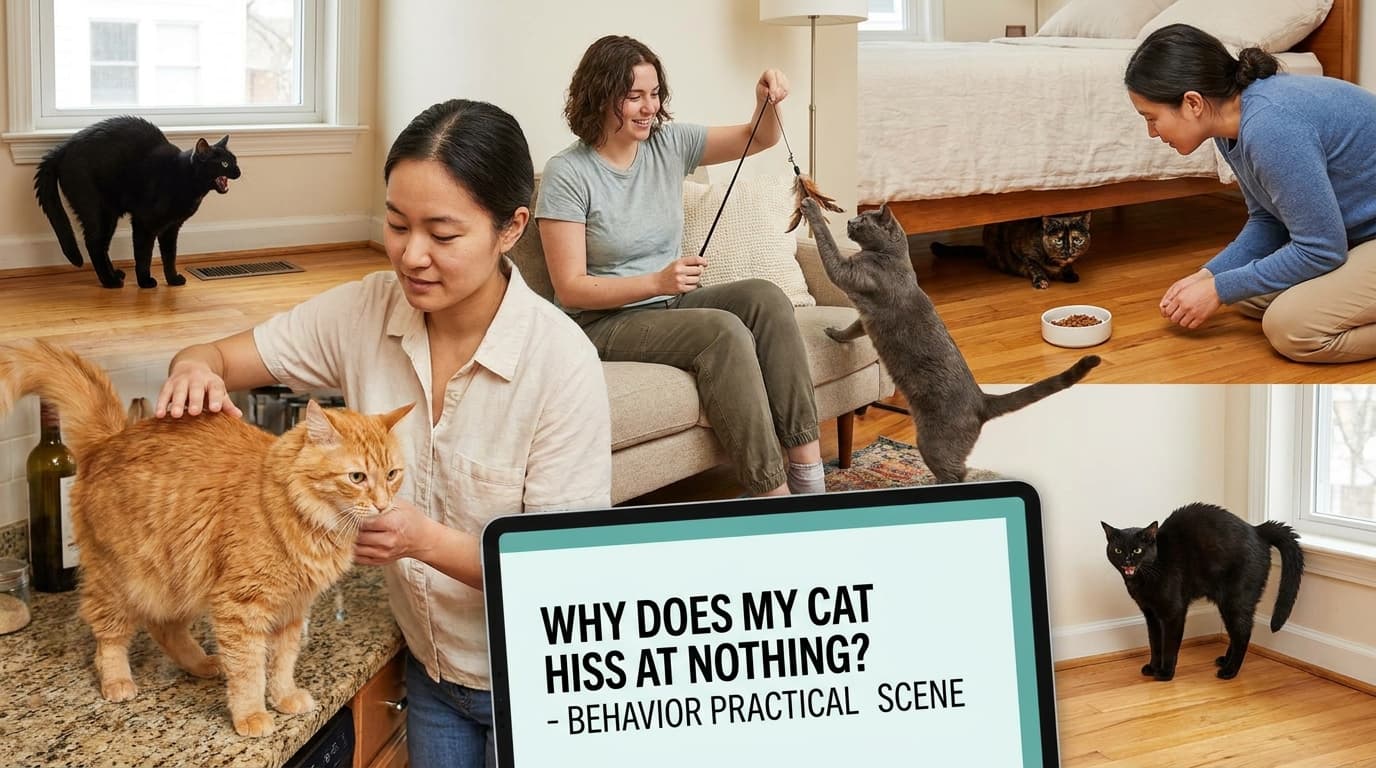
Behavioral change is frequently the first observable indicator of systemic illness in cats, preceding other clinical signs by days to weeks. This is a direct consequence of the same evolutionary concealment mechanism that makes cats effective prey — masking vulnerability is biologically prioritized over expressing it, and behavioral changes are less obvious to a casual observer than physical ones. The behavioral presentations that most reliably precede or accompany medical conditions are: sudden-onset aggression in a previously non-aggressive cat; hiding in a previously social cat without an identifiable environmental trigger; dramatic reduction in activity level or grooming; changes in vocalization pattern including new or different vocalizations; and changes in litter box behavior.
The three conditions most commonly producing behavioral change before other clinical signs are hyperthyroidism, dental disease, and osteoarthritis. Hyperthyroidism — the most prevalent endocrine disorder in cats over 8 years old — produces central nervous system hyperarousal as thyroid hormone levels rise. The behavioral presentation includes increased vocalization, restlessness, reduced tolerance for handling, and apparent irritability or reactivity that owners may attribute to personality change. Dental disease produces chronic oral pain that sensitizes the cat to any facial approach and produces food-related behavioral changes (feeding reluctance, food dropping, one-sided chewing) that are frequently attributed to pickiness. Osteoarthritis produces joint pain that manifests as reduced jumping, avoidance of previously accessed elevations, changes in grooming (particularly of hard-to-reach areas), and defensive aggression when painful areas are contacted.
The specific behavioral pattern that most reliably signals a medical rather than behavioral origin for any of these presentations is sudden onset in a previously consistent cat. A cat that has been reliably social and non-aggressive for years and develops sudden reactivity has not had a personality change — personality does not change suddenly in adult cats. Something has changed in the cat's internal experience of their environment, and pain or systemic illness is the most parsimonious explanation. This principle is worth internalizing because it is what drives the correct first step (veterinary assessment) rather than the incorrect first step (behavioral management).
A practical tool for veterinary appointments when behavioral change is the primary complaint: keep a behavior log noting when the behavior occurs, in what contexts, what the cat does specifically, and what happened immediately before. Veterinarians can assess behavioral presentations more accurately when provided with specific observational data rather than general impressions. Note the specific location of any defensive biting or aggression, as localized sensitivity is the most direct behavioral indicator of pain at a specific anatomical site.
**Key insights:
- Treat sudden-onset behavioral change in a previously consistent cat as a medical presentation requiring veterinary assessment, not a training problem.
- Schedule a senior blood panel for any cat over 8 with behavioral changes — hyperthyroidism, kidney disease, and diabetes all present behaviorally before obvious physical signs.
- Keep a behavior log with specific details — timing, context, preceding events, exact behaviors — to provide actionable data at the veterinary appointment.
- Note whether aggression or defensiveness is localized to touch in a specific body area — localized sensitivity is the most direct behavioral indicator of pain at that site.
- Never use physical punishment for behavior that may be pain-driven — punishment of a cat in pain is both inhumane and counterproductive, amplifying the defensive response it attempts to address.
Building a Home Environment That Prevents Most Behavioral Problems
The majority of feline behavioral problems that owners encounter — counter jumping, play aggression, destructive scratching, attention-seeking vocalization — are not primarily training failures. They are environmental failures: the home does not provide adequate outlets for the behavioral drives that are biological constants in domestic cats. Cats require vertical territory for security and surveillance, scratching surfaces for claw maintenance and territorial marking, foraging opportunities that engage the predatory sequence, and hiding options that provide felt safety. When these are absent or inadequate, the drives find expression through whatever behavioral channels are available — the counter, the furniture, the ankles, the owner.
The audit that prevents the most behavioral problems: identify whether the home contains at minimum one floor-to-ceiling or close-to-ceiling vertical space with a window view, at least one dedicated scratching surface in a socially significant location (near where the cat spends most time, not in a distant room), at least one fully enclosed hiding option in each main room, and a feeding arrangement that requires some active engagement rather than passive bowl eating. These four elements collectively address the most common environmental deficits that produce behavioral complaints.
Positive reinforcement is the only behavior modification tool that builds lasting behavioral change in cats. Cats do not respond to correction-based training in the way dogs do — they lack the social motivation to modify behavior to maintain owner approval, and they experience punishment as a threat that activates the defensive behavioral system. What they do respond to is reinforcement of alternatives: the cat that receives a high-value treat specifically when using the cat tree rather than the counter learns that the cat tree produces good outcomes. The behavior you reinforce is the behavior you get more of, and this principle is more reliable than any aversive applied to the behavior you want less of.
**Key insights:
- Audit the home for the four environmental requirements: vertical territory with a window view, dedicated scratching surfaces in high-use locations, enclosed hiding options in main rooms, and active feeding.
- Apply positive reinforcement specifically when the cat uses appropriate alternatives — the treat on the cat tree trains the cat tree choice; nothing trains the counter non-choice.
- Never use punishment-based tools including spray bottles, compressed air, or physical deterrents — these increase stress and defensive behavior without changing the underlying drive.
- Address medical causes before environmental or behavioral causes for any sudden behavioral change — behavioral management does not work for pain-driven behavior.
- Build enrichment into a brief daily routine rather than treating it as occasional maintenance — consistent five-minute daily adjustments prevent the habituation that makes single interventions fail.
Frequently Asked Questions
Conclusion
The framework that resolves most feline behavioral confusion is the same one that applies across all the specific behaviors in this guide: behavior is output, and the correct intervention targets the input. A cat hiding and not eating is communicating physical vulnerability — the intervention is veterinary assessment, not behavioral management. A cat jumping on counters is expressing a territorial drive for elevation — the intervention is a better elevated alternative, not correction. A cat biting during petting is communicating sensory threshold — the intervention is earlier session termination and signal reading, not punishment. A cat hissing at apparently nothing is responding to a genuine sub-threshold stimulus or pain — the intervention is space and investigation, not scolding.
The consistent errors that prolong behavioral problems are applying behavioral solutions to medical problems (pain-driven aggression does not respond to training), and applying punishment-based tools to any feline behavioral problem (punishment produces fear, fear produces stress, stress worsens every behavioral problem covered in this guide). Neither error is made from bad intent — they are made from frameworks that work for some other species but do not translate to feline behavioral biology.
One practical step from each section: if your cat is hiding and not eating, call your vet today rather than waiting to see if it resolves. If your cat jumps on counters, place double-sided tape on the surfaces and a cat tree adjacent to them this week. If your cat bites during petting, start a session today with the intention of ending it before any pre-bite signals appear. If your cat hisses at nothing, check for ultrasonic devices in the home before assuming behavioral origin. Each of these takes minutes and produces better outcomes than the alternatives.

Send it to someone who should read it next.
About the author

Oliver Chen
Cat Rescue Advocate
Founder of a no-kill rescue shelter and passionate advocate for feline welfare and responsible cat adoption.
View all articles