From Bonded Pairs to Working Cats: Finding Your Way Through the Modern Adoption Maze
Ever wonder why some cats love a lap while others prefer the stars? The way we talk about rescue has shifted from simple labels to a modern adoption maze that...

PurrScript Editorial Team
Editorial Team
From Bonded Pairs to Working Cats: Finding Your Way Through the Modern Adoption Maze
Ever wonder why some cats love a lap while others prefer the stars? The way we talk about rescue has shifted from simple labels to a modern adoption maze that can feel a bit overwhelming if you are just starting out. It is no longer just about picking a kitten from a box because today we use specific terms to make sure every cat finds the right spot to thrive.
Whether you are looking at a kitten or a senior, you will hear phrases like community cat or TNR explained at almost every shelter. Knowing the difference between feral vs. stray vs. community cat is the first step to becoming a great advocate for your local felines. We also need to talk about adoption: what is a bonded pair, the real special needs cat meaning, and why FIV positive cat adoption is not nearly as scary as the old myths suggest.
This article clears up the confusion so you can adopt with total confidence and find your perfect match. You will see how working cat programs give outdoor kitties a job and why keeping certain pairs together is better for their mental health. From the critical socialization window to the rise of no-kill communities, we will show you how these programs are saving more lives than ever before.
Deciphering the Labels: Feral, Stray, or Community Cat?
Ever found yourself staring at a cat in your yard and wondering if they are a lost pet or a wild spirit? We used to use words like nuisance to describe these outdoor residents, but things are changing for the better. Today, we use the term community cat as a big, friendly umbrella. It covers any unowned member of the Felis catus species living their life outdoors, from the shyest feral to the friendly neighborhood stray. This shift in language is about recognizing these cats as valued neighbors who belong in our ecosystem. Programs like TNVR, which stands for Trap-Neuter-Vaccinate-Return, help us keep them healthy in their familiar territories. By humanely trapping and fixing them, we support a community where every cat has a place. But how do you know if a cat needs a couch or just a bowl of kibble and some personal space? The answer lies in their behavior. While some might be happy in a home, others find their purpose in working cat programs at barns or warehouses where they can be themselves while staying safe. Understanding these labels determines a cat's entire path.
The 7-Week Window: Why Socialization is a Race Against Time. When it comes to making friends with cats, there is a ticking clock. For feral kittens, the magic window for socialization usually starts to close around seven weeks. Before this point, they are like little sponges that can learn to trust humans. Once they pass that mark without human touch, their wild instincts take the lead. This is why many older feral cats prefer the stars over a ceiling. To them, a house feels more like a cage than a home. Experts look at the Socialization Continuum to figure out where a cat falls on the scale. It is not a fixed state, but it helps us understand that for some cats, the kindest thing we can do is let them stay wild and free with a little help from the sidelines. Forcing a truly feral adult cat into a traditional home can be incredibly stressful for everyone involved.
Stray vs. Feral: Can a Lost Pet Go Wild? A stray cat is a pet that lost its way or was abandoned. They have a history with people, but those social skills are often use it or lose it. Without regular human contact, a stray cat can start acting quite wild over time. The good news is that most strays can find their way back to being a lap cat with enough time and patience. You just have to look for the subtle clues in their body language. A scared stray might eventually make eye contact or come forward for the sound of a food bowl, while a truly feral cat will stay crouched and vanish if you get too close. Identifying these differences is the best way to act in their interest. Whether they need a warm bed or just a safe outdoor territory, understanding their level of socialization helps you make the right call for their well-being.
Key insights:
- The term community cat shifts the focus from being a nuisance to being a valued member of the neighborhood.
- Socialization is a fluid continuum where strays can become more feral without human contact, and vice versa.
- The seven-week mark is the critical developmental cutoff for easily socializing feral kittens to humans.
- Working cat programs provide a safe alternative for healthy cats that are not suited for traditional indoor adoption.
The 7-Week Window: Why Socialization is a Race Against Time
Ever wonder why some kittens purr instantly while others hiss like tiny dragons? It comes down to a fast-moving clock. For feral kittens, the window for bonding with humans starts closing around 7 weeks old. Before that, they are sponges for love. After? Wild instincts take over. Their brains start seeing humans as predators if they haven't been handled by then.
This is the Socialization Continuum in action. It is not a simple yes or no switch. A stray cat might have loved people once but became wary after living alone, while a truly feral cat has never known a home. For them, a ceiling feels like a cage. They often prefer the stars and the freedom of their outdoor colony.
If a cat isn't the cuddly type, TNVR or working cat programs offer a great alternative. It is about meeting the cat where they are. Whether they are a lap cat or a backyard guardian, this timeline helps us give them the life they actually want.
Key insights:
- Socialization is a fluid scale where strays can become feral without human contact.
- The 7-week mark is a major turning point for a kitten's ability to trust people.
- Outdoor community cats often find more comfort in familiar territories than indoor homes.
Stray vs. Feral: Can a Lost Pet Go 'Wild'?
Imagine a cat hanging around your back porch. Is it a lost pet or a wild animal? There is actually a big difference between the two. A stray cat is a former pet that got lost or abandoned. They once knew humans, but as time passes without a warm lap to curl up in, their social skills start to fade. They might look scruffy, but they usually still remember what a can opener sounds like.
Feral cats are different because they have never really had a bond with people. While a stray might eventually let you pet them after a few weeks of consistent snacks, a truly feral cat prefers to keep their distance. If a kitten is not socialized by about seven weeks old, they are much more likely to stay wild for life. You can often tell the difference by watching their body language. A scared stray might eventually make eye contact or meow at you, whereas a feral cat will likely stay silent and stay low to the ground to avoid being seen.
The interesting part is that socialization is a fluid scale, not a fixed state. A stray cat can often make the journey back to being a house-cat with enough patience and love. For those who are simply not meant for indoor life, programs like TNVR or working cat placements in barns and warehouses give them a safe way to live on their own terms. It is all about figuring out what each individual cat needs to thrive.
Key insights:
- Stray cats are former pets whose social skills dwindle the longer they live without human contact.
- True feral cats are generally those not socialized to humans within the first seven weeks of life.
- Body language is the best clue; strays may eventually seek connection, while ferals prioritize staying hidden.
TNR and the Art of Living and Letting Live
Have you ever seen a cat dart under a parked car or lounge on a sun-baked fence and wondered if they needed rescue? Most of the time, these are community cats - a friendly term used to describe our unowned, outdoor neighbors. Instead of viewing them as a nuisance, many animal lovers now see them as valued members of the neighborhood. The most effective way to care for them is through Trap-Neuter-Return, or TNR. This process involves humanely trapping the cats, getting them spayed or neutered, and then - this is the vital part - bringing them back to their original territory. It's a compassionate way to keep the population in check while letting cats live their lives.
The reality is that the "Return" part of the acronym is what actually saves lives. To understand why, we have to look at the difference between a stray and a feral cat. A stray was once someone’s pet but lost their home, while a feral cat has had little to no human contact. Facts show that if a cat isn't socialized by the time they are 7 weeks old, the window for them to become a typical house pet mostly closes. Because feral cats aren't the "cuddly" type, they historically faced high euthanasia rates in shelters. TNR changes the math. By returning healthy cats to their outdoor homes, we support the No-Kill movement and ensure these cats aren't losing their lives just because they aren't house-trained.
But what happens if a cat’s original home isn't safe? That is where working cat programs come in. Think of it as a career change for cats that can't be adopted into traditional homes. These cats are placed in "jobs" at barns, warehouses, or even breweries. They get a safe environment and a steady food bowl, while the business gets natural pest control. It is a practical, life-saving alternative that respects a cat's wilder nature while giving them a purpose and a home that fits their personality.
Lately, you might have noticed the acronym growing into TNVR. So, what is the "V" for? It stands for "Vaccinate," and it is a massive win for both cats and humans. Adding vaccinations to the routine turns a group of random cats into a managed colony. By giving these cats basic shots, especially for rabies, we create a protective barrier for the whole neighborhood. This shift is about more than just stopping more kittens from being born; it is about making sure the cats already living among us are healthy. It is a simple step that provides huge public health benefits and makes the entire community a safer place for everyone who lives there.
Key insights:
- Socialization is a fluid spectrum; while stray cats can become feral without human contact, they can often be socialized again under the right circumstances.
- The term "community cat" is intentionally used by organizations to shift public perception from seeing outdoor cats as a problem to seeing them as valued residents.
- Working cat programs provide a vital safety net for healthy cats that cannot return to their original territory but aren't suited for indoor life.
Wait, What’s the 'V' For? The Rise of TNVR
You’ve likely heard of TNR, but have you noticed the 'V' popping up lately? TNVR stands for Trap-Neuter-Vaccinate-Return. It’s a simple addition that changes the game for community cats - the unowned felines living outdoors. By including vaccinations, we do more than just stop the cycle of unwanted litters. We create a health shield for the entire colony.
This matters because it shifts how we see these cats. Instead of being viewed as pests, they become managed, healthy neighbors. Vaccinating them against rabies is a massive win for public health and helps keep local pets safe too. It is a key part of the push for no-kill communities, ensuring healthy outdoor cats stay in their homes instead of facing euthanasia. It is a win for everyone.
Key insights:
- TNVR includes essential vaccinations like rabies to protect both the cats and the surrounding human community.
- The shift toward TNVR supports no-kill initiatives by keeping healthy outdoor cats out of the shelter system.
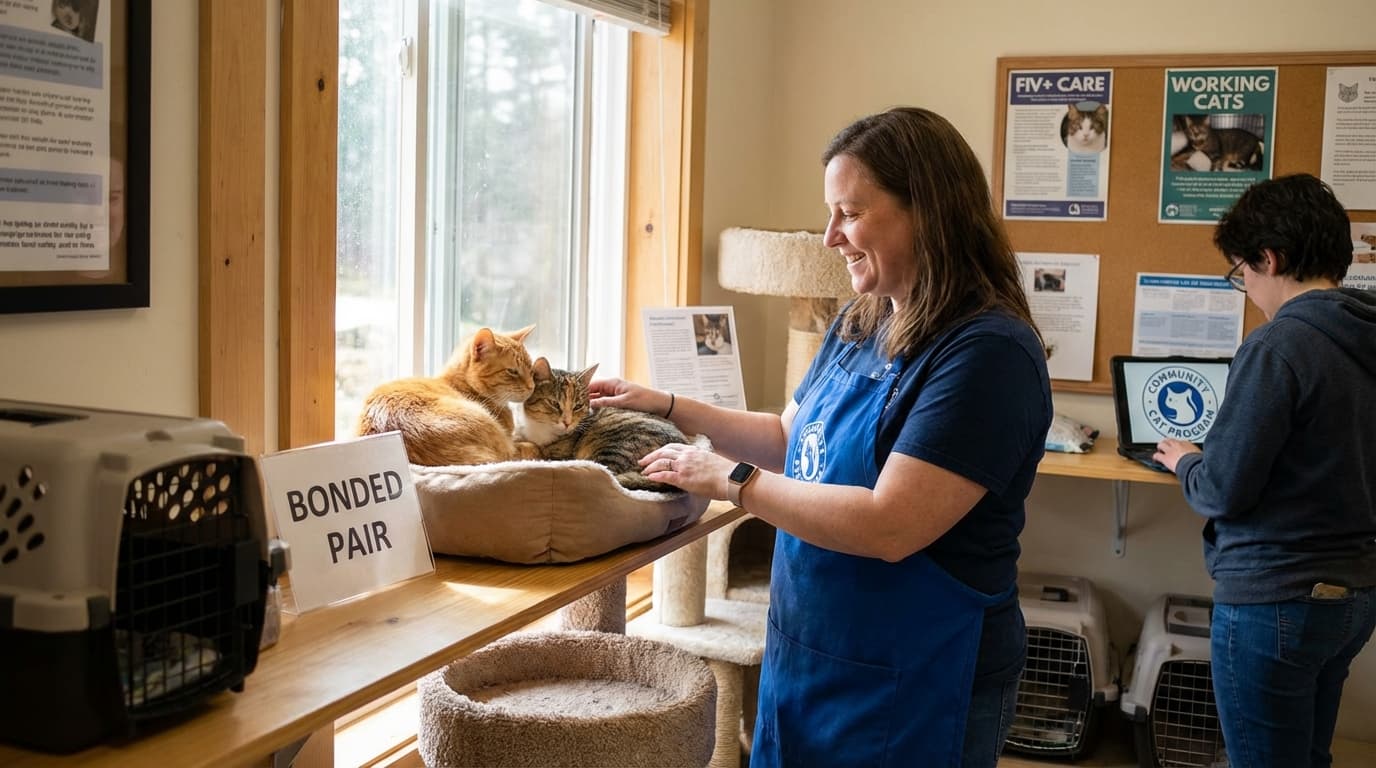
Two is Better Than One? The Truth About Bonded Pairs
Ever walked into a shelter and seen a sign that says "Must be adopted together"? It feels a bit like a sales pitch. You came for one cat, and suddenly you are looking at double the food bills. But here is the thing: for some cats, that bond is a literal lifeline. A true bonded pair is not just two cats who happen to share a sunbeam. It is a deep connection where their sense of safety is tied to the other's presence. When we talk about these pairs, we are looking at animals that have often survived tough situations together, whether that was on the streets or in a crowded hoarding house.
You might wonder if this is just a tactic to get more cats out the door. Some adopters definitely feel that way. But the reality is that separating cats who rely on each other can take a massive psychological toll. We are talking about cats that stop eating, develop behavioral issues, or sink into a deep depression when their partner vanishes. It is a biological need for stability. While some rescues might pair up kittens to help them socialize, a genuine adult bond is something you can see in the way they groom each other and look for one another before they even think about eating.
The interesting part is that two cats are often much easier to care for than one. It sounds counterintuitive, but it is true. Instead of you being the sole source of entertainment and exercise, they have a built-in playmate. This means less boredom-induced scratching on your sofa and fewer 3 AM wake-up calls. They also help each other adjust to a new home way faster. When everything else is strange and smells weird, having their best friend there makes the transition feel safe rather than scary. It turns a terrifying move into a shared adventure.
Think about the socialization continuum. A stray cat that lost its home might be terrified in a shelter, but having a buddy helps them stay brave enough to interact with you. Even for community cats, those unowned cats living outdoors, having a partner can be the difference between thriving and just surviving. If a rescue says a pair is bonded, they are usually trying to protect the cats from the trauma of starting over alone. It is about setting you, and them, up for a much happier life together from day one.
Key insights:
- A true bond is a biological necessity for some cats, not just a preference or a marketing trick.
- Adopting two cats can actually reduce behavioral problems like destructive scratching because they entertain each other.
- Bonded pairs provide an emotional safety net that speeds up the adjustment period in a new environment.
When One Plus One Equals a Happier Home
Ever thought about bringing home two cats instead of one? It sounds like double the trouble, but it is actually a secret shortcut to a peaceful house. When you adopt a bonded pair, they arrive with a built-in support system. This matters because moving into a new home is scary for any cat, especially strays who might have lost their previous families and need a familiar face to feel safe.
While some adopters worry that the 'bonded pair' label is just a tactic to boost adoption numbers, the reality is much sweeter. These cats rely on each other for confidence. Instead of hiding under your couch for a week, they lean on their buddy to explore. They also keep each other entertained, which means fewer 3:00 AM zoomies for you to manage alone.
Think of it as a buy-one-get-one-free deal on feline friendship and your own sanity. You get to skip the stressful introductions and dive straight into the fun part of pet ownership. Why settle for one lonely kitty when you can start with a happy, pre-made family that already knows how to get along?
Key insights:
- Bonded pairs provide immediate emotional security in new environments.
- Two cats can be lower maintenance because they provide each other with social stimulation and exercise.
- Adopting a pair helps socialized stray cats regain their confidence faster than being alone.
Redefining 'Special Needs': Why FIV Isn't a Dealbreaker
Seeing a special needs tag on a shelter cage can feel like a warning sign. It is easy to assume you are signing up for massive vet bills or a complicated medical routine that will take over your life. But here is the secret: in a shelter setting, special needs is a catch-all term that often covers very manageable situations. It might mean a cat needs a grain-free diet, a daily pill for allergies, or simply has a condition like FIV that requires a little extra awareness. It is less about a disability and more about a specific lifestyle requirement that most owners can handle without breaking a sweat.
FIV, or Feline Immunodeficiency Virus, is perhaps the most misunderstood label in the rescue world. For decades, it was spoken about in hushed, scary tones as cat AIDS, leading people to believe these cats were constantly sick or highly contagious. We know better now. An FIV positive diagnosis is not a death sentence or even a sign of poor health. Most of these cats live long, vibrant lives, purring on laps and chasing laser pointers just like any other feline. The virus moves slowly, and with a stable home, many cats never even show significant symptoms throughout their entire lives.
One of the biggest hurdles for adopters is the mixed household question. Can an FIV positive cat live with negative cats? Absolutely. The virus is not spread through casual contact like sharing a litter box, grooming each other, or eating from the same bowl. It requires a deep, aggressive bite wound to transmit, the kind of fight that rarely happens between socialized, indoor pets. If your cats get along, there is almost zero risk of the virus jumping from one to the other. It is time we stop isolating these cats and start letting them join the family.
Caring for an FIV positive cat does not require a medical degree or a pharmacy in your kitchen. Their routine is remarkably standard: high-quality food, a stress-free environment, and staying strictly indoors to prevent exposure to outside illnesses. The main difference is simple vigilance. Because their immune systems are a bit slower to react, a minor sniffle that a normal cat might shake off should be checked by a vet a little sooner. Think of it as proactive maintenance rather than emergency care. They are not sick cats; they are healthy cats who just need a slightly more attentive guardian to help them stay that way.
Key insights:
- The special needs label in shelters often refers to manageable lifestyle adjustments rather than constant medical crises.
- FIV is not highly contagious and cannot be spread through casual contact like sharing food or water bowls.
- FIV positive cats have similar lifespans to negative cats when kept indoors and given basic preventative care.
- A stable, low-stress environment is the best medicine for maintaining the health of an FIV positive feline.
The FIV Positive Cat: Long Lives and Normal Routines
Let’s clear the air about FIV once and for all. Many people hear the name and worry it is a death sentence or highly contagious. In reality, it is mostly passed through deep bite wounds like the kind you see with unneutered cats fighting over territory. Casual contact like sharing water bowls, grooming, or even a playful nip will not spread it. This means an FIV+ cat can live perfectly safely with your other feline friends without any drama.
Caring for these cats is surprisingly low-key. They do not need constant medical treatments or expensive pills. The secret? Keep them indoors, feed them good food, and stay on top of annual vet visits. Since their immune systems are slower, you just need to treat minor sniffles quickly before they become a bigger deal. With a little common sense, these cats live long, happy lives that look just like any other pet's routine. So why not give one a chance?
Key insights:
- FIV is not easily spread through casual contact like sharing food or grooming.
- Routine wellness care and a stress-free indoor life are usually all an FIV+ cat needs to thrive.
Cats with Careers: How Working Cat Programs Save Lives
Not every cat wants to nap on a velvet sofa. For some, the outdoors is the only home they have ever known. These are often called community cats, a term that helps us see them as neighbors rather than nuisances. While many thrive in their colonies through trap-neuter-vaccinate-return, some cannot go back to their old territory for safety reasons. In the past, this often meant a sad ending in a shelter, but today, these independent spirits are finding new purpose through working cat programs.
Think of it as a career change. When a cat is truly feral and missed the socialization window before they were seven weeks old, they will likely never be the cuddly type that Best Friends Animal Society describes. Instead of forcing them into a traditional home where they would be stressed and scared, rescues place them in jobs at barns, breweries, or warehouses. These businesses get natural pest control, and the cats get a safe place with regular food and medical care. This relocation strategy respects the cat's nature while keeping them safe.
Socialization is fluid. A stray might become a pet again, but a feral cat often prefers the company of other cats over humans. By expanding these working roles, we are moving toward a no-kill future where every cat has a place to belong. It is not just about finding a house, it is about finding the right environment for their specific personality. When you see a cat patrolling a local brewery or a garden center, remember that you are looking at a professional doing exactly what they were meant to do.
Key insights:
- Working cat programs provide a life-saving alternative for feral cats who cannot be socialized or returned to their original territory.
- These programs place cats in non-traditional roles like pest control for breweries and barns, benefiting both the animals and the businesses.
- The movement toward no-kill communities relies on these creative placement strategies to ensure every cat has a safe environment that fits their level of socialization.
Frequently Asked Questions
The short answer is that it is pretty unlikely for an adult feral cat to turn into a lap cat. Here is the thing: kittens have a socialization window that starts closing at about seven weeks old. If they have not bonded with humans by then, they usually stay wary of people for life and prefer their independence.
While some stray cats who were once pets can be socialized again, true feral cats often find indoor life stressful rather than cozy. They are usually much happier living outdoors as community cats or working in a barn or warehouse where they can stay active without constant human contact. It is really about respecting what makes the cat feel safe and comfortable.
It might seem like rescues are just trying to move more cats, but there is a solid reason for the pair requirement. Kittens learn how to be cats by playing with each other. They teach one another that biting and scratching hurts, which saves your hands and furniture from a lot of trouble as they grow up. This is why many rescues talk about the benefits of bonded pairs.
A solo kitten can get lonely and bored very quickly, which often leads to behavioral issues. When they have a buddy, they stay entertained and feel more secure in a new home. While some adopters worry it is an arbitrary rule, it really helps the kittens stay happy and well adjusted in the long run so you have a much easier time as a pet parent.
Not at all! You can breathe easy because FIV is strictly a cat thing. It is species-specific, which is a fancy way of saying the virus doesn't have the keys to get into the systems of humans or dogs. Your kids and pups are totally safe to snuggle up and nap with an FIV-positive kitty without any worries.
Most people don't realize that FIV is mainly passed through deep bite wounds between cats, usually during territory fights. In a chill home where everyone gets along, the risk to other cats is actually very low. For your non-cat family members, the risk is zero. It is just one of those myths that makes these sweet cats harder to adopt out, but they can live long, happy lives just like any other pet.
It really comes down to their vibe and body language. A stray cat is basically a pet that lost its way or was abandoned. They might look a bit scruffy, but they will often make eye contact, meow at you, or stay visible when you are nearby. Feral cats are different - they haven't been socialized to humans and will usually vanish the second they spot you.
Think of it as a sliding scale rather than a fixed label. A stray cat can actually become more feral over time if they don't have human contact. Also, keep an eye out for a tipped ear. If the top of one ear is clipped flat, that is a sure sign they are a community cat who has been through a TNVR program. Knowing the difference helps you decide if they need a trip to a shelter or if they are happiest living their best life outdoors with their colony.
Conclusion
So what does all this lingo actually mean? It means the adoption world is getting smarter about matching the right cat with the right home. We are looking past old labels to see the value in bonded pairs who need each other and FIV positive cats who just need a normal life. From community cats thriving outdoors to working cats with jobs, every cat now has a path to success.
Understanding these terms changes how you look at a shelter cage. Instead of seeing difficult animals, you see individuals with different social needs. Your next move might be to challenge your own assumptions. Maybe that shy stray or the special needs senior is exactly the friend you have been looking for.
Adoption is really just a big matchmaking game. By looking at the cat behind the label, you are not just saving a life but starting a great story. Go find the pair that belongs together or the cat who just needs a chance. Your new best friend is waiting.
Send it to someone who should read it next.

PurrScript Editorial Team
Editorial Team
PurrScript's in-house editorial team. We research, write, and review every guide using established veterinary and behavioral resources, and update articles as best practices evolve.
View all articles