How to Groom a Cat That Bites Me and Handle Matted Fur Safely
Cats bite during grooming out of fear, not spite. Learn desensitization methods, safe mat removal, dandruff diagnosis, and claw-trimming techniques that produce lasting results.

PurrScript Editorial Team
Editorial Team
How to Groom a Cat That Bites Me and Handle Matted Fur Safely
Learning how to groom a cat that bites you is not a matter of finding the right brush — it is a matter of understanding why the biting is happening in the first place. Most cats that bite during grooming are not being aggressive. They are responding to a sequence of physical sensations that their nervous system has learned to associate with pain, restraint, or threat. The tool is irrelevant until the underlying association is addressed.
The consequences of skipping grooming are more serious than most owners realize. Tight mats pull continuously on the skin with every movement the cat makes, creating low-grade chronic pain that builds toward open sores and skin infections. Claws that go untrimmed long enough curl back toward the paw pad and can grow into the tissue — a condition that requires veterinary intervention to correct. Dandruff, which looks cosmetic, frequently signals a mobility or metabolic problem that will worsen if the root cause is not identified.
This guide covers the specific desensitization techniques that actually change a difficult cat's response to grooming over time, the correct way to handle mats without scissors, what dandruff is usually telling you about your cat's health, how to trim black claws safely, and the long-term prevention strategy for long-haired cats.
Every section includes what most guides get wrong — the nuances that separate grooming that builds trust from grooming that creates lasting aversion.
How to Groom a Cat That Bites Me Without Getting Scratched
A cat that bites during grooming is almost always communicating fear rather than aggression, and the distinction matters because the correct response is completely different for each. Fear-based biting responds to desensitization and systematic trust-building. Redirecting aggression in the normal sense — ignoring it, correcting it, pushing through it — makes fear-based biting worse over time because it confirms to the cat that grooming situations are unpredictable and unsafe.
The neurological mechanism is classical conditioning. Your cat has learned that the appearance of a brush, the sound of clippers, or the sensation of their paw being held predicts something unpleasant. That association was built through repeated pairing, and it can only be changed through repeated pairing of those same cues with something the cat genuinely values — usually high-reward food. The process is called counter-conditioning, and it works, but it requires patience and an accurate read of where your cat's threshold actually is.
Threshold is the key concept. Every cat has a point below which they tolerate or accept contact, and above which they feel compelled to defend themselves. Most grooming sessions that end in biting do so because the owner pushed past that threshold without recognizing the warning signs. The signs that precede a bite are consistent and readable: tail flicking increases in speed and intensity, ears rotate backward or flatten, skin ripples along the dorsal surface of the back, the body stiffens, and the head turns toward your hand. Any one of these means stop. All of them together mean the bite is seconds away.
The practical protocol for a biting cat starts well before any grooming tool appears. For the first week, the brush lives on the floor near the cat's food bowl. Nothing else. The cat approaches it, sniffs it, ignores it, sits near it — all on their own terms. The goal is to establish the brush as a neutral environmental object rather than a threat-associated stimulus. Only after the cat shows relaxed, curious, or indifferent behavior around the brush does it move to the next stage.
The spaghetti desensitization technique works specifically for cats that react to the sound of nail clippers. Take a piece of dry, uncooked pasta and snap it next to the cat while they are eating a favorite treat. The crack of dry pasta closely mimics the sound of a clipper cutting through a nail. Do this consistently for several days. The cat learns to associate that sharp sound with food rather than restraint. This sound conditioning should happen well before the first actual nail trim attempt, not during it.
When physical restraint becomes necessary for a specific task — ear cleaning, checking a wound, removing a single mat — the towel wrap technique, sometimes called the feline burrito, provides a safer alternative to bare-hands restraint. Lay a large, thick bath towel flat, place the cat in the center, and fold one side firmly over the body and under the chin, then the other, so only the head is exposed. The snug, even pressure around the body reduces the flight response in many cats by limiting proprioceptive input — the same principle behind anxiety wraps for dogs. The critical limits: keep wrapped sessions under three minutes, watch for panting or ears that feel hot to the touch as signs of overheating, and never use this technique on a cat showing extreme distress or active aggression. A cat that is truly panicking inside a wrap is more dangerous than an unwrapped one.
If your cat is biting hard enough to break skin, lunging before contact is made, or showing aggression outside of grooming contexts, this is beyond the scope of home behavior modification. A veterinary behaviorist or certified applied animal behaviorist can assess whether there is an underlying pain source driving the reactivity — dental pain, arthritis, skin hypersensitivity — and provide a structured desensitization protocol specific to your cat's history.
**Key insights:
- Stop the session at the first threshold warning sign — tail flicking, ear rotation, skin rippling — do not wait for the bite to know the limit has been reached.
- Begin desensitization with the grooming tool as a neutral floor object near the food bowl for at least one full week before using it.
- Use the spaghetti snap technique during meals for three to five days before attempting nail trims — sound conditioning must precede the physical task.
- Keep the towel wrap under three minutes and monitor for overheating; it is a task-completion tool, not a restraint method for prolonged grooming.
- Consult a veterinary behaviorist if biting breaks skin or occurs before contact is made — pain is frequently the undiagnosed driver of extreme grooming reactivity.
The Towel Wrap Technique: What It Does and What It Cannot Do
The towel wrap works because it applies even, gentle pressure around the cat's body, limiting the degree of movement without creating the sharp, unpredictable sensations that trigger defensive biting. It is most effective for cats that bite reactively when startled rather than cats that are in active, sustained fight mode. For reactive biters — cats that are manageable until a specific stimulus triggers them — the wrap buys you a short, predictable window to complete a specific task.
What the towel wrap cannot do is calm a genuinely terrified cat. A cat in a high-fear state will struggle against the wrap, may overheat faster, and the experience will add to the negative associations around grooming rather than reducing them. The tell is in how the cat responds to the first moment of wrapping. A manageable cat becomes still or reduces struggling within 30 to 60 seconds. A genuinely terrified cat escalates, and that escalation is the signal to stop.
**Key insights:
- Use a large bath towel — small towels do not cover the hindquarters and the cat can kick free within seconds.
- Check that you can fit two fingers between the wrap and the cat's neck — too tight restricts breathing, too loose allows the front paws to escape.
- Release immediately if the cat is panting, has hot ears, or has been wrapped for more than three minutes.
- Do not use the wrap as a substitute for desensitization — it is a short-term task tool, not a long-term solution.
My Cat Has Matted Fur: What Should I Do to Fix It Safely?
The first and most important rule of mat removal is that scissors should be your last resort, not your first. Cat skin is significantly thinner and more elastic than human skin — it stretches readily when pulled, which means a mat that looks like it has a clear gap between itself and the skin almost certainly does not. As the mat tightens, it draws the skin up into its base through that elasticity. Inserting scissors into what appears to be a safe gap frequently results in cutting a fold of skin rather than just hair. Veterinary clinics see these lacerations regularly, almost always from well-intentioned owners.
The correct first approach is cornstarch or talcum powder applied directly to the mat. These fine powders work by reducing friction between individual hair fibers, giving them the ability to slide past each other rather than grip. Sprinkle a small amount onto the mat and work it in gently with your fingertips. Then begin teasing from the outer edges inward — never from the center outward, which tightens the knot. Use your non-dominant hand to pinch the hair firmly between the mat and the skin, creating a buffer that prevents the pulling sensation from transmitting directly to the skin. This is the step that makes the difference between a cat that stays still and a cat that launches itself off the table.
Understanding what a mat actually is mechanically helps explain why this approach works. A mat is not just tangled hair — it is a friction-bonded mass where individual fibers have interlocked and compressed under movement and moisture. The tension in a mat is not uniform; it is highest at the center and lowest at the outer edges. Working from the edges inward progressively releases the tension rather than concentrating it. Each small section you free reduces the total pull on the skin, making subsequent work progressively easier for both you and the cat.
The critical distinction that changes the entire approach is whether you are dealing with a surface mat or a pelted coat. A surface mat is a localized, three-dimensional tangle you can get your fingers under and work through progressively. Pelting is what happens when multiple mats have merged and flattened into a dense, carpet-like layer directly against the skin — you cannot get your fingers under it, and attempting to brush or comb through it is not stubborn work that will eventually pay off. It causes genuine tissue damage. The fibers are interlocked against the skin surface, and combing applies enough shear force to separate the skin from underlying connective tissue. If the coat feels like a solid shell and you cannot slide your fingers between it and the skin, professional shave-down is the humane option. The cat's coat grows back within months. The sores from forced brushing of a pelted coat take significantly longer to heal and cause lasting aversion to handling.
After the mat is resolved, assess whether the location tells you anything about why it formed. Mats that appear repeatedly in the same locations — armpits, groin, behind the ears, base of the tail — indicate ongoing friction or a grooming limitation. Armpits and groin mats often form because of friction from normal movement. Lower back and tail base mats in older cats frequently indicate that the cat can no longer reach that area to self-groom, which points toward arthritis or obesity as an underlying factor that deserves veterinary attention.
**Key insights:
- Apply cornstarch or talcum powder to the mat before attempting any physical manipulation — friction reduction is what makes finger-teasing possible.
- Pinch the hair firmly between the mat and the skin with your non-dominant hand before working the mat — this prevents the pulling sensation from reaching the skin.
- Work from the outer edges of the mat inward, never from the center, to progressively release tension rather than concentrate it.
- Recognize pelting by the inability to slide fingers under the coat — this requires professional shave-down, not more patient brushing.
- Never use scissors unless you can insert a comb flat between the mat and the skin with clear daylight visible — if you cannot confirm the gap, do not cut.
What to Do for Cat Dandruff Treatment and Flaky Skin
Cat dandruff is visible evidence of a skin turnover imbalance — dead skin cells accumulating faster than they are being shed through normal grooming and friction. The reflex response of shampooing is often counterproductive because it strips the sebaceous oils that give the skin its barrier function, accelerating the very cycle you are trying to interrupt. Before reaching for any topical treatment, the more useful first question is why the skin turnover cycle has become dysregulated, because the answer almost always points to something systemic rather than something local.
The 'dandruff triangle' — flaking concentrated on the lower back between the hips and the base of the tail — is the most diagnostically significant pattern in cats. This is anatomically the hardest location for a cat to self-groom. A flexible, healthy-weight cat can reach it with effort. An arthritic cat cannot. An overweight cat cannot. When you see dandruff concentrated specifically in this location in a cat over eight years old, or in a cat who has gained significant weight, the flaking is not a primary skin problem. It is a mobility or body composition problem producing a secondary skin symptom. Addressing the skin without addressing the mobility means the dandruff will return as soon as you stop treating it.
Diet-related dandruff presents differently — it tends to be more diffuse, distributed across the coat rather than concentrated in one area, and it often appears alongside a coat that lacks luster or feels dry to the touch. Omega-3 fatty acid deficiency is the most common nutritional driver, producing skin that cannot maintain adequate moisture or barrier function. The fix is dietary rather than topical: fish oil supplementation at doses appropriate for the cat's body weight, confirmed with your vet, produces visible coat improvement within four to six weeks in most cases.
The differential that most owners miss — and that has significant implications because it is contagious to other pets and to humans — is Cheyletiella mites, sometimes called 'walking dandruff.' The distinguishing feature is movement: if you look closely at the flakes in bright light and they appear to be moving, or if you see tiny white specks at the fur surface rather than on the skin, suspect Cheyletiella. The other distinguishing feature is distribution — Cheyletiella favors the dorsal midline, particularly the neck and upper back, and causes intense pruritus. Standard shampoos and home remedies do not eliminate mites. This requires veterinary diagnosis and appropriate antiparasitic treatment, and all contact animals need to be assessed simultaneously.
Environmental factors play a supporting role that is easy to address. Indoor heating in winter drops ambient humidity significantly, and low humidity accelerates transepidermal water loss in cats just as in humans. A humidifier maintaining 40 to 50 percent relative humidity in the rooms where the cat spends most time meaningfully reduces environmental contributions to skin dryness. This does not resolve dandruff caused by mobility issues or nutritional deficiency, but it removes a compounding factor that makes any underlying condition worse.
**Key insights:
- Identify the location pattern before treating — lower back dandruff in an older or overweight cat points toward mobility limitations, not a primary skin problem.
- Add Omega-3 supplementation for diffuse, coat-wide dandruff in younger cats — allow four to six weeks for visible improvement before assessing effectiveness.
- Rule out Cheyletiella if flakes appear to move or if dandruff is concentrated on the neck and upper back with intense scratching — this requires veterinary treatment.
- Run a humidifier in rooms where your cat spends most time during winter months to reduce environmental dryness as a contributing factor.
- Avoid frequent bathing as a dandruff treatment — it disrupts the sebaceous barrier and worsens the underlying cycle in most cases.
How to Safely Trim Cat Claws at Home Without the Stress
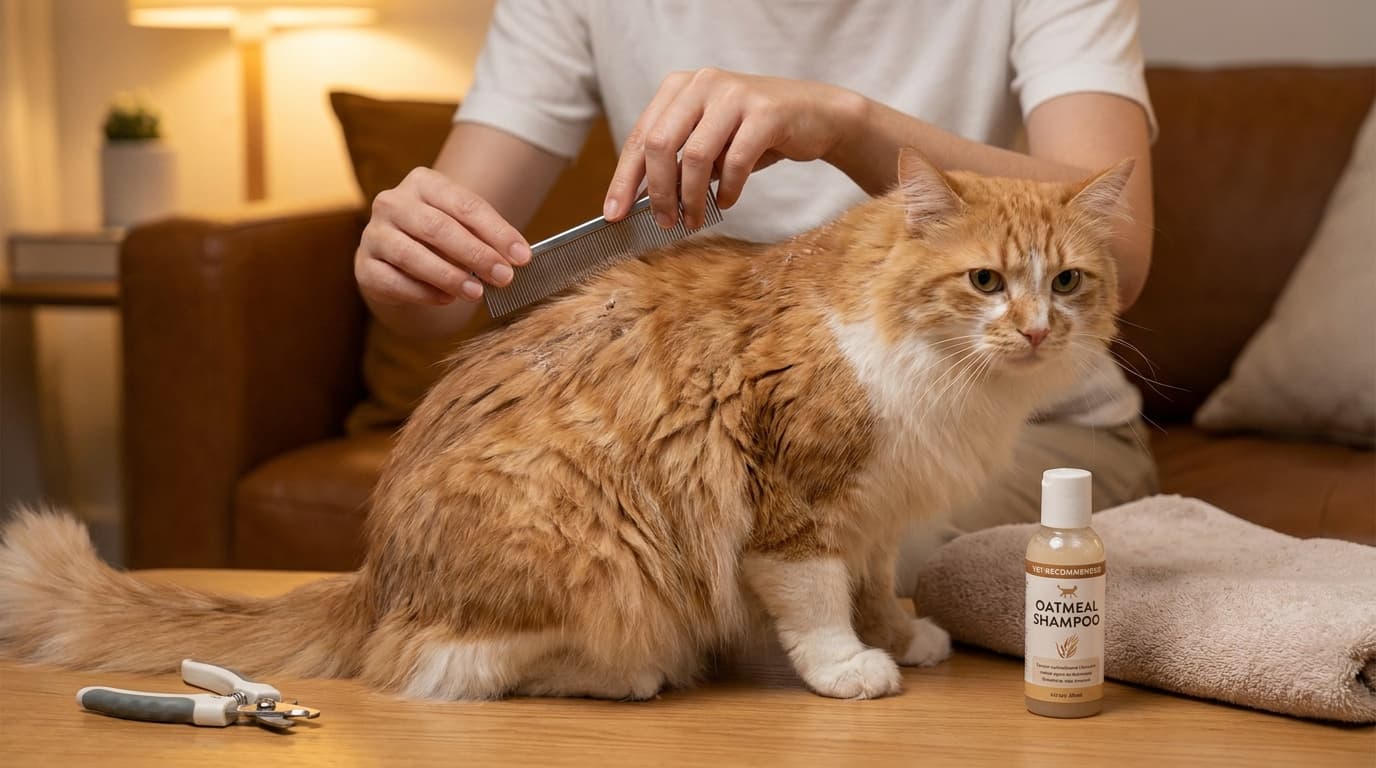
Nail trimming in cats is less a grooming skill than a relationship skill — the technique itself is simple, but executing it on a cat that associates paw handling with restraint requires groundwork that most guides skip entirely. The physical act of trimming takes seconds. Building the tolerance that makes those seconds possible takes days to weeks. Investing in that groundwork produces a cat that accepts nail trims as a routine neutral event rather than a recurring crisis.
The quick is the vascular and neural core of the nail — visible as a pink region through translucent nails, invisible through pigmented ones. Cutting into the quick causes immediate pain and bleeding. The goal of every trim is to remove only the curved, hook-like tip of the nail, staying clearly distal to where the quick terminates. In translucent nails, you can see the pink column and cut 2mm beyond it. In black nails, you cannot see the quick, so the technique changes: look at the cross-section of the nail from the side profile. The quick-bearing portion of the nail is thicker and more rounded in cross-section. The tip beyond the quick thins out and becomes narrower. Trim only the thin, pointed terminal section. A series of small, conservative micro-trims on a 10-day schedule is always safer than attempting to cut back significantly in a single session.
Paw desensitization needs to happen independently of nail trimming and well in advance of it. During relaxed moments — while the cat is resting, mid-meal, or drowsy — gently rest your hand on the cat's paw without applying pressure. Progress over several days to gentle paw holds, then to briefly extending a single claw by pressing the pad. Each stage should produce no reaction before advancing to the next. This incremental approach teaches the cat that paw contact is not a reliable predictor of anything unpleasant, which is the necessary foundation for a stress-free trim.
The 10-day trimming schedule serves two purposes beyond length management. The first is behavioral: frequent, brief, low-stakes sessions normalize the experience far more effectively than infrequent sessions that require trimming significantly more nail. The second is biological: consistent trimming at short intervals gradually conditions the quick to recede further into the nail over time, creating a larger safe margin for subsequent trims. A cat whose nails are trimmed every 10 days develops a shorter quick than a cat trimmed every six weeks, making each successive trim progressively easier and safer.
One nail per session is a legitimate and effective strategy for cats that tolerate limited handling. There is no rule requiring all four paws in one sitting. Ending after one paw with the cat still calm and receiving a high-value treat produces a better outcome than completing all four paws while the cat escalates through stress. The former builds positive association. The latter reinforces that nail trimming sessions end badly. Styptic powder or cornstarch should always be accessible during any trim — if the quick is nicked, applying styptic powder with light pressure for 30 seconds stops bleeding reliably and prevents the mild injury from becoming a setback in the cat's association with trimming.
**Key insights:
- Complete paw desensitization as a separate project before the first nail trim — approach it in incremental stages over days, not in a single session.
- For black nails, trim only the thin, pointed terminal section from the side profile view — micro-trim conservatively rather than risk the quick.
- Trim on a 10-day schedule rather than when nails become obviously long — frequency builds tolerance and gradually conditions the quick to recede.
- Stop after one paw if the cat shows any stress escalation — a calm single-paw session with a treat is a better outcome than a complete all-four-paws session that ends in biting.
- Keep styptic powder or cornstarch on hand and apply with light pressure for 30 seconds if the quick is nicked — never skip this step and continue trimming.
How to Prevent Matting in Long-Haired Cats Long-Term
Mat prevention in long-haired cats is a friction management problem more than a brushing frequency problem, and that distinction changes where you focus your effort. The mats that cause the most problems — the ones that form tight enough to pull skin, create sores, and hide infections — do not form in the areas that are easy to brush. They form in the friction zones: armpits, groin, the inner surface of the hindquarters, the area behind the ears, and the belly. These are locations where movement creates constant fiber-against-fiber contact, where moisture accumulates, and where most grooming tools are difficult to use effectively. A brushing routine that covers the back and flanks but consistently skips the friction zones is providing about 40 percent of the necessary maintenance.
The mechanical reason long-haired coats mat faster than short ones is the undercoat. Long-haired breeds carry a dense, fine secondary coat beneath their guard hairs. This undercoat sheds continuously, and shed fibers that are not physically removed stay within the coat structure. Fine, loose undercoat fibers act as nucleation sites for matting — they snag on neighboring hairs and begin the interlocking process that, under the influence of movement and moisture, produces a progressively denser tangle. A wide-toothed metal comb that reaches through the guard coat into the undercoat removes these loose fibers before they can contribute to mat formation. Slicker brushes that primarily address the outer coat are insufficient as a sole tool for this reason.
Bathing is the mat prevention intervention most likely to accelerate the problem it is meant to address if done incorrectly. Water causes hair fibers to swell and interlock more readily, and a wet coat dries in whatever configuration the fibers land in after the bath — which in a long-haired cat, without active combing during the drying process, frequently means early-stage matting in every friction zone. The protocol that prevents this: comb through the entire coat before wetting, use a diluted shampoo at a 1:5 ratio to ensure complete rinsing, comb gently through the coat while it is still wet before drying, and use a low-heat dryer or allow air drying only with continued combing until fully dry.
The connection between nail length and coat condition in long-haired cats is underrecognized. When a long-haired cat scratches — a behavior that happens dozens of times daily — overgrown claws snag the coat rather than passing through it cleanly. Each snagging event pulls fibers from their natural alignment and creates micro-tangles in the belly and chest fur. Keeping claws trimmed on the 10-day schedule is not just a grooming task in isolation. For long-haired cats, it is directly protective of coat condition.
The realistic maintenance schedule for long-haired breeds is combing through friction zones daily and full coat combing every other day. Most owners find this manageable only when it is integrated into an existing routine — during television time, in the evening before feeding, or as part of a morning routine — rather than treated as a standalone task that requires deliberate scheduling. Five focused minutes daily is significantly more effective than a 30-minute weekly session, both for mat prevention and for the cat's tolerance. Frequent short contact maintains the cat's acceptance threshold far better than infrequent long sessions that push the cat to its limit.
**Key insights:
- Focus every grooming session on the friction zones first — armpits, groin, inner hindquarters, behind the ears — not the back and flanks, which are easy to reach but low-risk.
- Use a wide-toothed metal comb as the primary tool to reach the undercoat where mat formation begins — slicker brushes alone are insufficient for long-haired breeds.
- Comb through the coat before any bath and continue combing during the drying process — a wet coat that dries uncombed mats faster than one that was never washed.
- Maintain the 10-day nail trim schedule as part of coat maintenance — overgrown claws create micro-tangles in belly and chest fur with every scratch.
- Build grooming into an existing daily routine rather than scheduling it separately — five minutes daily prevents mats that 30 minutes weekly cannot undo.
Frequently Asked Questions
The key distinguishing features between simple dandruff and a skin infection are texture, distribution, and whether the skin itself shows signs of inflammation. Simple dandruff produces dry, loose flakes that come off the coat easily and are not associated with redness, heat, or broken skin. A skin infection — bacterial folliculitis, ringworm, or a secondary infection over a traumatized area — typically produces flakes or crusts that sit on visibly reddened, swollen, or irritated skin. The affected area may feel warm compared to surrounding tissue, and hair loss often accompanies or follows the inflammation.
The other important differential is Cheyletiella mite infestation, where the apparent flakes are actually moving mites visible under bright light or a magnifying lens. The itching associated with Cheyletiella is typically more intense than environmental dandruff, and it concentrates on the dorsal midline rather than distributing evenly. If you are uncertain between infection and simple dandruff, the practical guidance is to see a vet: a skin scraping takes minutes and definitively identifies mites or fungal infection. Treating a mite infestation as dry skin delays resolution and allows the infestation to spread to other household pets.
No, and the problem is more fundamental than ingredient incompatibility. Human skin has a pH of approximately 5.5, meaning it is mildly acidic, and human shampoos are formulated to maintain that pH balance. Cat skin has a pH closer to 7, which is neutral, and products formulated for the human pH range disrupt the feline skin barrier, stripping the sebaceous oils that protect the skin surface and predisposing the cat to secondary bacterial and fungal colonization. This effect is not immediately visible but manifests within days as increased flaking, itching, and sometimes skin inflammation.
When dealing with a mat specifically, bathing before mat removal is the wrong sequence regardless of shampoo choice. Water causes hair fibers to swell and interlock more tightly, converting a manageable surface mat into a hardened mass that resists even professional tools. Resolve mats by the dry powder and finger method first. If bathing is needed afterward, use a species-appropriate shampoo diluted at a 1:5 ratio with water to ensure complete rinsing and minimize barrier disruption.
Paw intolerance needs to be treated as a separate project from nail trimming, and the two should not happen simultaneously until paw handling has been fully desensitized. Start by resting your hand near the cat's paw without contact during relaxed moments — when the cat is eating, resting, or drowsy. Progress to brief paw contact that lasts one second and is followed immediately by a high-value treat. Over multiple daily sessions across several days, extend duration gradually. The criteria for progression to the next stage is no reaction at the current stage, not the passage of time.
Use the spaghetti technique concurrently: snap a piece of dry pasta near the cat during meals for three to five days to decouple the clipper sound from any anticipatory stress. Only after both paw handling and sound desensitization are complete should you attempt the first actual trim. At that session, aim to trim one nail from one paw, reward immediately, and stop. A single nail trimmed with no adverse reaction is a more valuable outcome than all twenty nails trimmed under escalating stress. Build from there.
For most surface mats, your fingers combined with cornstarch or talcum powder are more effective than any purpose-built tool because they allow you to feel the tension within the mat and adjust your approach in real time. Tools apply force without feedback. Fingers transmit the sensation of resistance through the mat, which tells you whether the fiber is releasing or whether you are pulling skin. Start with fingers in all cases and progress to tools only if the mat resists after powder application.
If a tool is needed for a dense mat that does not respond to the finger method, a mat splitter — a comb-format tool with serrated blades between the tines — can slice through the fiber mass without the skin contact risk of scissors. The safe-use requirement is that you must be able to slide the tool into the mat with clear space between the tool and the skin surface. If you cannot achieve that clearance, the mat is too close to the skin for safe tool use and requires professional intervention. A mat that cannot be safely resolved at home with powder and fingers should go to a professional groomer, not to a pair of household scissors.
Conclusion
What all of these grooming challenges share is a common underlying principle: cats do not resist grooming because they are difficult. They resist because grooming has been, at some point, associated with sensations their nervous system classifies as threatening — pain from a mat being pulled, the startling sound of clippers, the feeling of being held down without warning. That association was built gradually and it changes gradually. The timeline cannot be compressed by force, but it can be shortened significantly by understanding what is driving the reaction and applying the correct counter-conditioning approach systematically.
The practical hierarchy for most owners is: resolve any active pain source first (mats, overgrown claws, a skin condition causing hypersensitivity), then address the environmental associations that have built up around grooming tools, then establish a routine frequent enough to prevent the problem from recurring. The second step is where most people give up, because behavioral change in cats is slower and less linear than in dogs — there are setbacks, threshold resets, and sessions that go backward. That is normal. The metric that matters is the trend over weeks, not performance in any single session.
Start tonight with the lowest-stakes possible intervention: place the brush on the floor near where the cat eats and leave it there. Do nothing else. That single step begins the desensitization process without requiring anything from your cat and without any risk of a negative experience. Everything else in this guide builds from that foundation. A cat that trusts the process will eventually tolerate the process. That is not optimism — it is how classical conditioning works.
Send it to someone who should read it next.

PurrScript Editorial Team
Editorial Team
PurrScript's in-house editorial team. We research, write, and review every guide using established veterinary and behavioral resources, and update articles as best practices evolve.
View all articles