Is Your Cat Just Fluffy? How to Use the Cat Body Condition Score at Home
We've all seen those 'chonky' cat memes that make us smile, but is that extra fluff actually a health risk? While a round kitty looks cute, carrying even a little...

PurrScript Editorial Team
Editorial Team
Is Your Cat Just Fluffy? How to Use the Cat Body Condition Score at Home
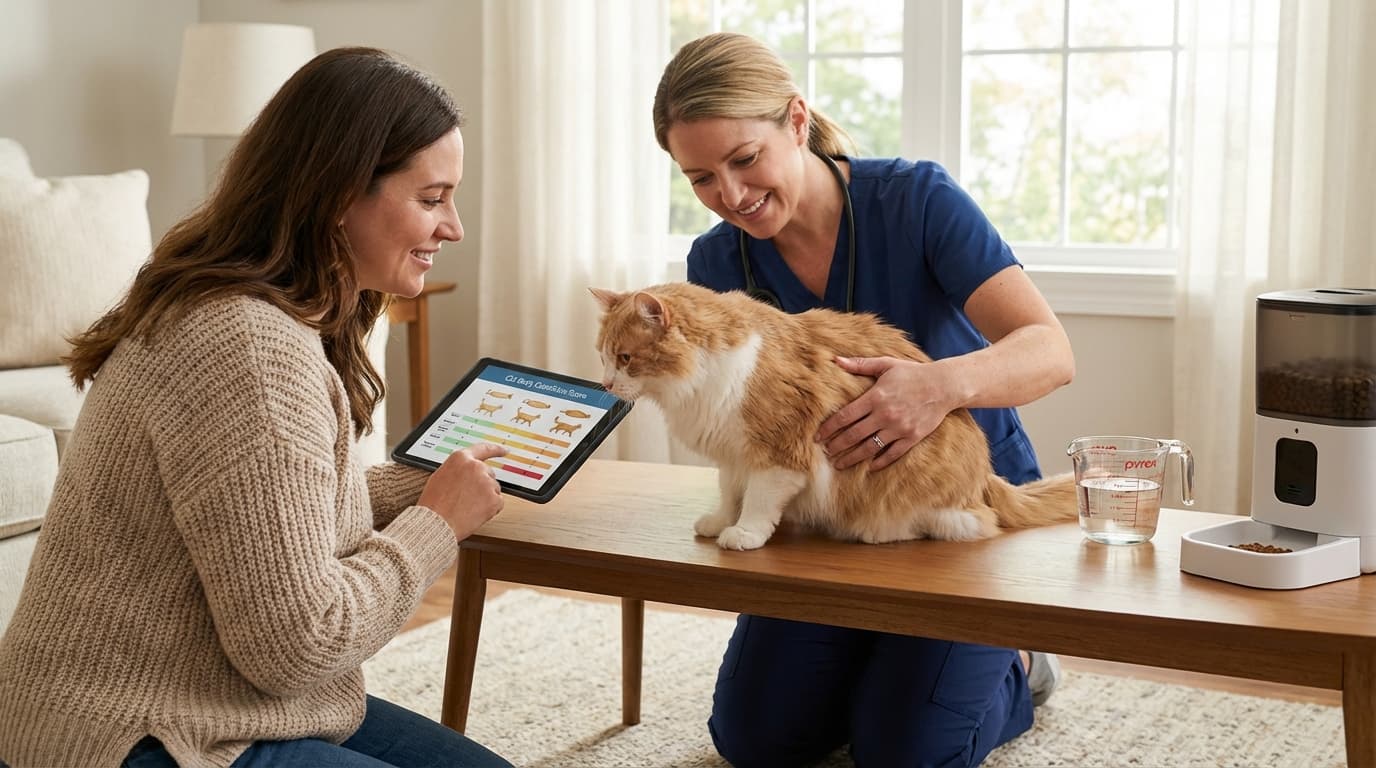
We've all seen those 'chonky' cat memes that make us smile, but is that extra fluff actually a health risk? While a round kitty looks cute, carrying even a little extra weight can lead to serious issues like diabetes or joint pain. Learning how to check your cat body condition score is the best way to see past the fur and understand what's really going on with your pet's health.
Most owners rely on a bathroom scale to track progress, but that doesn't always show the full picture, especially for long-haired breeds. This guide will show you how to use the 1-to-9 veterinary scale right in your living room. You'll discover the knuckle test for ribs and why that belly flap might not be what you think it is.
We'll also cover how to put a cat on a diet safely and how a calorie calculator for cats can take the guesswork out of mealtime. From using automatic feeders for portion control to spotting the dangers of feline obesity, you'll get everything you need to keep your cat happy and active for years to come.
The 1-to-9 Scale: Decoding the Body Condition Score
Think of the Body Condition Score (BCS) as a GPS for your cat's health. While we often rely on the number on a scale, veterinarians use this 1-to-9 system because it measures body fat rather than just total weight. A heavy cat isn't always fat, and a light cat isn't always healthy. The sweet spot is a 4 or a 5. At this level, your cat has a visible waist and you can easily feel their ribs without digging through a layer of padding. It is the difference between a cat that is built for agility and one that is struggling to jump onto the sofa.
On the lower end of the scale, scores 1 through 3 indicate a cat is underweight or even emaciated. You will see prominent ribs, a very narrow waist, and almost no muscle mass over the hips. If your cat suddenly looks bony or you notice their spine sticking out more than usual, it is time to worry. Sudden weight loss is a red flag for issues like hyperthyroidism or kidney disease. It is not just about them being picky eaters; it is a physical signal that their body is burning through its own resources to survive. This changes everything regarding how you approach their daily care.
Then there is the other extreme. Scores 6 through 9 cover the overweight and obese categories. This is where waists disappear and heavy fat deposits start to settle over the ribs and the base of the tail. Carrying even 20% extra body weight takes a massive physical toll. It is not just about looks. Extra fat increases the risk of diabetes, arthritis, and liver disease. The tricky part? Long-haired cats often hide this extra weight well. Also, that primordial pouch on their belly can sometimes trick you into thinking they are heavier than they actually are, even though it is a normal anatomical feature.
To get an accurate reading, you have to get your hands on them. Visual checks are often wrong because fur is deceptive. Try the rib test: if their ribs feel like the back of your hand, they are likely at an ideal weight. If they feel like your knuckles, they are too thin. If they feel like your palm? They are likely overweight. Keep in mind that certain breeds like Siamese or Abyssinians are naturally trimmer. Before you cut back on the kibble, always talk to your vet. Starting a diet too fast can lead to hepatic lipidosis, a dangerous liver condition that happens when a cat's body tries to process fat too quickly.
Many owners are now using monthly home checks to stay ahead of the curve. It is much easier to adjust a diet when a cat hits a score of 6 than it is to manage a health crisis at a 9. Some people even use smart feeders or motion detectors to see how much their cat is actually moving during the day. Ultimately, the BCS isn't about judging your pet. It is about making sure they feel good enough to keep chasing that laser pointer for years to come. What does this mean for your cat today? A simple two-minute check could add years to their life.
Key insights:
- Visual checks are often inaccurate; palpation is the only way to truly assess fat coverage.
- A score of 4 or 5 is the target for most domestic cats to avoid chronic health issues.
- Naturally thin breeds like the Siamese may have different baseline expectations than a Maine Coon.
- Never start a feline weight loss plan without professional guidance to avoid fatty liver disease.
The Underweight End (Scores 1-3)
Ever petted your cat and felt like you were touching a bag of marbles? On the 9-point Body Condition Score scale, a score between 1 and 3 means a cat is officially underweight. At a level 1, they are emaciated with almost no body fat. While breeds like Siamese or Abyssinians are naturally lean, seeing ribs or hip bones clearly through the fur is a major red flag.
But wait, fur hides a lot. You might think your fluffy cat is fine until you actually put your hands on them. If the ribs feel like a washboard with zero padding, there is a problem. Remember that feeling their sides is much more reliable than just looking because coats can be deceiving. Sudden weight loss isn't just a random phase, it often signals health issues like dental pain or thyroid trouble.
If your cat falls into this skinny category, don't just double their food portions. Talk to a vet first to rule out medical causes. We want to see a smooth, healthy covering over the ribs where they can be felt with light pressure but aren't sticking out like a cage.
Key insights:
- Long hair can mask extreme weight loss, making physical touch essential for assessment.
- A score of 1 indicates a medical emergency or severe malnutrition.
- Naturally thin breeds still need a layer of fat over their ribs to be considered healthy.
The Overweight End (Scores 6-9)
When your cat’s waistline starts to vanish, you have likely crossed into the 6 to 9 range on the Body Condition Score scale. At this stage, that extra fluff is actually heavy fat deposits sitting over the ribs and spine. It might look cute when they resemble a round little loaf, but carrying 20% extra body weight puts a massive strain on their tiny frames. Think of it this way: every extra pound is like you carrying a heavy, stuffed backpack all day and night.
The real worry isn't just the silhouette; it is the hidden health risks like diabetes and painful arthritis that come with feline obesity. If you cannot feel their ribs with a light touch, they are definitely in the overweight zone. But wait before you hide the food bowl. Starting a sudden, drastic diet without a vet's help can trigger hepatic lipidosis, a dangerous liver condition. A quick professional checkup ensures they slim down safely without the risks.
The goal is to move back toward that ideal score of 4 or 5. While it takes patience, watching your cat regain their energy and jump back onto the counter is worth the effort. It is not just about the scale; it is about giving them more years of comfortable, active life.
Key insights:
- A score of 9 indicates severe obesity and requires immediate veterinary intervention.
- Palpation is more reliable than sight because thick fur often hides significant fat deposits.
- Rapid weight loss in cats is dangerous and can lead to life-threatening fatty liver disease.
Hands-On: How to Check Your Cat's Condition
Ever wonder if your cat is actually big boned or just carrying a few extra treats? Looking can be deceiving, especially with long-haired breeds where thick fur hides the truth. To get the real story, you have to get your hands involved. Veterinarians use a standard tool called the Body Condition Score, which is a scale from one to nine. A score of four or five is the healthy goal for most cats. Anything higher increases the risk of serious issues like diabetes, arthritis, and liver disease.
Start your assessment with a simple three-step process: look, feel, and weigh. From above, look for a visible waistline that tapers in behind the ribs. From the side, look for an abdominal tuck where the belly slopes upward toward the back legs. If your cat looks like a straight rectangular loaf from above instead of having a curve at the waist, they are likely carrying too much weight.
The most reliable check is the rib test. Think of your own hand as a guide. If you feel the back of your hand while your fingers are flat, that is what a healthy cat feels like. You should be able to feel the ribs easily with light pressure, even if you cannot see them. If you have to press down hard to find the bone, there is too much padding. This touch test is much more accurate than just looking because it reveals what is happening under the coat.
Do not let the primordial pouch confuse you. That floppy skin hanging near the back legs is often a normal part of cat anatomy that helps them stretch and run. The trick is to feel the texture of that flap. A healthy pouch is loose and jiggly, almost like a thin layer of skin. Obesity feels thick, heavy, and firm. If that belly area feels full of fat instead of just being a loose fold of skin, it is a sign of a weight problem.
While some breeds like Siamese or Abyssinians are naturally trimmer, these markers apply to almost every cat. Recent data shows that even a small amount of extra fat reduces a cat's quality of life. By checking these spots once a month, you can catch weight trends early. It is always best to talk to a vet before starting a diet, as losing weight too fast can lead to dangerous complications like fatty liver disease.
Key insights:
- Visual checks often fail because long fur or the primordial pouch can hide a cat's true shape.
- The rib test uses the back of your hand as a guide for what a healthy weight feels like.
- A healthy Body Condition Score is usually a 4 or 5 on a 9-point scale.
- The primordial pouch is a loose flap of skin, while obesity feels firm and heavy in the belly area.
The Rib Test: A Simple Touch Technique
Ever wonder if your cat is truly 'big-boned' or just carrying a few extra treats? Since thick fur and that floppy primordial pouch often hide the truth, the rib test is your best friend. Think of it like the 'knuckle test' analogy. If your cat’s ribs feel like the back of your hand - smooth but easy to find - they are likely at an ideal body condition score of 4 or 5.
But what if it feels like you're pressing into a thick, plush duvet? If you have to really dig your fingers in to even locate a rib, there is simply too much padding. This matters because even modest fat gain increases the risk of painful arthritis and diabetes. While breeds like Siamese or Abyssinians are naturally trimmer, most cats need ribs you can feel with a light touch.
By using your hands, you get an honest look at their health that your eyes might miss. If those ribs are buried, it is a clear sign to watch their portions and perhaps consult a vet. It only takes a second, but this simple check helps ensure your cat stays active and happy for years.
The Myth of the Primordial Pouch
Ever looked at your cat and wondered why they have a swinging belly flap? You aren't alone. Many owners mistake this for a weight problem, but it is often just the primordial pouch. This loose skin serves a practical purpose, like protecting vital organs during a fight or letting them stretch out fully while running. It is a normal part of feline anatomy and not a sign that your cat has had too many treats.
The real trick is knowing where the pouch ends and obesity begins. The Association for Pet Obesity Prevention notes that visual checks are often inaccurate because this flap masks a cat's true shape. To get a real answer, you have to move past looking and start feeling. While a healthy cat should still have a visible waist when viewed from above, the primordial pouch might make their side profile look a bit saggy even if they are fit.
So how do you tell the difference? Use your hands. An ideal body condition score is usually a 4 or 5 on a 9-point scale. At this weight, you should be able to feel your cat's ribs easily with light pressure, even if that belly flap is swinging. If you cannot find the ribs or if the area above the pouch feels thick and padded, that is when you are looking at actual fat gain rather than a protective skin fold.
Key insights:
- The primordial pouch is a normal anatomical feature used for protection and flexibility.
- Visual assessments are often misleading because the pouch can hide a cat's actual body condition.
- Palpation is the most reliable way to distinguish between a healthy pouch and excess body fat.
Why a 'Little Extra' Is Actually a Big Deal
It’s easy to look at a rounder cat and think they're just cuddly or well-fed. But for a ten-pound animal, gaining just one pound is like a human gaining twenty. It’s a massive shift for their small frames. This isn't just about aesthetics; it’s about the very real dangers of feline obesity happening under the surface. When a cat carries extra weight, the risk for diabetes and liver disease sky-rockets. If you try to fix it too fast without a vet's help, your cat could develop hepatic lipidosis - a dangerous condition where the liver gets overwhelmed by fat stores. This is why professional guidance is a must before changing their routine.
Think about how your own knees feel after a long day. Now imagine carrying a heavy backpack 24/7. That’s what it’s like for an overweight cat. Extra weight puts constant pressure on their joints, turning a playful leap onto the counter into a painful chore. This leads to a cycle where they move less because it hurts, which makes them gain even more weight. Using a cat body condition score helps you see past the fur. The BCS scale runs from 1 to 9. While a score of 1 means a cat is emaciated, a 9 indicates severe obesity. Most experts, like Dr. Dwight Alleyne, point to a score of 4.5 to 5 as the healthy sweet spot.
The tricky part is that cats are masters of disguise. Long-haired breeds hide a lot of padding, and that saggy belly flap - the primordial pouch - is actually a normal anatomical feature, not a sign of fat. This is why visual checks often fail. The Association for Pet Obesity Prevention notes that many owners underestimate body fat because they aren't feeling for the ribs. If you have to press hard to find them, your cat is likely trending toward a higher score. Palpation is more reliable than just looking. You want to feel the ribs with light pressure, similar to the bones on the back of your hand.
So, what’s the next move? It might mean looking into automatic feeders for portion control or using a calorie calculator for cats to get their meals exactly right. When learning how to put a cat on a diet, the first step is always a professional check-up to avoid health crashes. Small changes today prevent a shorter lifespan later. We want our cats around for as long as possible, and keeping them trim ensures their golden years are spent chasing laser pointers rather than struggling to walk. High fat cat health risks are avoidable, but it starts with a hands-on check at home.
Key insights:
- A weight gain of just one pound in a cat is equivalent to a 20-pound gain in an average human.
- The 'primordial pouch' is a normal flap of skin and should not be confused with obesity.
- Feeling the ribs (palpation) is a more accurate health indicator than simply looking at a cat's silhouette.
- The ideal Body Condition Score for most cats is between 4 and 5 on a 9-point scale.
How to Put a Cat on a Diet Without the Drama
Putting a cat on a diet isn't as simple as just cutting their kibble in half. If you do that, you might actually put them in danger. Cats are unique because their bodies cannot handle rapid weight loss. When a cat loses weight too fast, their liver can get overwhelmed by fat stores, leading to a serious condition called hepatic lipidosis. This is why a vet visit is non-negotiable before you start. They will help you find a safe pace so your cat stays healthy while trimming down. Think of it as a slow walk rather than a sprint. You should also transition their food slowly over a week or two to avoid those loud, hunger-fueled protests.
So, how do you know the right amount to serve? It is about more than just reading the back of a bag. Most experts suggest using a calorie calculator for cats to find a baseline. You have to account for their age and how much they actually move. A lazy older cat needs much less fuel than a kitten zooming around the house. Since even a little extra weight increases the risk of diabetes and arthritis, getting these numbers right is a big deal. The goal is usually a body condition score of 4 or 5, where you can feel their ribs but they still have a visible waist.
Using technology can also take the drama out of the process. Automatic feeders are great because they provide precise portion control without you having to measure every single time. They also help break the habit of the midnight wake-up call for snacks. When the machine handles the food, your cat stops seeing you as a 24-hour snack dispenser. This makes the diet easier on everyone and ensures your cat gets exactly what they need to reach a healthy weight without the constant begging.
Key insights:
- Rapid weight loss in cats can lead to life-threatening liver failure.
- A body condition score of 4 or 5 is the target for a healthy, long-lived cat.
- Automatic feeders help shift the cat's focus away from the owner for food, reducing begging behavior.
Calculating the Right Calories
Once you have figured out where your cat sits on the 1-9 scale, it is time to talk numbers. Think of a calorie calculator for cats as your roadmap. It gives you a baseline starting point, but keep in mind that no two cats are exactly the same. A senior cat who spends eighteen hours a day napping in a sunbeam has very different needs than a high-energy Abyssinian with a permanent case of the zoomies. Age and activity levels change everything, so your cat's baseline will likely shift as they grow.
But here is the tricky part: if your cat is currently a 7 or 8 on the scale, you cannot just slash their portions overnight. Starting a weight loss journey too aggressively without consulting a vet can lead to hepatic lipidosis, a dangerous liver condition. The goal is a slow, steady move toward that ideal score of 4 or 5. Use the data to find a baseline, then adjust based on how your cat actually lives. It is not just about the bowl; it is about keeping them healthy for years to come.
Key insights:
- Calorie calculators provide a starting baseline that must be adjusted for age and daily movement.
- Rapid weight loss in cats is dangerous and can lead to serious liver disease.
- The target for most cats is a Body Condition Score of 4 or 5 on a 9-point scale.
The Role of Automatic Feeders
Ever been woken up at 3 AM by a hungry cat? It’s a classic move, but it often leads to accidental overfeeding just so you can get back to sleep. This is where automatic feeders change the game. They stop those midnight wake-up calls by handling the schedule for you, ensuring your cat gets fed without you having to lift a finger in the dark.
Beyond saving your sleep, these tools offer incredible precision for weight management. Since a healthy body condition score of 4 or 5 is a relatively tight window, every extra kibble counts. Some of the latest smart feeders even track daily movement to help you calculate the perfect portion. It turns the struggle of a diet into a consistent, automated routine.
This matters because even modest fat gain increases the risk of serious issues like diabetes and arthritis. By letting a machine handle the portions, you remove the emotional pressure of those big, begging eyes. It is a simple way to keep your cat at a healthy weight while keeping your mornings peaceful and your kitchen drama-free.
Keeping the Weight Off for Good
So, your cat finally reached their goal weight. That’s a huge win, but the real challenge is making sure those extra pounds do not sneak back on. Think of weight management like a regular hobby rather than a chore. One of the best ways to stay on top of things is by doing a quick Body Condition Score (BCS) check every single month. Because you see your cat every day, you might miss small changes that a hands-on check would catch. Remember, an ideal score is a 4 or 5 on that 9-point scale. If they start drifting toward a 6, you will know it is time to adjust their portions before it becomes a real problem.
Exercise for cats does not have to mean running laps. It is more about tapping into their natural hunting instincts. Instead of just filling a bowl, try using food puzzles that make them work for their kibble. This keeps their minds sharp and their bodies moving. Also, do not be afraid to embrace some smart tech. GPS trackers and activity monitors are not just for outdoor explorers anymore; they are great for seeing if your indoor cat is actually active or just napping while you are at work. This data helps you see exactly how much energy they are actually burning.
But wait, if you notice your cat gaining weight again, talk to your vet before slashing their food. Starting a strict diet without professional help can lead to serious complications like fatty liver disease. We want to avoid risks like diabetes or arthritis, but we have to do it safely. Every cat is different - a Siamese is naturally going to look thinner than a fluffy forest cat - so knowing your cat's specific baseline is the secret to keeping them happy and healthy for the long haul.
Key insights:
- Monthly BCS checks help you catch weight trends before they become health risks.
- Food puzzles and activity trackers turn weight maintenance into an engaging game.
- Always consult a vet before changing a cat's diet to avoid dangerous liver issues.
Frequently Asked Questions
It is actually pretty tough to tell just by looking because all that beautiful fur acts like a bulky sweater. You will find that visual checks often lie to you when it comes to long-haired breeds. The best way to know is to use your hands and really feel for their actual shape.
Try feeling for their ribs. You should be able to feel them with just a light touch, similar to how the bones on the back of your hand feel. If you have to dig through a layer of padding to find them, your cat is likely overweight. Also, try to look for a waist when they are wet or during a bath, because that is when their true body shape finally shows up.
Not at all. Weight is just a number, but body condition is what really matters for their long term health. A naturally petite cat like a Siamese might be quite chunky at 9 pounds, while a large breed like a Maine Coon could be perfectly lean and healthy at 15 or even 20 pounds.
Instead of focusing only on the scale, look at their proportions. Experts use the Body Condition Score to see if a cat has the right amount of fat for their specific frame. As long as they have a nice tuck at the waist and you can feel their ribs easily, they are likely doing just fine regardless of the total weight.
The knuckle test is a handy trick to figure out if your cat is carrying too much weight or just the right amount. You basically use your own hand as a guide to see how their ribs should feel. When you run your fingers over your cat's side, they should feel like the back of your hand when it is flat. You can feel the bones, but there is a little bit of padding over them.
Here is how you tell the difference. If their ribs feel like your knuckles when you make a tight fist, they are likely too thin. But if they feel like the fleshy part of your palm, those ribs are buried under too much fat. It is a much better way to check than just looking at them because long hair or a saggy belly pouch can easily hide their true shape.
It sounds like the easiest fix, but you have to be really careful about just cutting back their portions. If a cat loses weight too quickly or stops eating enough, they can get a life-threatening liver disease called hepatic lipidosis. This happens when their body tries to process fat too fast and it clogs up the liver.
Instead of guessing, it is a good idea to chat with your vet first. They can help you figure out a safe daily calorie count and maybe suggest an automatic feeder to keep those portions exact. Even a little bit of weight loss goes a long way in preventing things like diabetes or sore joints, but it has to be done slowly and safely.
Conclusion
So what does all this mean for your favorite furball? It means that looking past the fluff to find the actual cat underneath is one of the kindest things you can do. Using the cat body condition score helps you move away from guessing and toward knowing exactly how your pet is doing. Whether they are a perfect five or leaning toward a nine, having this baseline makes every health decision much clearer.
The goal isn't just to win a diet challenge. It is about making sure your cat can still jump on the high shelf and stay clear of risks like feline diabetes or joint pain. When you use a calorie calculator for cats or set up automatic feeders for portion control, you aren't being strict. You are actually adding years to their life and more life to their years.
If you realized today that your kitty is carrying a bit too much love, your next move is simple: chat with your vet and start a slow, safe transition. Helping a cat lose weight takes patience, but seeing that extra pep in their step makes every measured meal worth it. Here is to many more happy, healthy years of head bumps and purrs.
Send it to someone who should read it next.
PurrScript Editorial Team
Editorial Team
PurrScript's in-house editorial team. We research, write, and review every guide using established veterinary and behavioral resources, and update articles as best practices evolve.
View all articles