Why Your Lone Kitten is a "Land Shark" (And How to Fix It)
You are sound asleep when suddenly a tiny set of needle-sharp teeth sinks into your big toe. Your adorable new furball has officially turned into a midnight land shark and...

Dr. Emily Hart
Veterinarian, DVM
Why Your Lone Kitten is a "Land Shark" (And How to Fix It)
You are sound asleep when suddenly a tiny set of needle-sharp teeth sinks into your big toe. Your adorable new furball has officially turned into a midnight land shark and your ankles are the primary target. While it might feel like your pet has a personal vendetta, this spicy behavior is often a classic case of single kitten syndrome. Without littermates to teach them boundaries, lone kittens simply do not realize that their play hurts.
It is frustrating to deal with kitten aggressive play when you just want a cuddle bug, but there are simple ways to fix it. You do not have to accept the scratches as a normal part of pet ownership. By understanding why kittens pounce on feet and learning how to redirect that wild energy, you can restore peace to your home and save your skin.
This guide covers practical tips like the hiss-technique for biting and why teaching no to a kitten is easier than you think. From the golden rule that hands are never toys to the secret of toy rotation, you will get everything you need to turn your tiny hunter into a gentle companion. Let us get your sanity back and your kitten on the right track.
The 3 AM Toe Pounce: Why Your Sweet Kitten Turned Into a Land Shark
You are sound asleep when a furry blur launches at your feet like a tiny, caffeinated predator. Sound familiar? If your sweet fluffball has turned into a land shark, you are not alone. This spicy behavior often stems from Single Kitten Syndrome. It happens when a kitten grows up without littermates to teach them that biting hurts. Without a feline playmate to wrestle with, all that hunting instinct gets directed at your moving toes.
The reality is that kittens cannot tell a playful nip from a painful bite. Teaching a cat that hands are toys makes them much harder to adopt out later if they ever enter a shelter. With over 1,000 shelters in America not yet designated as no-kill, good behavior is a lifesaver. As Jackson Galaxy says, hands are not toys, ever. Your kitten is not being mean, they are just bored and misdirecting their energy.
So, how do you stop the pouncing? It comes down to redirection and smart play. We will look at why human play often is not enough to tire out a solo kitten and how rotating toys keeps them from getting bored. You will learn how to turn those 3 AM attacks into peaceful snuggles by speaking your kitten's language and setting better boundaries starting today.
Key insights:
- Single Kitten Syndrome happens when kittens miss out on early social lessons from littermates.
- Human hands and feet should never be used as play objects to avoid confusing the kitten.
- Redirection to wand toys is the most effective way to stop aggressive pouncing behavior.
Why Being an "Only Child" Makes Some Kittens Grumpy
Ever wonder why your sweet little furball suddenly turns into a tiny "land shark" the moment you walk across the room? If you have a solo kitten, you might be dealing with Single Kitten Syndrome. This isn't just a fancy label; it happens when a kitten is raised without littermates or other feline friends to keep them in check. Without siblings to pounce on, you become the primary target for all that pent-up energy and hunting instinct.
In a normal litter, kittens learn through a constant feedback loop. When one kitten bites too hard, the other lets out a sharp squeal and stops playing. This teaches them exactly where the line is between a fun romp and actual pain. But when a kitten is alone, they miss this crucial social lesson. They simply don't realize those sharp teeth and claws actually hurt because nobody is "speaking cat" back to them during the developmental window for social learning.
You might think playing with your kitten for an hour a day is plenty, but for a solo kitten, it often isn't enough to curb the "menace" behavior. Even high-energy play sessions can fall short because humans cannot mimic the 24/7 wrestling matches kittens have with each other. Plus, if we use our hands to wrestle, we are accidentally teaching them that skin is a toy. As Jackson Galaxy famously says, "Hands are not toys, ever." Teaching a cat that biting is play makes them much harder to place in homes and puts them at higher risk if they ever enter the shelter system.
The science behind the "playful nip" is pretty straightforward but easy to misunderstand. Insights from the Best Friends Animal Society suggest that in a kitten’s mind, a playful nip is indistinguishable from a painful bite. They aren't trying to be mean; they just lack the context to know they're causing harm. This is why human-led play needs to be very specific. If you let them chew on your fingers now, you are essentially training a future adult cat to be aggressive.
So, how do you handle a pounce? When a kitten attacks your hands or feet, try to go totally limp. Moving around only triggers their prey drive further. Make a loud "Ouch!" and immediately redirect them to an interactive wand toy. This keeps your skin safe and teaches them that toys are for biting, while humans are for cuddles. It’s also smart to rotate their toys every few days; if a toy is always available, it becomes boring "dead prey" and they’ll go back to hunting your ankles instead.
Key insights:
- Single kitten syndrome occurs when a kitten lacks the feline feedback loop that teaches them biting hurts.
- Human hands and feet should never be used as play objects because kittens cannot tell play from pain.
- Redirecting a kitten to an interactive wand toy after a loud 'Ouch!' is the most effective way to stop aggressive pouncing.
- Toy novelty is essential; rotating toys every few days keeps a solo kitten engaged and less likely to hunt their owners.
The Science of the 'Playful Nip'
Ever wonder why your sweet furball suddenly turns into a tiny land shark during playtime? They aren't being mean. They just don't know any better. During their early developmental window, kittens learn social boundaries from their littermates. Best Friends Animal Society points out that, in a kitten’s mind, a playful nip is indistinguishable from a painful bite. Without a sibling to yelp when a pounce goes too far, your kitten never learns where the ouch line is.
This is the core of Single Kitten Syndrome. When kittens grow up alone, they miss out on essential lessons in bite inhibition. Jackson Galaxy famously says that hands are not toys, ever, and for good reason. Teaching a cat that biting is play makes them much harder to place in homes later. It puts them at a higher risk if they ever enter the shelter system, which is a scary reality for the 1,300 shelters in America that aren't yet no-kill.
Think of it this way: your moving feet are just fast-moving prey. Without a feline wrestling partner, they will take out that high energy on you. Even an hour of play often isn't enough to curb the menace behavior of a solo kitten. It is not just a phase they grow out of; it is a social skill they never had the chance to learn.
Key insights:
- Kittens lack natural bite inhibition when raised without other cats to provide feedback.
- Aggressive play behaviors can make cats significantly harder to rehome or keep in long-term housing.
- Human hands and feet should never be used as play objects to avoid confusing the kitten's hunting instincts.
The Golden Rule: Your Hands Are Never Toys
You are sitting on the couch and your tiny kitten pounces on your fingers. It is adorable, right? Those little needle teeth do not really hurt yet, so you wiggle your hand to keep the game going. But here is the thing: you are accidentally training a land shark. Jackson Galaxy always says that hands are not toys, ever. If you teach your kitten that your skin is a plaything, they will not magically stop when they grow into a ten-pound adult with powerful jaws.
This is more than just a habit that leads to scratched arms. It can actually be a matter of life and death for some cats. In the American shelter system, there are about 3,900 shelters, and roughly 1,300 of them are not yet no-kill. When a cat learns that biting is a form of play, they become much harder to rehome. They might get labeled as aggressive or unadoptable just because their owner thought wrestling was cute. To a kitten, a playful nip feels the same as a painful bite, so it is up to you to set the boundary early.
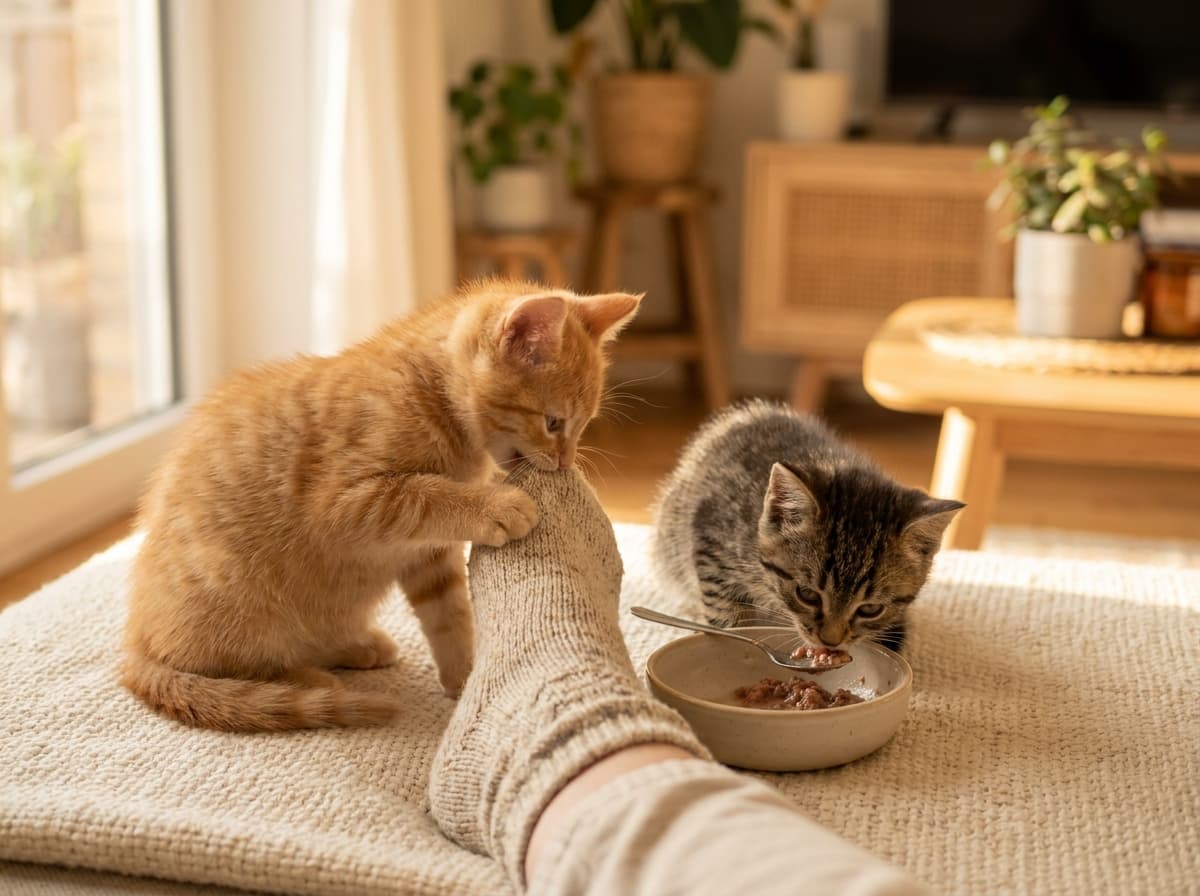
Then there is the blanket monster. You move your feet under the covers and suddenly your toes are under siege. To your kitten, that movement triggers a deep prey drive because it looks exactly like something scurrying through the grass. To stop the pounce before it happens, try to keep your feet still if you notice them stalking. If they do attack, go totally limp. Moving your feet away just makes the prey look like it is trying to escape, which makes them bite harder.
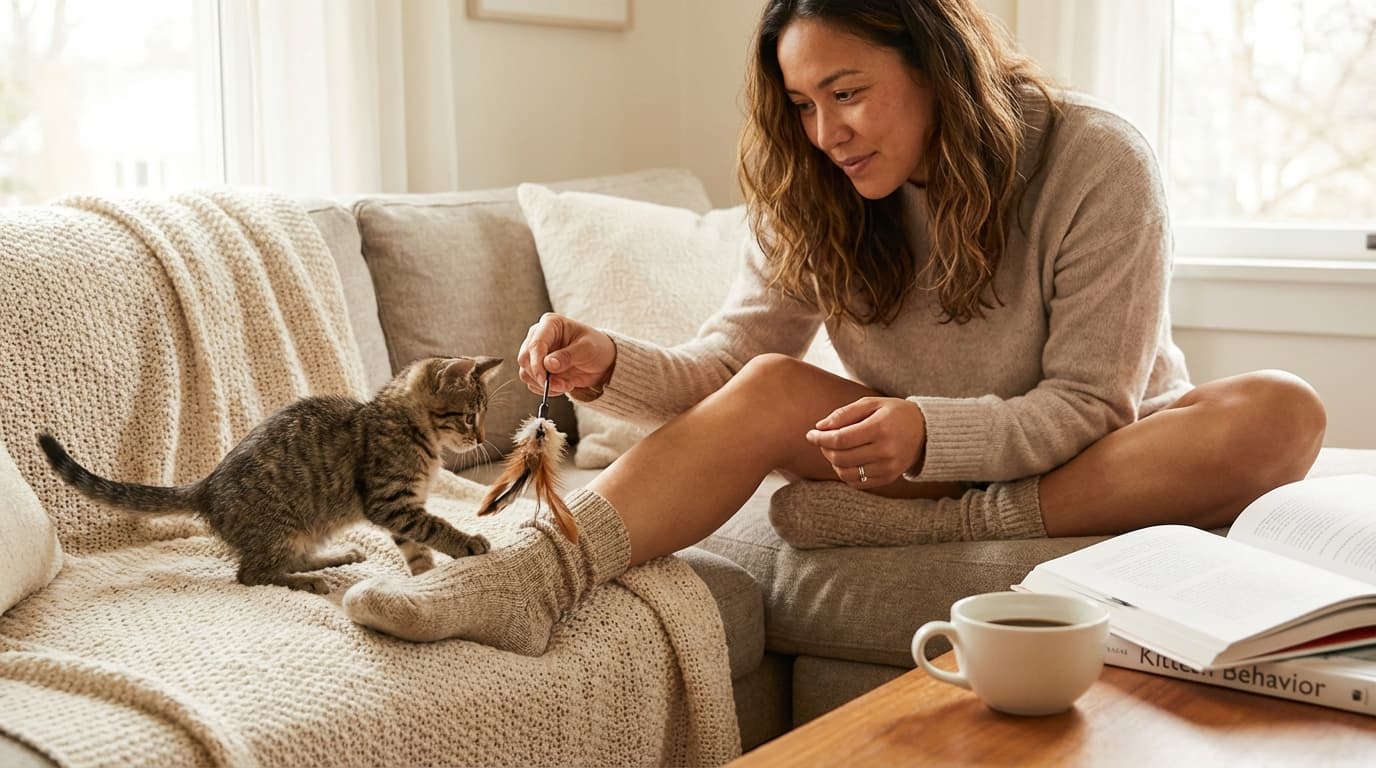
Instead of using your body, grab an interactive wand toy with feathers or strings. This keeps a safe distance between your skin and their claws. If they do catch your hand, say Ouch loudly and stop moving entirely. This tells them the game is over because they were too rough. By rotating their toys every few days to keep things fresh, you can satisfy that high energy without becoming a human scratching post. It is much easier to teach these rules now than to fix a biting habit in an adult cat later.
Key insights:
- Kittens cannot distinguish between a playful nip and a painful bite, so all hand-play should be avoided.
- Teaching aggressive play can lead to cats being labeled unadoptable in the shelter system.
- To stop an attack, go limp to deactivate the kitten's prey drive and redirect them to a wand toy.
Why Feet Are Fair Game (In Your Kitten's Mind)
To a kitten, those wiggling lumps moving under your duvet aren't actually your feet - they are burrowing prey. This 'land shark' behavior is a hallmark of single kitten syndrome, which happens when a cat is raised without littermates. Without a sibling to yelp and nip back, your kitten never learns that biting hurts. They simply see your ankles as moving targets for a high-speed pounce.
The reality is that this habit can lead to serious trouble later. Jackson Galaxy famously warns that hands and feet are never toys because teaching a kitten that biting is play makes them much harder to keep in a home. In fact, with roughly 1,300 shelters in America not yet designated as no-kill, aggressive behavior can put a cat's future at risk. What starts as a cute pounce can quickly become a reason for rehoming if not corrected.
So, how do you stop the attack? When your kitten lunges, don't kick or pull away, as fast movement only triggers their prey drive further. Instead, go completely limp to 'kill' the excitement and say a loud 'Ouch!' to signal that the game is over. Immediately redirect their energy toward an interactive wand toy. Keeping a few different toys on a rotation helps maintain that sense of novelty they crave, making your toes much less interesting by comparison.
Key insights:
- Human hands and feet should never be used as play objects because kittens cannot distinguish between a playful nip and a painful bite.
- When a kitten attacks, going limp and redirected to a wand toy is more effective than pulling away.
- Single kittens often lack the 'bite inhibition' that littermates naturally teach each other through rough play.
3 Steps to Stop the Biting Without Ruining the Fun
Your kitten is not trying to be a jerk; they are just bored and lonely. When a kitten grows up without littermates to teach them boundaries, we call it single kitten syndrome. Without another cat to wrestle with, they turn your ankles into moving targets. Jackson Galaxy famously says that hands are not toys, and he is right. If you teach a cat that biting is a game, they become much harder to place in a home if they ever enter the shelter system. With about 3,900 shelters in America and many not yet designated as no-kill, teaching your cat good manners is actually a life-saving skill.
The first step to stopping the land shark attacks is to go limp. When your kitten grabs your hand or foot, your natural instinct is to pull away quickly. Do not do that. Pulling away triggers their prey drive, making them think the mouse is trying to escape. Instead, let your hand go heavy and completely still. This makes you boring instantly. Pair this with a sharp Ouch! to mimic the sound a sibling would make. If they are really worked up, a quick, natural hiss can serve as a feline warning that they have crossed the line.
Even if you spend an hour a day playing with your kitten, it might not be enough to stop the pouncing. Some owners of high-energy cats find their pets still act like menaces despite all the attention. The reality is that in a kitten's mind, a playful nip is exactly the same as a painful bite. They do not know the difference until you show them. While getting a second cat is the best way to fix this, it can add about $50 to your monthly pet rent, so these training techniques are vital if a companion is not an option right now.
Once you have killed the momentum of the bite by going limp, you need to redirect that energy immediately. This is the secret to keeping the fun going without the pain. Keep an interactive wand toy within reach at all times. The second they let go of your skin, get those feathers moving. You want to shift their focus from your body to the toy in seconds. Interactive toys win over stationary balls every single time because they require the kitten to use their senses to hunt something that actually moves back.
To keep the redirection working, you have to keep the toys alive. If a toy is always sitting in the middle of the floor, your kitten will get bored with it. Think of it this way: a real mouse does not just sit in the open all day. Rotate your toys every few days and keep the best ones out of reach when it is not playtime. This novelty ensures that when you bring out the wand toy to stop a biting session, your kitten actually cares enough to switch targets and leave your hands alone.
Key insights:
- Human hands should never be used as play objects because kittens cannot distinguish between a playful nip and a painful bite.
- Going limp stops the prey drive by making the human target seem uninteresting or dead.
- Toy novelty is essential for engagement; kittens lose interest if the same toys are always available on the floor.
- Interactive wand toys are more effective than stationary toys because they mimic the unpredictable movement of prey.
Mastering the Redirection
When your kitten treats your ankles like a snack, your first instinct might be to pull away or wiggle your fingers. But doing that just makes you look like even better prey. Instead, try going limp. If you stop moving, the hunt becomes boring. Pair this with a loud "Ouch!" to let them know that their playful nip feels exactly like a painful bite to you. As expert Jackson Galaxy says, hands are never toys, and teaching a cat that biting is play only makes them harder to live with later.
Once you have paused the attack, it is time for the swap. Keep an interactive wand toy nearby so you can immediately redirect that energy away from your skin. While a stationary ball just sits there, a feather on a string mimics the fast movement of a bird or mouse. This taps into their natural drive much better than a plastic toy they have to move themselves. It is the difference between watching a movie and being part of the action.
The trick is to keep these toys special. If they are always on the floor, your kitten will eventually ignore them. Try rotating your stash every few days to keep the excitement alive. Since even an hour of play might not fully tire out a solo kitten, making every minute count with high-engagement toys is your best bet to save your skin. Think of it as a way to burn off that "single kitten syndrome" energy before it turns into a pounce on your feet.
Key insights:
- Going limp stops the prey drive reflex that makes kittens keep biting.
- Interactive wand toys are more effective than stationary balls because they mimic real hunting.
- Rotating toys every few days prevents boredom and keeps the kitten engaged during play sessions.
Keeping Your Tiny Hunter Busy While You're at Work
You leave for work, and your kitten treats your departure like the start of a solo mission to destroy the living room. It's tempting to think a basket of toys is enough, but kittens are smart. If the same plush mouse has been sitting in the same corner for three days, it is basically furniture to them. This is where toy rotation becomes your best friend. By putting away half the toys and swapping them out every few days, you keep the prey fresh. It is a simple hack that prevents boredom from turning into Single Kitten Syndrome, where a lonely cat starts acting out because they lack a playmate to teach them boundaries.
Think about how a cat hunts in the wild. They do not just use their eyes; they use everything. To keep a high-energy breed like a Ragdoll engaged while you are gone, you need to trigger all four senses. Try hiding treats inside a puzzle feeder to engage their sense of smell, or choose toys that crinkle and chirp to mimic the sounds of actual prey. Some owners even leave a bird-watching video on the TV to provide visual stimulation. The goal is to make their environment interactive so they do not feel the need to pounce on your ankles the second you walk through the door.
Here is a tough truth: even an hour of intense play when you get home might not be enough for a solo kitten. Without a brother or sister to wrestle with, they often forget that hands are not toys, ever. If they start lunging at your feet, do not use your hands to push them away because that just looks like more wrestling to them. Instead, go limp, say a firm Ouch, and redirect them to a wand toy. It is about teaching them that human skin is boring, but feathers and bells are where the real fun happens. This training is vital because cats that learn to bite as play are much harder to rehome if they ever end up in the shelter system.
You might worry about the cost of a second cat, especially with pet rents hitting around $50 a month in some places. But keeping a single kitten busy does not have to be expensive. It just requires a bit of strategy. Use what you have, rotate often, and remember that a tired kitten is a well-behaved kitten. By focusing on sensory play and consistent boundaries, you can survive the land shark phase without losing your mind or your favorite pair of socks.
Key insights:
- Toy novelty is essential because kittens lose interest if the same toys are always available.
- Human hands and feet should never be used as play objects to prevent aggressive biting habits.
- Engaging sight, smell, hearing, and touch helps simulate a natural hunting environment for solo cats.
- Redirection is the most effective way to stop a kitten from attacking your feet when you return home.
Is a Second Kitten Actually Cheaper Than One?
You might think bringing a second tiny whirlwind into your home is asking for double the chaos. It feels like a lot to handle at first. But here is the secret most shelters want you to know: two kittens are often easier and cheaper than one. When a kitten grows up alone, they often develop what experts call single kitten syndrome. Without a brother or sister to wrestle with, they never learn that those sharp teeth actually hurt. They turn into land sharks because they have no one to tell them ouch in a way they naturally understand.
Think about the daily grind of owning a solo kitten. You might spend an hour or more waving a wand toy, yet your cat still pounces on your ankles the moment you sit down. A second kitten solves about 90% of these behavioral issues overnight. They play with each other until they are exhausted, which means your hands and feet are finally safe. As Jackson Galaxy says, hands are not toys, ever. When kittens play together, they teach each other boundaries that humans simply cannot. This saves you from the stress of a cat that is hard to live with, which is vital since many cats lose their homes because of aggressive play.
Now consider the actual money. Yes, you will buy more food and litter. You might also face an extra $50 a month in pet rent if you live in an apartment. But compare that to the cost of a shredded sofa or the medical bills from a nasty bite. Teaching a cat that biting is okay makes them much harder to keep in the long run. There are about 3,900 shelters in America, and roughly 1,300 of them are not yet no-kill. Keeping your kitten well-behaved by getting them a buddy is basically an insurance policy against the behavioral problems that lead to rehoming.
Even the best interactive toys lose their charm after a few days. You have to rotate them and hide them to keep a solo kitten interested. A second kitten is a living playmate that never gets boring. While the upfront costs like vaccines are higher, the sanity tax you save is huge. You get to watch them snuggle and zoom around together while you finally enjoy a cup of coffee without a kitten hanging off your leg. It turns out that doubling the kittens actually halves the headache.
Key insights:
- A second kitten acts as a built-in trainer to prevent single kitten syndrome.
- The cost of extra pet rent is often lower than the cost of repairing furniture damaged by a bored solo cat.
- Feline companions provide 24/7 stimulation that human-led play cannot match.
- Preventing aggressive play early keeps cats out of the shelter system where they may be at risk.
Frequently Asked Questions
Conclusion
Dealing with a tiny land shark can feel exhausting, but it helps to remember that your kitten isn't actually being mean. They are just missing the social lessons they usually get from littermates. When you stop using your hands as toys and start using the hiss-technique or consistent redirection, you are filling in those gaps. It is all about showing them where their energy belongs so they can grow up to be the cuddly companion you wanted.
The bottom line is that kittenhood is short, but the habits they form now will stick. If the solo play still feels like a full-time job, you might want to think about the double trouble solution. Often, a second kitten is the easiest way to handle aggressive play because they can teach each other when a bite goes too far. Whether you stick with one or add a buddy, staying consistent with your rules is what makes the difference.
Your next move is simple: grab a wand toy and start rewarding the good behavior you want to see. With a little patience and the right tools, those 3 AM toe pounces will soon turn into quiet naps by your side. You have got this, and your ankles will definitely thank you later.
Send it to someone who should read it next.
About the author

Dr. Emily Hart
Veterinarian, DVM
Small animal veterinarian with 12 years of clinical experience specializing in feline health and preventive care.
View all articles