Why Is My Cat Suddenly Aggressive Towards Me? 5 Behavior Solutions
Sudden aggression in cats is the second most common behavior problem reported to experts, yet it is almost never just a bad mood. If you are asking, why is my...

PurrScript Editorial Team
Editorial Team

Why Is My Cat Suddenly Aggressive Towards Me? 5 Behavior Solutions
Sudden aggression in cats is the second most common behavior problem reported to experts, yet it is almost never just a bad mood. If you are asking, why is my cat suddenly aggressive towards me, you are likely seeing a cry for help triggered by hidden physical pain or a spike in environmental stress.
The stakes of ignoring these outbursts go far beyond a simple scratch. When a normally sweet cat starts hissing or biting, it often signals an underlying medical issue like arthritis, dental disease, or hyperthyroidism that needs urgent attention. Without the right intervention, your home can quickly turn from a sanctuary into a high-stress zone for both you and your feline friend.
While many articles just tell you to give your cat space, this guide pulls from veterinary research and behavior science to explain complex triggers like redirected aggression and pheromone depletion. We look at the connection between territorial marking, anxiety, and physical health to provide a complete picture of your cat's well-being.
By the end of this post, you will know how to read subtle body language warnings and which five behavior solutions will help turn your grumpy kitty back into a happy companion.
Why Is My Cat Suddenly Aggressive Towards Me? Fixes for 5 Common Behaviors
While it feels personal when your cat suddenly turns on you, it is almost always a cry for help rather than a shift in personality. Aggression is the second most common behavior problem cats face, but it is rarely about being mean. Instead, it is usually a physical reaction to hidden pain or a massive spike in environmental stress. Because sudden changes are often tied to medical triggers like hyperthyroidism, arthritis, or dental disease, your first step should always be a quick chat with your vet to rule out a health emergency.
The pattern here is that a cat’s physical health and their sense of security are totally linked. If they are hurting, they feel weak, and a weak cat in the wild is a target. This is why they use their five weapons - teeth and four sets of claws - to keep you at a distance when they feel vulnerable. What many owners miss is that a cat’s aggression is their way of regaining control over a situation that feels scary or painful. Since individual circumstances vary, it is worth checking with a professional to see if your cat needs pain management or a change in diet.
For example, think about a senior cat who has always loved back rubs but suddenly hisses when you try to pet their lower back. You might think they have just become grumpy in their old age, but they might actually be dealing with undiagnosed joint pain. They aren't trying to be difficult; they are simply trying to protect a sore spot from being touched. It is a high-stakes game of communication where the cat feels they have no other choice but to use their claws to get the message across.
A common misconception is that if a cat attacks you, you must have done something to trigger them right that second. That isn't always true. Redirected aggression can happen hours after a cat sees a stray through a window. They get frustrated, their adrenaline stays high, and then they take it out on the first thing that moves, which might be your ankle. If your home feels high-strung, it might be time to look into why your indoor cat acts like a zoo animal and find ways to lower the environmental tension before the aggression becomes a habit.
Understanding the difference between offensive and defensive body language is the key to stopping a bite before it happens. An offensive cat will try to look larger with stiff legs and forward-facing ears, while a defensive cat will crouch and flatten their ears sideways. In both cases, the best fix is to stop what you are doing and give them space. Forcing a cat to interact when they are in this state is the fastest way to get hurt and damage the bond you have worked so hard to build.
Key insights:
- Watch for early warning signs like a twitching tail, flattened ears, or 'piloerection' where the fur on the back stands up.
- Rule out medical triggers like arthritis or dental disease with a professional veterinary exam before assuming it is a behavioral issue.
- Avoid all forms of physical punishment, as this usually creates more fear-based aggression and makes the cat more likely to bite.
- Use synthetic pheromone diffusers to help mimic natural safe scents and lower the overall stress levels in your home.
Why Is My Cat Suddenly Aggressive Towards Me?
Sudden aggression does not mean your cat has turned mean overnight. In most cases, it is a physiological response to pain or a high-stress environmental trigger that has pushed them past their limit. According to the ASPCA, aggression is the second most common behavior problem reported by pet owners. If a normally sweet cat starts hissing or swatting, they are likely trying to communicate a medical emergency like hyperthyroidism, arthritis, or dental disease.
What this actually means is that we have to stop looking at cat behavior as a choice and start seeing it as a symptom. Most people overlook the fact that cats are masters at hiding illness until it becomes unbearable. When a cat is in a state of constant inflammation or hormonal imbalance, their fuse becomes incredibly short. They are not trying to ruin your day; they are stuck in a fight-or-flight loop where their brain tells them that any interaction is a potential threat to their already fragile physical state.
Imagine a senior cat who has spent the last decade being a perfect lap companion. One evening, you reach down to give them a pet near their hips, and they suddenly whirl around with a sharp hiss and a swat. It feels like a betrayal, but in reality, that cat might be dealing with undiagnosed joint pain. For them, your hand was not an offer of affection. It was a looming threat to a sore spot, and they used the only tools they had to say that it hurts.
There is also a tricky phenomenon called redirected aggression that catches many owners off guard. This happens when a cat gets agitated by something they cannot reach, like a stray cat outside a window, and they stay in a state of high arousal for hours. If you happen to walk by later, they might lash out at your ankles because their adrenaline is still spiking. This is why it is so important to understand why your indoor cat is obsessed with windows and how that visual stimulation can turn into bottled-up frustration.
Learning to read the difference between offensive and defensive postures can save you from a nasty bite. An offensive cat will try to look bigger with stiff legs and ears rotated forward, while a defensive cat will crouch low with ears flattened sideways. If you see piloerection, where the fur on their back stands up like a brush, that is your cue to back away immediately. Cat bites are serious and can lead to infections like cat scratch fever, so individual circumstances vary and it is always worth checking with your vet for advice specific to your situation.
To fix this, you need to provide a healthy outlet for their natural predatory sequence: stalk, pounce, and kill bite. Instead of letting them hunt your hands, use wand toys to let them burn off that energy safely. It is also a good time to remember that punishment never works with cats because it only creates more fear and makes them more likely to bite next time. If your home feels high-strung, you might want to look into why your indoor cat acts like a zoo animal and find ways to lower the environmental tension before the aggression becomes a habit.
Key insights:
- Schedule a vet check immediately to rule out medical triggers like arthritis, dental disease, or hyperthyroidism.
- Look for early warning signs like a twitching tail, flattened ears, or the hackles-up warning sign known as piloerection.
- Avoid all forms of physical punishment since this usually creates more fear and leads to uninhibited biting.
- Use interactive wand toys to redirect the predatory sequence away from your hands and onto appropriate targets.
- Clean any cat scratches or bites immediately with soap and water to prevent infections like cat scratch fever.
Decoding Offensive vs. Defensive Postures
Spotting the difference between an offensive and defensive cat can be the difference between a fun afternoon and a trip to the doctor. An offensive cat is an active pursuer; they stand tall on stiff legs and keep their ears tilted forward to track movement. A defensive cat is reactive, crouching low with ears flattened to protect them from injury. While both look scary, the offensive cat is actually trying to control the environment, while the defensive cat is just trying to survive it.
This distinction matters because the fix for each is different. Offensive behavior often stems from territorial confidence or redirected frustration, whereas defensive behavior is rooted in fear. We often see these signals when a cat is obsessed with windows and sees a rival outside. If you misread the stiff-legged offensive stance as a request for pets, you are likely to get a redirected bite. The ASPCA notes that aggression is the second most common behavior problem, and much of it comes from owners missing these subtle shifts in body language.
Imagine you are cleaning the house and your cat suddenly freezes, ears sideways and back arched. This defensive posture means they are overstimulated by the noise or movement. If you keep pushing, they may lash out. Because cat bites can carry bacteria that cause cat scratch fever - leading to flu-like symptoms and swelling - any break in the skin needs immediate attention. Washing the area thoroughly with soap and water is a non-negotiable step to prevent infection.
Most people overlook the fact that sudden aggression isn't always a mood at all - it can be a medical red flag. Conditions like hyperthyroidism, epilepsy, or dental disease can make a normally sweet cat adopt an offensive posture because they are in constant discomfort. If your cat’s body language changes overnight, it isn't just a training issue. Individual circumstances vary, so it is always worth checking with your vet for advice specific to your situation to rule out physical pain.
To help your cat feel more secure, you can provide outlets for their natural predatory sequence: stalking, pouncing, and the killing bite. Using wand toys allows them to burn off that hunting energy on an appropriate target rather than your ankles. If the aggression persists even after you've provided plenty of play, it's time to look at the environment. You might find useful tips on why your indoor cat acts like a zoo animal to help lower the overall tension in your home.
Key insights:
- Look for piloerection, where the fur on the back stands up, as a sign the cat is prepared to fight, not just play.
- Use wand toys to let the cat practice their predatory sequence of stalking and pouncing on a safe target.
- Clean every scratch or bite immediately with soap and water to avoid the risk of cat scratch fever.
- Give a defensive cat an exit route, like a high shelf or a quiet room, to lower their stress levels.
How to Stop Cat Scratching Furniture Solutions That Work
Your cat isn't trying to ruin your interior design; they are just following a deep-seated evolutionary blueprint. Scratching is a biological necessity that kicks in as early as eight weeks of age, serving as both a physical workout and a social signal. It isn't just about shedding old claw sheaths to keep them sharp. Cats actually have tiny scent glands in their paws that release unique pheromones every time they dig in. This turns your favorite armchair into a giant chemical billboard that tells the world exactly who owns this territory.
What this actually means is that the best scratching spot is usually the one that is most visible and holds scent the longest. Most people overlook the fact that a scratching post tucked away in a quiet back room is useless to a cat. If the sofa is in the center of the living room where everyone gathers, that is where the cat wants to leave their mark. The pattern here is simple: cats choose stability and visibility. If a scratching post is wobbly or the material is too soft to provide resistance, the sturdy, textured frame of your couch becomes the far more attractive option for a meaningful stretch.
Imagine a young cat named Luna who completely ignores her tall sisal tower but has turned the corner of the Persian rug into a frayed mess. To a human, it looks like Luna is being destructive. However, Luna is what behaviorists call a horizontal scratcher. She prefers the specific muscle engagement of pulling her body across the floor rather than reaching up a wall. Because her owners only provided vertical options, she had to find her own horizontal surface. For Luna, the rug isn't a decoration; it is the only tool in the house that fits her physical requirements.
A common misconception is that declawing is a quick and harmless fix for furniture damage. This is a dangerous misunderstanding of feline anatomy. As noted by PetMD, declawing is a surgical procedure that removes the claw and the entire first bone of each toe. This isn't just a permanent nail trim. It fundamentally changes how a cat carries their weight, often leading to lifelong balance issues and chronic pain. Because they lose their primary way to mark territory and defend themselves, declawed cats frequently become much more prone to biting and suffer from severe, long-term anxiety.
Instead of surgery, the most effective solution is to change the vibe of the furniture. You can use synthetic pheromones like Feliway to spray the areas your cat currently targets. These sprays mimic the happy facial pheromones cats leave when they rub their cheeks on things. Once a cat smells those specific markers, they often feel the area is already safe and claimed, which reduces their urge to scratch it. It is a way of speaking their language to set boundaries without using fear. If you find your cat is still acting out, it might be worth checking why your indoor cat acts like a zoo animal to see if their environment is causing extra stress. Individual cases vary, so consulting a vet is always a good idea if behavior changes seem extreme.
Key insights:
- Apply synthetic pheromones like Feliway to the sofa to mark it as a safe zone where scratching isn't needed.
- Place a sturdy, non-wobbly scratching post directly in front of the furniture your cat currently targets.
- Match the texture of the furniture they prefer, such as using a horizontal cardboard scratcher if they like the rug.
- Reward your cat with high-value treats and praise immediately whenever you see them using the correct post.
- Avoid any form of physical punishment, as this creates fear and can lead to redirected aggression or biting.
How to Calm an Anxious Cat in a New Home
To calm an anxious cat in a new home, you need to shrink their world before you expand it. A new house is a sensory overload of unclaimed space that feels like a potential battlefield to a territorial animal. The fastest way to help them settle is to set up a base camp - a single, quiet room equipped with their litter box, food, and familiar scents - rather than letting them roam the whole house immediately. Expect this process to take anywhere from a few days to two weeks depending on the cat’s personality.
This base camp approach works because it allows the cat to saturated a small area with their own scent. Cats have scent glands in their feet that release pheromones when they scratch, which serves as a vital chemical territory marker. In a new environment, none of the property smells like them yet, which leaves them feeling exposed and vulnerable. By staying in one room, they can quickly claim the space, which lowers their cortisol levels and builds the confidence they need to eventually explore the rest of the home.
What most people overlook is that behavior problems during a move are often a cry for help regarding stress or hidden physical pain. As noted by the ASPCA, aggressive cats can be formidable because they have five potential weapons - their teeth and all four clawed paws - compared to a dog's sole weapon. If a cat feels cornered in a strange hallway, they might lash out not because they are mean, but because their nervous system is stuck in a fight-or-flight loop. If your new friend is struggling to adjust, it might be worth looking into why your indoor cat acts like a zoo animal to see how their environment impacts their stress.
Imagine you have just brought home a newly adopted rescue cat, but instead of exploring their new toys, they have spent the last 72 hours wedged behind a suitcase under the guest bed. They aren't eating, they won't come out for treats, and every time you walk by, you hear a low growl. This is a classic sensory shutdown scenario. The cat isn't being stubborn; they are waiting for the imaginary predators in the hallway to leave so they can safely claim the room. Forcing them out of hiding only confirms their fear that the new environment is dangerous.
There is a common misconception that giving a cat space just means leaving them alone in a room. While they do need peace, they also need active enrichment to build confidence. A cat on the floor feels like prey, but a cat on a vertical perch feels like a hunter. Providing a tall cat tree or a shelf in their base camp room changes their perspective entirely, allowing them to observe the room from a position of power. It is a nuanced balance between letting them hide and giving them the tools to stop hiding. Just keep in mind that if your cat stops eating for more than 24 hours, you should consult a vet, as stress-induced fasting can lead to serious health issues.
The transition to a new home is a marathon, not a sprint. By focusing on scent-marking and vertical security, you are speaking your cat's language and showing them that this new territory is safe. Once they are confidently walking around their base camp with a high tail, you can slowly begin opening the door to the rest of the house, one room at a time.
Key insights:
- Create a base camp room with all essentials and familiar-smelling items like old blankets or t-shirts.
- Use synthetic pheromones like Feliway diffusers to mimic happy facial hormones and reduce environmental stress.
- Install vertical perches or cat trees so the cat can observe their new surroundings from a safe height.
- Avoid pulling the cat out from under furniture; let them choose when to emerge to build a sense of control.
- Scent-swap by rubbing a cloth on the cat's cheeks and then placing it in other rooms to prep the house for their arrival.
Why Is My Cat Spraying Urine Everywhere Suddenly?
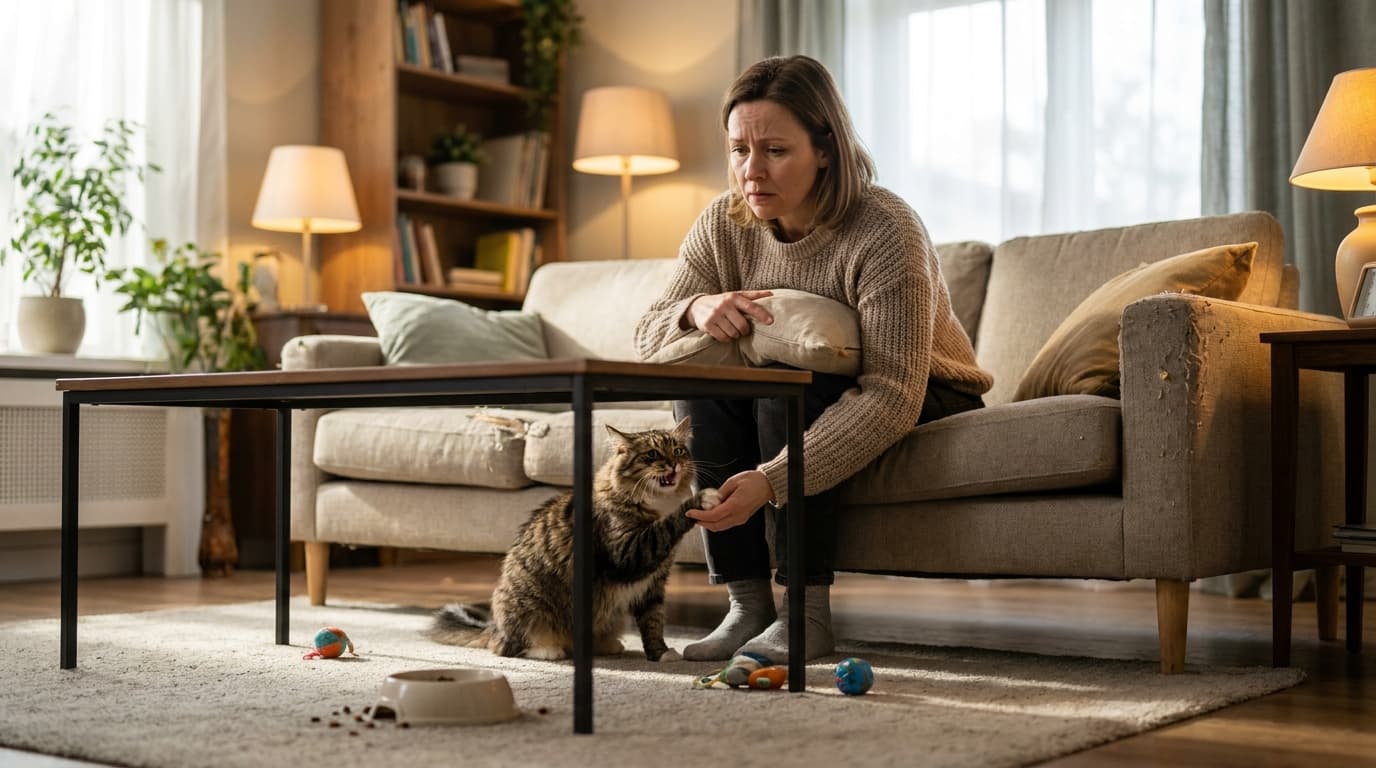
Sudden spraying is rarely about your cat forgetting their training or being a bad pet. Instead, it is a high-stakes form of feline communication that serves as a biological distress signal. When a cat backs up to a vertical surface, lifts their tail, and performs a rapid quiver while releasing urine, they are depositing a complex chemical message. This isn't about emptying their bladder. It is about broadcasting their presence to mark territory or soothe their own deep-seated anxiety. This behavior is usually triggered by a perceived threat to their home turf, such as a new pet, a change in the household routine, or even a stray cat wandering outside the window.
What this actually means is that your cat is trying to build a scent wall to feel safe in their own skin. While cats have scent glands in their feet that release pheromones when they scratch, spraying is the feline equivalent of a neon sign that says keep out. It is a heavy-duty biological response to stress. Most owners think their cat is being spiteful or getting back at them for something, but the pattern here is actually a desperate attempt to reclaim control over an environment that feels unstable. If your cat feels their territory is under siege, they use urine to surround themselves with their own familiar smell. This acts as a chemical security blanket in a world that suddenly feels unpredictable.
Imagine you just moved a new piece of furniture into the living room, or perhaps a neighborhood stray has started patrolling your porch at night. You might notice your cat suddenly targeting the front door, the curtains, or the legs of your brand-new sofa. They aren't trying to ruin your expensive decor. They are reacting to the scent of the unknown that has breached their perimeter. By spraying near the entry points of the home, they are essentially locking the doors and windows with their own pheromones. This warns off the invisible intruder they can smell through the glass or the fresh chemicals they detect on the new upholstery.
The catch is that not all accidents are behavioral, and misdiagnosing the cause can lead to months of frustration. One thing most guides get wrong is assuming every spray is a territorial message. According to the ASPCA, medical conditions like hyperthyroidism, arthritis, and dental disease can trigger sudden shifts in behavior, including inappropriate urination. If the cat is squatting on horizontal surfaces like your rug rather than spraying vertically against walls, it might be a sign of a urinary tract infection or physical pain that makes getting into a high-walled litter box difficult. It is vital to rule out these health triggers with a vet before focusing solely on behavior. A cat in pain will never stop acting out until the underlying physical issue is addressed.
Managing this behavior requires a two-pronged approach that focuses on cleaning up the past while securing the future. Because cats have such a powerful sense of smell, any lingering urine scent tells them that this is a designated marking spot. This creates a frustrating cycle that is incredibly hard to break. You have to remove the chemical trigger using specialized products while simultaneously lowering their stress levels. If you find the behavior is more about the box itself rather than territorial marking, you might want to look into why your cat stopped using the litter box and how to fix it to see if a simple equipment change could solve the problem.
Key insights:
- Use enzymatic cleaners specifically designed for pet messes to break down the uric acid that regular soaps leave behind.
- Block the view of outdoor triggers by using frosted window film or keeping the blinds closed in rooms where the cat sprays.
- Try synthetic pheromone diffusers like Feliway to mimic natural calming hormones and reduce the cat's need to mark.
- Consult your vet immediately to rule out bladder inflammation or metabolic issues like hyperthyroidism.
- Provide more vertical space, such as cat trees or wall shelves, so your cat can observe their territory from a position of safety.
Best Ways to Make a Shy Cat More Social
A shy cat or a so-called 'scaredy cat' can absolutely transition into a lap cat, but it rarely happens on a human's schedule. Most owners expect a linear progression where the cat gets a little braver every day, but feline socialization is more like a dance where the cat leads every single step. It usually takes weeks or even months of consistent, low-pressure interaction to rewire a shy cat's brain so they view you as a source of safety rather than a potential predator. Success isn't measured by when they finally sit on your lap, but by the first time they groom themselves or stretch while you are in the same room.
The secret to this transformation is 'choice-based interaction,' which is a fancy way of saying you should never be the one to initiate contact. What this actually means is that you must give the cat total agency over their body and space. When you give a cat the power to walk away or stay hidden without being chased, they actually become more likely to eventually approach you. Most people overlook the fact that a cat’s sense of security is tied to their environment, so giving your indoor cat more than just a couch by adding vertical shelves or hiding spots helps them feel brave enough to observe you from a distance.
Imagine you have a new rescue cat named Jasper who spends twenty hours a day squeezed behind the washing machine. Instead of reaching in to pet him or dragging him out for 'cuddle time,' you sit five feet away on the floor and read a book out loud in a soft voice. Every time Jasper even pokes his nose out or looks at you, you toss a high-value treat, like a piece of freeze-dried chicken, in his direction. You aren't asking for anything in return. Over a few days, Jasper starts to associate the sound of your voice with the best snacks he has ever had, and he eventually moves his safe zone from behind the machine to the kitchen doorway just to be closer to the 'treat dispenser.'
One thing most guides get wrong is the 'tough love' approach of forcing a cat out of a hiding spot to show them that the house is safe. This is a massive mistake that signals to the cat that you are a threat to their sanctuary. Forcing interaction triggers a spike in cortisol and can reset weeks of trust-building progress back to zero. If your cat is hiding, they are doing it because they have a biological need for safety. Respecting that hidey-hole is actually the fastest way to get them to stop using it. Just keep in mind that if a social cat suddenly becomes shy and hides, it might be a sign of medical conditions like arthritis or dental disease, so a vet visit is always a smart first step.
You can also use tools like synthetic pheromone diffusers to lower the overall anxiety levels in your home. These products mimic the natural facial hormones cats use to mark an area as safe and familiar. When the environment feels chemically secure, a cat's natural curiosity will eventually outweigh their fear. It is a slow process, but once that first 'slow blink' is exchanged, you know the tide has turned. Be patient and let the cat set the pace, and you will eventually find them sleeping at the foot of your bed.
Key insights:
- Master the 'slow blink' by looking at your cat and slowly closing and opening your eyes to signal that you are not a threat.
- Use short, five-minute play sessions with a wand toy to help the cat build confidence through their natural hunting instincts.
- Offer high-value rewards like liquid treats or tuna only when you are in the room to create a strong positive association with your presence.
- Avoid direct eye contact or looming over a shy cat, as these are seen as aggressive predator behaviors in the feline world.
- Create 'safe zones' throughout the house using cardboard boxes or cat trees so the cat always has a nearby retreat.
Frequently Asked Questions
It can be really upsetting when your sweet cat suddenly snaps, but usually, this sudden change is their way of saying they are in pain or feeling overwhelmed. Aggression is actually the second most common behavior problem in cats. According to an ASPCA guide, medical issues like arthritis, dental disease, or hyperthyroidism are often the hidden culprits behind these outbursts.
Here is the thing most owners miss: redirected aggression is often to blame. Your cat might see a bird outside or get startled by a noise and then lash out at you hours later because they are still on high alert. It is always smart to chat with your vet to rule out physical pain because behavior problems are often a cry for help regarding medical issues. In the meantime, watch for subtle signs like a twitching tail or flattened ears, which are clear stop signals in cat body language.
Yes, cats can definitely stop spraying, but you have to figure out if it is a medical issue, a territorial thing, or just plain old stress. Spraying is often about marking territory with pheromones, especially if there are new cats in the neighborhood or changes in your home. Recent trends show that many owners are having success using synthetic pheromone products like Feliway to help cats feel more secure without needing heavy medication.
People often think spraying is a bathroom problem, but it is actually a communication tool. Punishing them for it usually backfires because it makes them more anxious, which leads to even more spraying to try and feel safe. Start by deep cleaning the spots with an enzymatic cleaner so the scent is totally gone. Then, try to identify the stressor and help your cat feel like the king of their castle again. Since spraying can sometimes be linked to urinary tract issues, a quick checkup with your vet is the best way to make sure your cat is healthy.
Moving is a huge deal for a cat, and you'll usually find that it takes about two to four weeks for them to really feel at home. Some bold cats might strut around on day one, while shy ones could hide under the bed for a week or more. The key thing to remember is that cats are very scent-oriented creatures. When they arrive in a new place, none of the smells belong to them, which makes them feel exposed and vulnerable.
Here is an interesting detail most people miss: cats actually have scent glands in their paws. When they scratch, they are leaving pheromones that mark the area as theirs. To help them settle faster, you can use synthetic options like Feliway Classic to mimic happy facial hormones and signal that the space is safe. It is always smart to have a quick chat with your vet if your cat seems stuck in a state of high anxiety, as they can offer specific tips for your kitty's unique personality.
It is absolutely true that declawing can lead to more behavior issues down the road. Many people do not realize that declawing is actually a major surgery where the vet removes the first bone of every toe. Because this changes how a cat's weight is distributed and can cause lasting discomfort, it often changes their temperament. When a cat feels vulnerable or in physical pain, they are much more likely to lash out in other ways to protect themselves.
In fact, PetMD reports that declawing often results in more frequent biting and general anxiety. As Hannah Hart, DVM, points out, scratching is a totally normal and instinctive behavior rather than a sign of being bad. Instead of surgery, most experts now suggest using tall scratching posts or nail caps. If you are struggling with a cat that is destroying the sofa, your own vet can help you find a behavioral plan that works without resorting to surgery.
Conclusion
So, what is the real takeaway here? When your cat starts acting out, it is rarely because they have suddenly decided to be mean. Instead, think of these behaviors as a flashing check engine light. Whether it is sudden aggression, shredded furniture, or spraying, your cat is trying to tell you that something in their world feels off. The clearest verdict is that feline behavior is almost always a reaction to physical pain or a perceived threat in their territory. By connecting the dots between their health and their environment, you can stop guessing and start helping. It is all about shifting your perspective from being a disciplinarian to being a detective who looks for the why behind the hiss.
Looking ahead, the way we live with cats is changing for the better. We are moving past the era of spray bottles and toward a world of pheromone therapy and choice based interaction. This is great news because it means problem cats are becoming a thing of the past as we learn to meet their biological needs for vertical space and scratching outlets. If you want to see a change today, start by booking a vet appointment to rule out any hidden dental or joint pain that might be making them grumpy. After that, pick one high traffic area and add a sturdy scratching post or a cozy hiding spot to give them a sense of ownership again.
It takes a little bit of work and a lot of patience to rebuild trust, but the payoff is a cat that feels safe enough to be their best self. You do not need to be a professional behaviorist to fix these issues; you just need to be observant and willing to try a few new tricks. Your home should be a sanctuary for both of you, not a battlefield. Just keep in mind that your cat is not giving you a hard time, they are simply having a hard time.

Send it to someone who should read it next.

PurrScript Editorial Team
Editorial Team
PurrScript's in-house editorial team. We research, write, and review every guide using established veterinary and behavioral resources, and update articles as best practices evolve.
View all articles