What to Do When Your Cat Is Bored at Home: Simple Fixes
Shredded sofa, 3 AM meowing, ignored toys, a cat that follows you from room to room: these are the classic signs of a bored indoor cat. This guide covers how to spot boredom (including in older cats), why it happens, and the enrichment fixes that actually work.

PurrScript Editorial Team
Editorial Team
What to Do When Your Cat Is Bored at Home: Simple Fixes
If your cat is shredding the sofa, yowling at 3 AM, or ignoring the expensive toys you keep buying, you're almost certainly dealing with boredom. The fix is not more stuff — it's environmental enrichment that lets your cat complete the hunting cycle their brain is wired for: stalk, chase, catch, and "kill."
Feline boredom isn't laziness. It's chronic under-stimulation, and it shows up as stress behaviors, destructiveness, overeating, over-grooming, or a cat that seems to have simply switched off. This guide walks through how to recognize it, why it happens, and a practical daily routine that fixes it — including what to check when the "bored" cat is a senior.
Table of Contents
- How to Tell Your Cat Is Bored (Not Just Sleepy)
- Why Indoor Cats Get Bored: The Hunter Without a Hunt
- Why Your Cat Ignores Expensive Toys
- The Play Prescription: Two Hunts a Day
- Enrichment Beyond Toys: Territory, Food Puzzles, and Cat TV
- Is Your Older Cat Bored — or Slowing Down for a Medical Reason?
- When It Isn't Boredom: Stress and Medical Red Flags
- Frequently Asked Questions
- Conclusion
How to Tell Your Cat Is Bored (Not Just Sleepy)
Cats normally sleep 12 to 16 hours a day, so a napping cat is not automatically a bored cat. The difference is what happens in the waking hours. A stimulated cat patrols, plays, watches, and investigates. A bored cat either invents jobs you won't like — or stops doing much of anything.
Watch for these signs:
- Destructive behavior: scratching furniture, chewing cords and plants, knocking things off shelves for a reaction
- Night-time yowling or 3 AM "zoomies" that wake the household
- Repetitive, zoo-animal-style behaviors: pacing the same route, over-grooming one spot until the fur thins, or obsessive licking of surfaces
- Overeating and constant begging — food becomes the only event of the day
- Attention-demanding behavior: following you room to room, swatting your legs, sitting on keyboards the moment you focus elsewhere
- Withdrawal: sleeping even more than usual and showing little interest in anything
That last one surprises people. Under-stimulated cats often don't act out — they shut down. If your cat's whole day is sleep, eat, stare at a wall, repeat, treat that with the same urgency as a shredded couch.
Why Indoor Cats Get Bored: The Hunter Without a Hunt
Your indoor cat is still a predator. In the wild, a cat of your pet's size would make dozens of short hunting attempts per day — stalking, pouncing, failing, trying again. That cycle isn't a hobby; it's the core program their brain runs. Domestication changed where cats live, not what they are.
An indoor home removes the hunt but leaves the drive. Food appears in a bowl with zero effort, there's nothing to stalk, and territory is fixed and fully explored by week two. The energy and focus that would have gone into hunting has to go somewhere — into your sofa, your ankles, or into anxious, repetitive self-soothing.
Enrichment isn't a luxury add-on for indoor cats. It's the replacement for the job they were built to do.
Why Your Cat Ignores Expensive Toys
The most common complaint from owners of bored cats: "I bought a basket full of toys and they don't touch them." That's expected — a toy lying motionless in a basket is, to a predator's brain, dead prey. Nothing about it triggers the chase instinct.
Three fixes change everything:
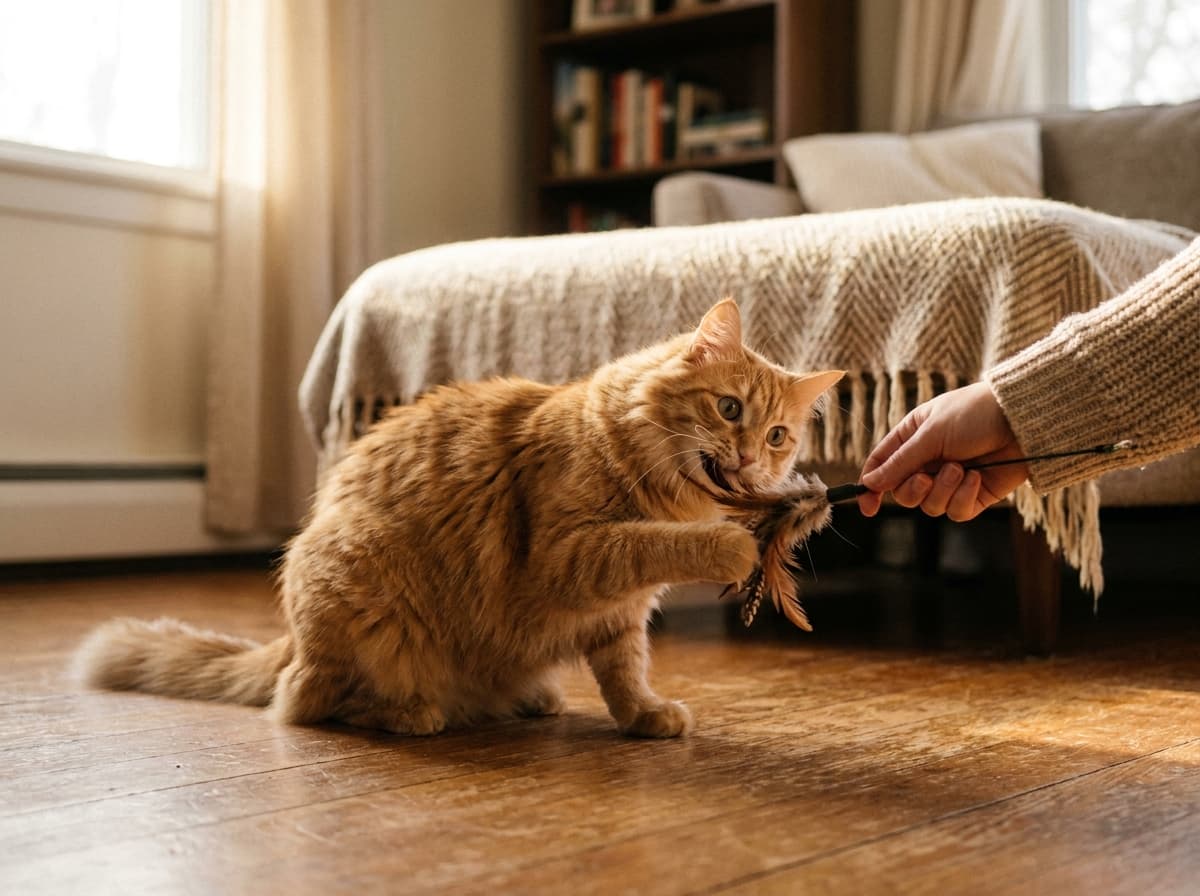
- Movement matters more than the toy. A $2 wand toy dragged in prey-like starts and stops beats a $40 electronic gadget sitting in the corner. You are the difference — solo toys mostly work only when they move unpredictably.
- Rotate, don't accumulate. Leave out three or four toys and hide the rest. Swap them weekly. A toy that disappears for two weeks becomes new again.
- Match the prey type. Some cats are birders (feathers, things that flutter), some are mousers (small furry things that scurry along the ground), some love bugs (small, erratic movement). Try each style before concluding your cat "doesn't play."
The Play Prescription: Two Hunts a Day
Treat play like feeding: scheduled, daily, non-negotiable. Two sessions of 10–15 minutes — one in the morning, one in the evening — will do more for a bored cat than any product you can buy. The evening session is especially powerful: it drains the energy that otherwise becomes the 3 AM crazies.
Structure each session like a real hunt:
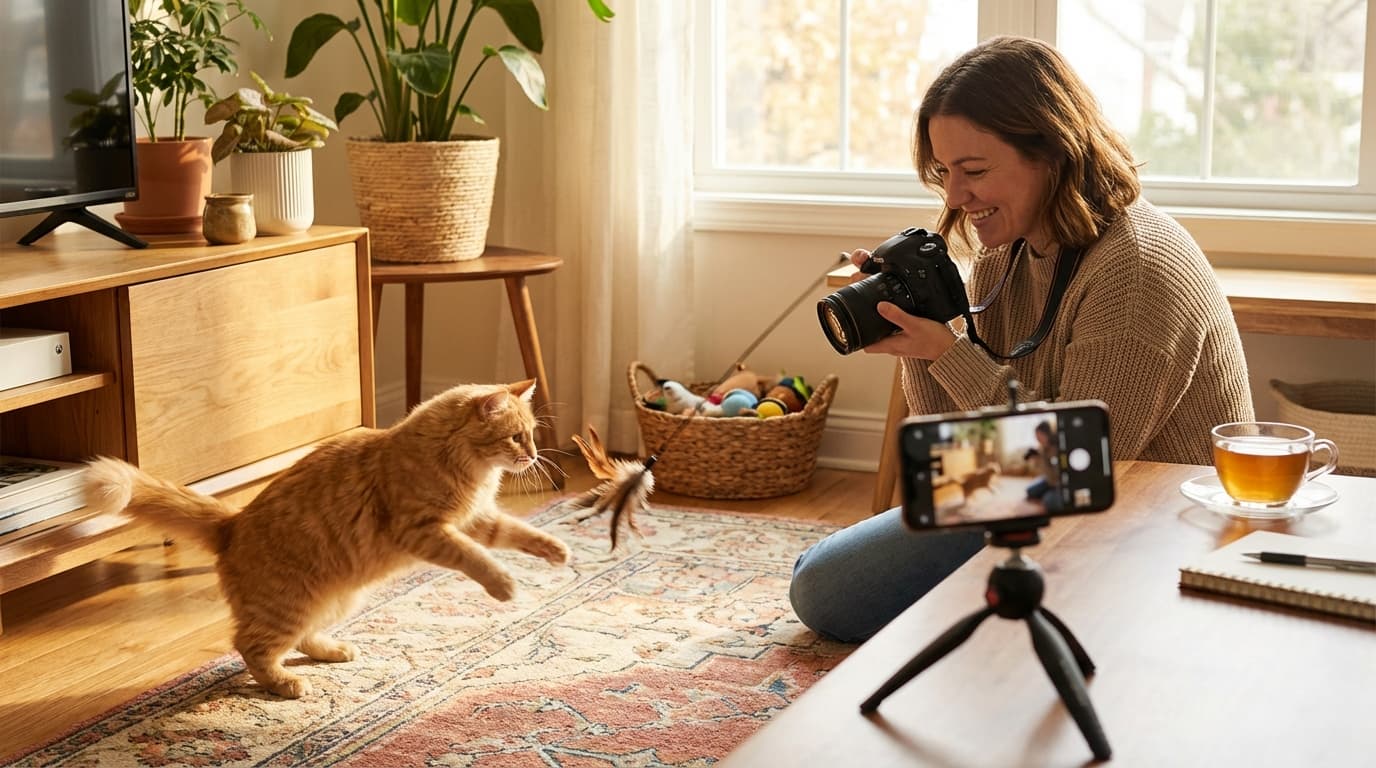
- Stalk and chase: move the wand toy like prey — dart it behind furniture, freeze it, twitch it. Let your cat crouch, stare, and wiggle before pouncing.
- Let them catch it. A laser pointer alone frustrates because there's nothing to sink claws into. If you use a laser, land the dot on a physical toy for the final pounce.
- Finish with the "kill" and a meal. End the session by letting your cat thoroughly capture the toy, then serve dinner or a small treat. Hunt → catch → eat → groom → sleep is the natural sequence, and completing it is what actually satisfies the cat.
Cats are sprinters, not marathoners. Several short bursts with breaks beat one long forced session. If your cat walks away, the prey "escaped" — try again later rather than chasing them with the toy.
Enrichment Beyond Toys: Territory, Food Puzzles, and Cat TV
Play is the engine, but the environment is what keeps a cat occupied for the other 23 hours. Aim to add one thing from each category:
- Vertical territory: cat trees, wall shelves, or simply a cleared bookcase top. Height multiplies usable territory and gives your cat a safe observation post — see our guide to vertical space.
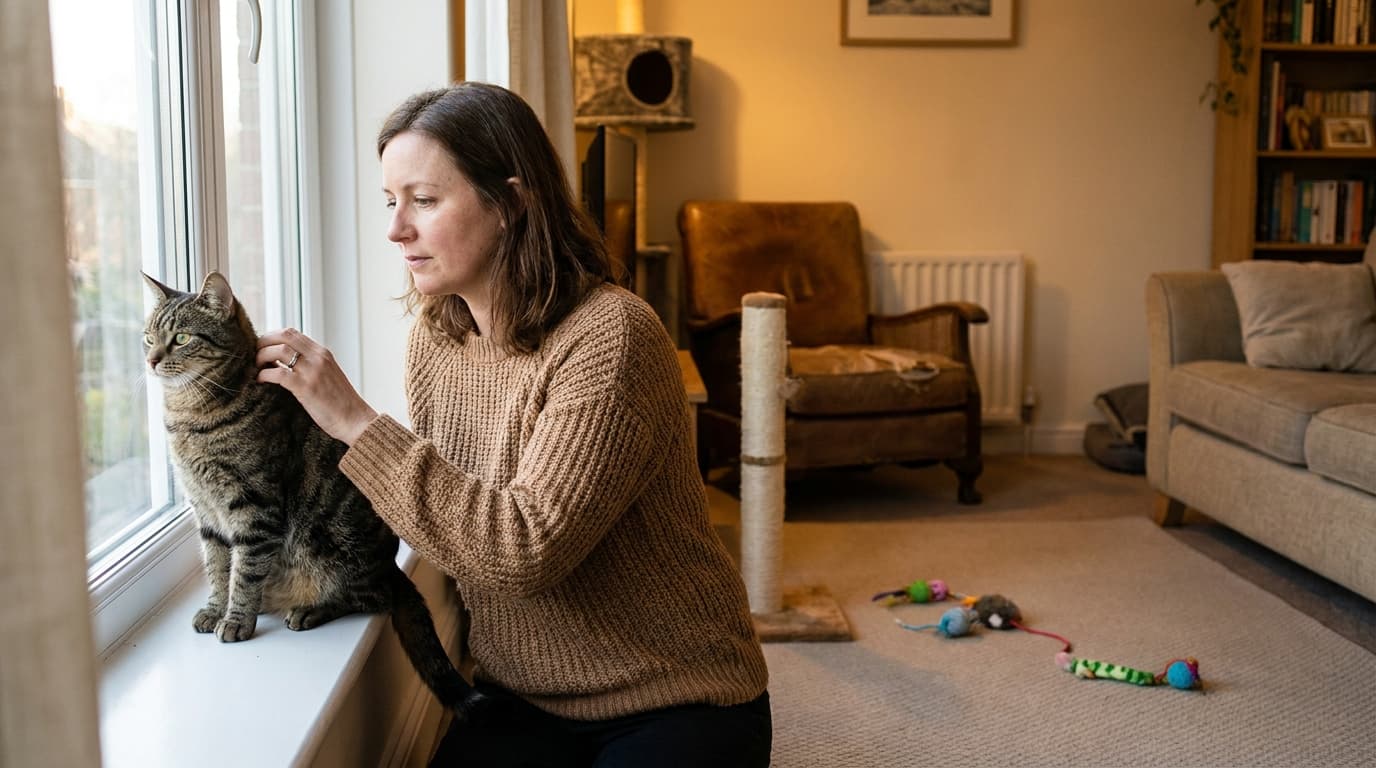
- A window perch ("cat TV"): a bed or hammock at a window overlooking birds, people, or traffic gives hours of genuine stimulation. A feeder outside the window turns it into premium programming.
- Food puzzles: retire the bowl for at least part of the daily ration. Puzzle feeders, snuffle mats, or treats hidden around the house make your cat work for food the way nature intended — this alone noticeably calms many food-obsessed, bored cats.
- Legal scratching: sturdy vertical and horizontal scratchers near sleeping spots and by the sofa they currently target — more on placement in our scratching guide.
- Novelty on a budget: a cardboard box, a paper bag with the handles cut off, a rotated piece of furniture. New objects to investigate cost nothing and reset the territory's interest level.
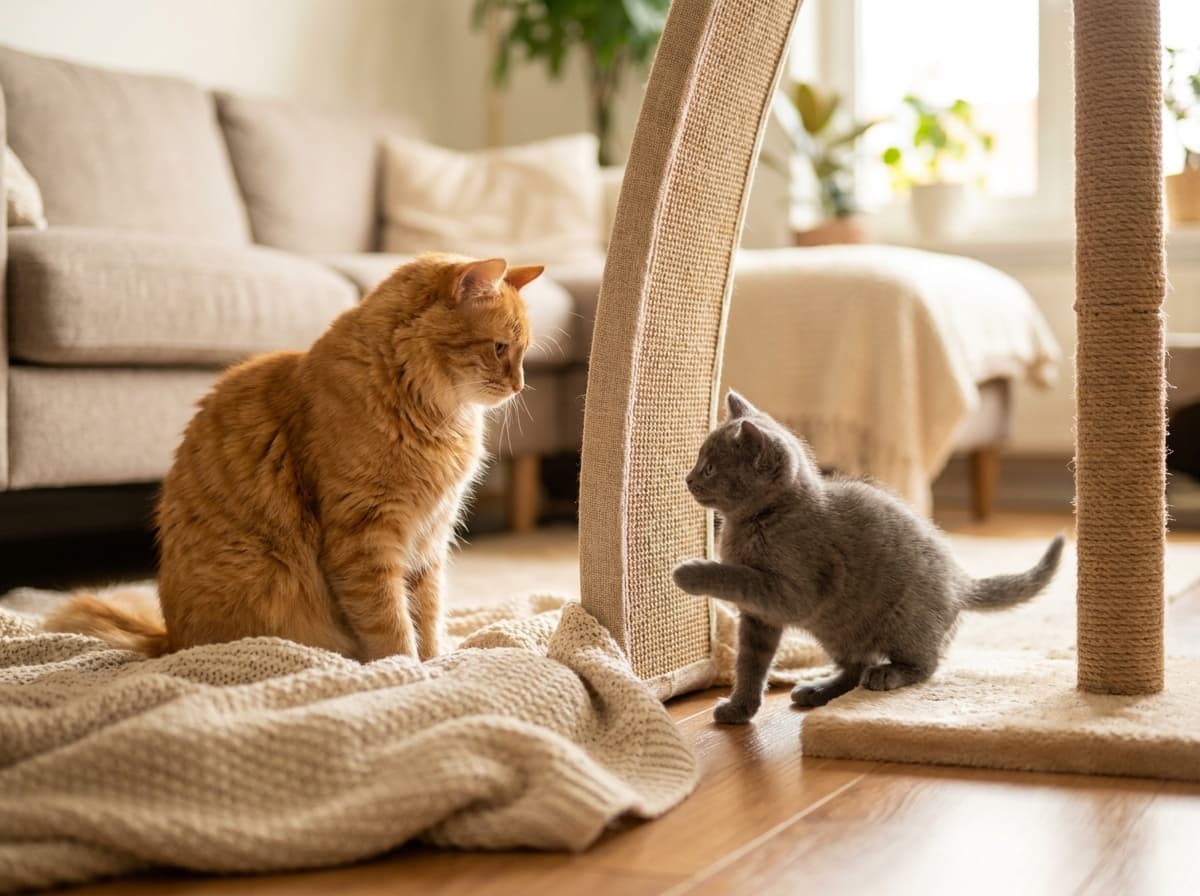
If your schedule keeps you out of the house most of the day, consider whether your cat would do better with a feline companion — for kittens especially, two are often easier than one. It's not a universal fix (some adult cats strongly prefer being only cats), but chronic solo boredom is one of the signs it's worth considering.
Is Your Older Cat Bored — or Slowing Down for a Medical Reason?
Owners of senior cats often ask a double question: "Is my older cat less active because of age, or just bored?" Sometimes the answer is both — but a real drop in activity in a cat over ten should never be written off as boredom or "just getting old" without a closer look.
- Arthritis is dramatically underdiagnosed in cats. Cats rarely limp; they just stop jumping, groom less, or hesitate at stairs. Our guide to hidden pain in cats covers the subtle signs.
- Hyperthyroidism, kidney disease, and dental pain all change activity and mood in seniors before they cause obvious symptoms.
- A vet check comes first. If the senior wellness exam comes back clean, then treat it as boredom — with gentler play (shorter sessions, ground-level prey), easier access to perches (ramps, steps), and more food-puzzle time.
Senior cats absolutely still need and enjoy play. They just need the hunt scaled to their joints.
When It Isn't Boredom: Stress and Medical Red Flags
Boredom and stress produce overlapping symptoms, and some "boredom" behaviors are actually medical. Escalate beyond enrichment if you see:
- Peeing or pooping outside the litter box — start with this litter box guide and rule out urinary problems with your vet, especially in male cats
- Over-grooming to bald spots or skin damage — this is usually stress or skin disease, not entertainment-seeking
- Sudden hiding, aggression, or a personality change — see our guide to hidden feline stress
- Appetite loss, weight loss, or lethargy that persists more than a day or two — these are vet visits, not enrichment problems
The rule of thumb: boredom responds to enrichment within a week or two. If you've genuinely added hunts, puzzles, and territory and the behavior hasn't budged — or it's getting worse — assume it's something else and involve your vet.
Frequently Asked Questions
Total play time of 20–30 minutes daily, split into two or three short sessions, is enough for most adult cats. Kittens and high-energy breeds like Bengals need more. Consistency beats duration — two reliable daily hunts outperform an occasional hour-long marathon.
Less than humans do — but they get very bored of how it arrives. Before switching brands, switch delivery: food puzzles, scatter feeding, or hiding portions around the house adds the stimulation owners often misread as pickiness.
No — indoor cats live significantly longer on average, and an enriched indoor life beats a risky outdoor one. The key word is enriched. If you want to add outdoor time safely, harness training and catios are the middle ground — see our guide to safe outdoor adventures.
Sometimes. Kittens and young sociable cats usually benefit; settled adult cats may find a new housemate more stressful than the boredom. If you go this route, the introduction process matters more than the choice of cat — do it gradually and by the book.
Conclusion
A bored cat isn't a naughty cat — it's an unemployed hunter. Give the hunt back: two structured play sessions a day ending in a catch and a meal, food that has to be worked for, vertical territory, and a window worth watching. Do that consistently for two weeks and most "behavior problems" — the shredding, the 3 AM opera, the counter patrol — shrink to a fraction of what they were. And when enrichment doesn't move the needle, especially in an older cat, let your vet rule out the medical causes that like to masquerade as boredom.
Send it to someone who should read it next.

PurrScript Editorial Team
Editorial Team
PurrScript's in-house editorial team. We research, write, and review every guide using established veterinary and behavioral resources, and update articles as best practices evolve.
View all articles